Electromagnetic Induction for the ESAT
Updated July 2026
This study guide covers the principles of electromagnetic induction, detailing how voltage is induced by changing magnetic fields or conductors cutting through field lines. It explores the factors affecting induced voltage magnitude and direction, the mechanics of alternating current generators, and practical applications like transformers, essential for the ESAT Physics syllabus.
Electromagnetic induction occurs when a conductor experiences a changing magnetic field or cuts across magnetic field lines, resulting in an induced voltage. This induced voltage always acts in a direction that opposes the change that caused it, in accordance with the conservation of energy.
The Fundamentals of Electromagnetic Induction
Electromagnetic induction is the process by which a voltage is generated in a conductor. This occurs under two specific conditions: when a conductor cuts across the lines of a magnetic field, or when the magnetic field passing through the conductor changes. These principles can be demonstrated by observing the interaction between a magnet and a coil of wire.
A voltage is induced in a coil when the wires within that coil cut the magnetic field lines. This is shown in the diagram below:
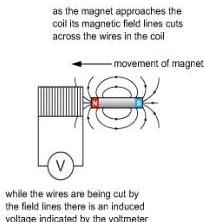
It is important to note that no voltage is induced if there is no relative motion between the magnet and the coil. Whether the coil moves or the magnet moves does not matter, as long as the magnetic field lines are being cut by the wires, a voltage will be induced.
Induction also occurs when the magnetic field strength through a conductor changes, as seen in this experimental setup:
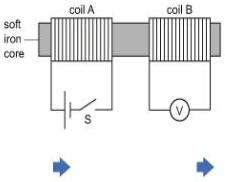
In this setup, closing switch S creates an increasing magnetic field in coil A. A soft iron core carries this changing field through coil B. While the field through coil B is changing, a voltage is induced. Once the magnetic field becomes constant, the induced voltage drops to zero. If the switch is then opened, the field falls suddenly to zero, which induces a voltage once more because the field is changing again.
Cutting Field Lines and Changing Fields
Cutting field lines and changing magnetic field strength are often just two different ways of describing the same physical phenomenon. When a magnet moves toward a coil, we can say the wires are cutting field lines, or we can say the magnetic field through the coil is getting stronger. Similarly, when a stationary magnetic field changes strength, the field lines effectively move past the wires, which cut them as the field expands or contracts.
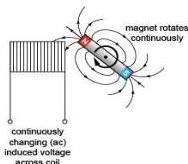
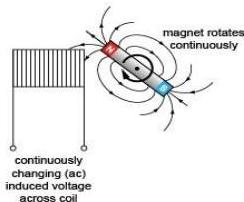
To generate a continuous voltage, the change must be continuous. This can be achieved by rotating a magnet near a coil or by using an alternating current (ac) supply in the primary coil to create a constantly varying magnetic field.
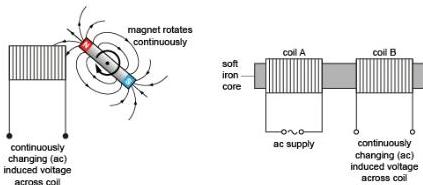
These principles form the basis for generators and transformers. Note that induction always results in a voltage, but a current will only flow if the circuit is closed. If a resistor is connected to the terminals, energy is transferred via the resulting current.
Factors Affecting the Magnitude of Induced Voltage
The magnitude of an induced voltage is directly proportional to the rate at which a wire cuts magnetic field lines, or the rate at which the magnetic field through a conductor changes.
Consider the following worked example involving a bar magnet and a coil:
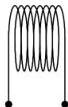
In which of the following situations would a voltage be induced across the terminals of the coil?
- The magnet is moved toward the coil.
- The magnet is moved away from the coil.
- The coil is moved toward the magnet.
- The coil is moved away from the magnet.
- The coil and magnet are both moved to the right at the same speed.
- The coil and the magnet are both moved to the left at the same speed.
- The magnet is placed at rest inside the coil.
Analysis: A voltage is induced in situations 1 to 4 because there is relative motion, meaning the magnetic field inside the coil is changing. In situations 5 to 7, there is no relative motion or change in the field, so no voltage is induced.
Increasing Induced Voltage
The induced voltage will increase in the following scenarios:
- Linear motion: Moving the magnet faster increases the rate of cutting field lines. Using a stronger magnet provides a higher density of field lines, also increasing the rate of cutting at the same speed.
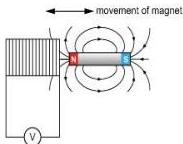
- Rotational motion: Spinning the magnet at a greater rate or using a stronger magnet increases the rate of cutting field lines.
- Changing fields: Increasing the ac frequency in the primary coil (coil A) increases the rate of change of the field through the secondary coil (coil B). Increasing the ac amplitude in the primary coil also increases the rate of change.
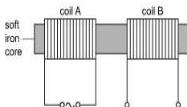
In all cases, increasing the number of turns on the coil will also increase the induced voltage.
The Direction of Induced Voltage and Energy Conservation
An induced voltage always acts in a direction that opposes the change that caused it. This is a requirement for the conservation of energy.
When a north pole approaches a coil connected to a resistor, the induced current creates a north pole at the end of the coil to repel the approaching magnet. Work must be done by the person pushing the magnet to overcome this repulsion. This work is the source of the electrical energy generated in the circuit.
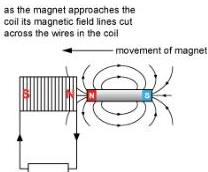
If the magnet is pulled away, the induced voltage reverses, creating a south pole that attracts the magnet, again opposing the motion.
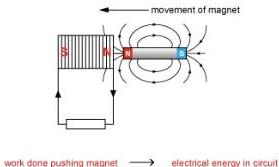
If the voltage did not oppose the change, energy would be created from nothing, which is impossible. The direction of induced voltage reverses when:
- The direction of cutting magnetic field lines reverses.
- An increasing magnetic field changes to a decreasing one (or vice versa).
Worked Example: Aircraft Wings An aircraft flies due north, its aluminium wings cutting the vertical part of the Earth's magnetic field, inducing a voltage. On the return journey, it flies due south at a higher speed. How does the induced voltage compare?
Answer: The voltage is higher because the rate of cutting field lines is greater due to the higher speed. However, the polarity is reversed because the direction of cutting has reversed.
Operation of an AC Generator
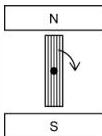
A simple ac generator consists of a coil rotated in a magnetic field. As it turns, the magnetic field through the coil changes continuously, inducing a continuously changing voltage. Because the direction of the change reverses every half rotation, the output is alternating current (ac).
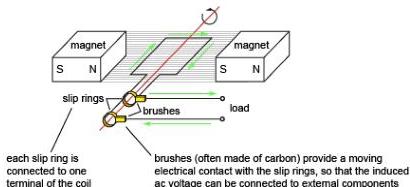
The amplitude of the output voltage increases if:
- The coil is rotated more rapidly.
- The magnetic field is made stronger.
- The coil has a greater area.
- There are more turns on the coil (voltages in each turn add together in series).
The frequency of the output ac voltage is exactly equal to the frequency of the coil's rotation.
As the coil rotates, one side (AB) moves up through the field while the other (CD) moves down. This induces voltages in opposite directions on each side, which add together around the circuit.
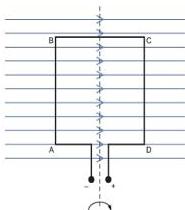
Some designs, like bicycle dynamos, use a rotating magnet near a stationary coil instead, but the physical principle remains the same.
Worked Example: Generator Statements Which of the following are correct?
- Turning the generator in the opposite direction still produces ac.
- Slip rings and brushes must be conductors.
- If rotation time doubles, peak voltage doubles and frequency halves.
- One slip ring is always positive.
Analysis: Statement 1 is correct; the direction of cutting still reverses every half cycle. Statement 2 is correct; current must flow through them. Statement 3 is incorrect; if the time doubles, the speed halves, so the peak voltage halves, and frequency () halves. Statement 4 is incorrect; slip rings change polarity every half rotation.
Interpreting Generator Output Graphs
The induced voltage changes in magnitude and sign as the coil rotates. The graph below shows one complete cycle:
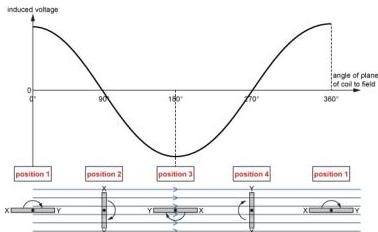
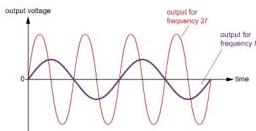
If the frequency of rotation is doubled from to , the output changes in two ways: the frequency doubles, and the amplitude (peak voltage) doubles because the rate of cutting field lines has doubled.
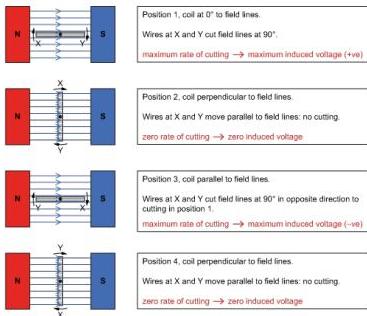
Worked Example: Coil Positions In Position 1 (coil vertical), the wires move horizontally at the maximum rate across the field lines. In Position 2 (coil horizontal), the wires move vertically, parallel to the field lines.
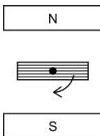
In Position 1, there is peak voltage. In Position 2, there is zero voltage.
Applications of Electromagnetic Induction
The primary applications are the generation and transmission of electrical energy. Generators convert mechanical work into ac electricity. This mechanical work can come from chemical energy (fossil fuels heating water to steam), kinetic energy (wind or water turbines), or nuclear energy.
Other applications include:
- Car alternators: Recharging batteries while the engine runs.
- Electromagnetic torches: Shaking a magnet through a coil.
- Induction hobs: Alternating fields induce currents directly in the metal base of a pan to heat it.
- Transformers: Stepping ac voltage up for efficient long distance transmission or down for devices like laptop chargers and phone chargers.
Worked Example: Power Stations What energy transfer is carried out by a generator in a nuclear power station?
- nuclear to electrical
- chemical to electrical
- kinetic to electrical
- thermal to electrical
Answer: 3. The generator itself transfers the kinetic energy of the spinning turbine into electrical energy via electromagnetic induction.
Key takeaways
- Voltage is induced only when there is relative motion or a changing magnetic field environment for a conductor.
- The magnitude of induced voltage is directly proportional to the rate of change of the magnetic field or the rate of cutting field lines.
- Increasing the rotation frequency of an ac generator doubles both the frequency and the peak voltage of the output.
- The direction of the induced voltage always opposes the change that created it to ensure the conservation of energy.
- Transformers and generators are the primary applications, enabling the efficient transmission and generation of ac power.
In ESAT questions about generators, remember that changing the rotation speed affects two variables: the frequency and the amplitude. If the speed doubles, both the frequency and the peak voltage double. Look out for graphs where only one of these has changed, as this usually indicates a different factor was altered.
A common mistake is thinking that a voltage is induced whenever a magnet is inside a coil. A voltage is only induced when the field is changing or lines are being cut. If a magnet is stationary inside a coil, the induced voltage is zero.
The fact that induced voltage opposes the change that caused it is known as Lenz's Law. It is a specific manifestation of the Law of Conservation of Energy; if the induced field aided the change, you could create a self-accelerating system that generates infinite energy, violating the first law of thermodynamics.
Frequently asked questions
What is the difference between induced voltage and induced current?
Electromagnetic induction always produces an induced voltage. However, an induced current will only flow if the conductor is part of a complete, closed electrical circuit.
How does a stronger magnet affect the induced voltage?
A stronger magnet has a higher density of magnetic field lines. This means that for the same speed of movement, more field lines are cut per second, resulting in a higher induced voltage.
Why does the peak voltage of a generator increase when it spins faster?
The magnitude of the induced voltage is proportional to the rate of cutting field lines. Spinning the coil faster increases the number of field lines cut per second, which increases the peak voltage.
What are slip rings used for in an ac generator?
Slip rings and brushes allow the rotating coil to maintain an electrical connection with a stationary external circuit without the wires becoming twisted, allowing the alternating current to be exported.