Magnetic Effects of Electric Current for the ESAT
Updated July 2026
Understand how electric currents generate magnetic fields and how these principles apply to wires, coils, and solenoids. This guide covers field patterns, the right hand grip rule, and the critical differences between permanent magnets and electromagnets, providing the foundations for electromagnetic engineering problems in the ESAT Physics section.
An electric current, consisting of moving electric charges, generates a magnetic field in its surrounding space: the strength of this field is proportional to the current and inversely proportional to the distance from the conductor.
The Magnetic Effect of a Current
Electric currents produce magnetic fields in the space around them. This fundamental physical effect can be demonstrated using a magnetic compass. When a small compass is placed near a conducting wire, the needle points towards the magnetic north if no current is flowing. However, once the current is switched on, the needle deflects away from the north, indicating the presence of a new magnetic field generated by the moving charges.
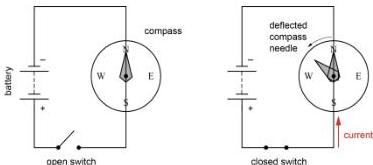
The experiment shown above demonstrates two key factors:
- Direction: Reversing the direction of the current reverses the deflection of the compass needle. This proves that the magnetic field direction depends directly on the current direction.
- Strength: Increasing the magnitude of the current increases the deflection, showing that a larger current creates a stronger magnetic field.
Magnetic Fields and Moving Charges
It is important to understand that the magnetic field is produced by the moving electric charges themselves, not the specific material of the conductor. For example, a beam of electrons or ions moving through a vacuum will generate a magnetic field in exactly the same way as a current flowing through a copper wire.
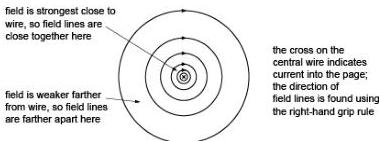
A common classroom demonstration involves iron filings on a white card perpendicular to a straight wire. When current flows, the filings align into concentric rings. These rings are most densely packed near the wire, where the magnetic field is at its strongest.
Magnetic Field Patterns and the Right Hand Grip Rule
The field pattern for a long, straight current carrying wire consists of concentric circles. As the distance from the wire increases, these circles are spaced further apart, indicating a weakening field.
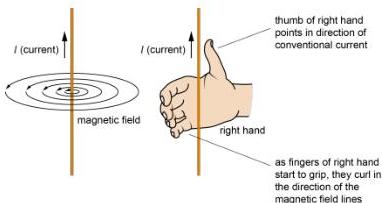
To find the direction of the field, use the right hand grip rule: imagine gripping the wire with your right hand so your thumb points in the direction of the conventional current (positive to negative). Your curled fingers will then indicate the direction of the magnetic field lines.
Magnetic Field in Coils and Solenoids
When a wire is wound into a coil, the magnetic fields from each part of the wire loop add together. This creates a much stronger field through the centre of the coil.
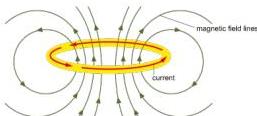
A solenoid is a long coil consisting of many narrow loops wound closely together. This arrangement creates a very uniform magnetic field through the centre of the solenoid, where the field lines are parallel and equally spaced.
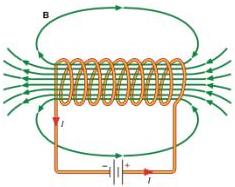
Key characteristics of a solenoid field include:
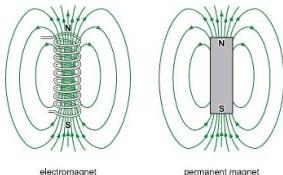
- The field pattern outside the solenoid is very similar to that of a permanent bar magnet.
- One end acts as a magnetic north pole (where field lines emerge) and the other as a south pole (where lines enter).
- The field inside the solenoid is uniform in direction and strength through most of its length, though it decreases at the very ends.
- The field at the sides of the solenoid is weak and runs in the opposite direction to the internal field.
Identifying Solenoid Polarity
Beyond the right hand grip rule, you can identify the poles by looking at the end of the coil. If the current appears to circulate clockwise, that end is a south pole. If the current circulates anti-clockwise, that end is a north pole. This can be remembered by the shape of the letters and .
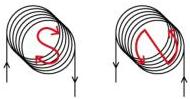
Worked Example: Identifying the North Pole
A coil of insulated wire has ends and . is connected to the positive terminal and to the negative terminal of a d.c. supply.
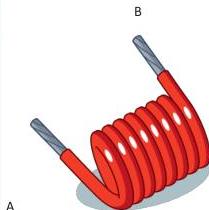
Question: Which end acts as the north pole?
Solution: Conventional current flows from positive to negative, so it moves from to . By looking at the end near , we can see the current rotates anti-clockwise. According to the rule, the anti-clockwise end is the north pole. Alternatively, applying the right hand grip rule shows field lines emerging from the end near , confirming it is the north pole.
Factors Affecting Magnetic Field Strength
The strength of a magnetic field around a wire is determined by three variables:
- Current: Field strength increases as current increases.
- Distance: Field strength decreases as you move further from the wire.
- Medium: Surrounding the wire with magnetic materials, such as iron, increases the field strength.
The Role of the Iron Core
Iron is a ferromagnetic material. Each iron atom behaves like a tiny bar magnet. In the presence of an external field from a current, these atomic magnets align with the field, greatly increasing the total resultant magnetic field strength. This is why iron is used in motors and transformers. In a solenoid, the field is strengthened by:
- Increasing the current.
- Increasing the number of turns per unit length.
- Inserting a soft iron core.
Worked Example: Overhead Power Cables
Consider the following statements about magnetic fields from a.c. power cables:
- People further from the cable experience a weaker field.
- The field strength directly beneath the cable has constant magnitude.
- The field direction regularly changes.
- The field is created by moving electrons.
- Field strength depends on current magnitude.
Analysis: Statement 4 and 5 are correct based on the fundamental nature of currents. Statement 1 is correct because field strength decreases with distance. Because the current is alternating (a.c.), its direction and magnitude constantly change. This means the magnetic field direction changes (Statement 3 is correct) and its magnitude is not constant (Statement 2 is incorrect). Thus, statements 1, 3, 4, and 5 are correct.
Permanent Magnets vs Electromagnets
An electromagnet is essentially a solenoid wound around a soft iron core.
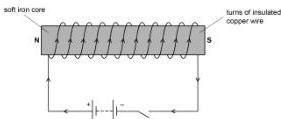
While its field pattern resembles a bar magnet, there are distinct differences:
| Feature | Electromagnet | Permanent Magnet |
|---|---|---|
| Action | Can be switched on or off | Always active |
| Strength | Variable by changing current | Constant (may decay over time) |
| Polarity | Reversible by reversing current | Constant |
| Materials | Soft magnetic material (e.g. iron) | Hard magnetic material (e.g. steel) |
Material Selection
Permanent magnets are made from "hard" magnetic materials like steel, neodymium, or certain ceramics. These are difficult to magnetise but retain their magnetism well. They can be weakened by physical impacts or by heating them above their Curie temperature.
Electromagnets use "soft" magnetic materials like iron. These are easy to magnetise and demagnetise quickly, allowing the magnet to be "switched off". Using a hard material for an electromagnet core would be unsuitable because it would stay magnetised even after the current is stopped.
For extremely powerful applications, like the Large Hadron Collider, superconducting coils are used. These have zero resistance, preventing the heat that would otherwise melt standard insulation, though they must be cooled with liquid helium to extremely low temperatures.
Key takeaways
- The magnetic field direction for straight wires is found using the right hand grip rule with conventional current.
- The field inside a solenoid is uniform and resembles a bar magnet, with the north pole being the end where current flows anti-clockwise.
- Field strength is increased by higher current, proximity to the source, higher turn density in solenoids, and the presence of a soft iron core.
- Electromagnets are temporary and adjustable, whereas permanent magnets are made from hard magnetic materials that retain magnetism until hit or heated to their Curie temperature.
When identifying the poles of a solenoid in an exam, always check whether the diagram shows conventional current (positive to negative) or electron flow. The right hand grip rule and the clockwise/anti-clockwise rule only work with conventional current.
Do not confuse the direction of magnetic field lines with the direction of the force on a wire. The field lines around a straight wire are circular; they do not point towards or away from the wire.
The Curie temperature is a critical phase transition in condensed matter physics. Above this temperature, thermal fluctuations are strong enough to overcome the alignment of the 'tiny atomic magnets' (magnetic moments), causing the material to become paramagnetic and lose its permanent magnetic properties.
Frequently asked questions
What happens to the magnetic field if I use a.c. instead of d.c. in a solenoid?
The magnetic field will fluctuate in magnitude and its polarity will reverse at the same frequency as the alternating current. This means the north and south poles will swap places periodically.
Why is 'soft' iron used for electromagnet cores instead of 'hard' steel?
Soft magnetic materials like iron demagnetise as soon as the external current is removed. Hard magnetic materials like steel would remain magnetised, meaning the electromagnet could not be switched off.
Does a beam of protons in a vacuum create a magnetic field?
Yes. A magnetic field is created by any moving charge. Since protons are charged particles, their motion constitutes a current and generates a field.