Structure and Function of Eukaryotic Cells for the ESAT
Updated July 2026
An exploration of eukaryotic cell biology, focusing on the sub-cellular components of animal and plant cells. This page details the structures and functions of organelles like the nucleus and mitochondria, essential for understanding how organisms maintain life. A key fact is that eukaryotic DNA is stored as linear chromosomes within a double-membraned nucleus.
Eukaryotic cells are complex units of life characterised by a membrane-bound nucleus containing linear DNA and various specialised organelles that compartmentalise metabolic reactions.
All living organisms are composed of one or more microscopic units called cells. Eukaryotic organisms are defined by having their genetic material, in the form of one or more linear chromosomes, enclosed within a recognisable nucleus. While some eukaryotes are unicellular, consisting of just one cell, many are multicellular. In multicellular organisms, cells can be specialised to perform specific roles, leading to variations in size and shape. Generally, plant cells are larger than animal cells.
Sub-cellular Components of Eukaryotic Cells
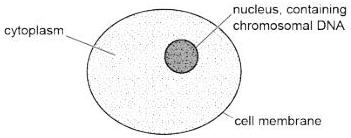
The internal features of a cell are referred to as its sub-cellular components. Both animal and plant cells share common features, such as the cell membrane and cytoplasm. Most eukaryotic cells contain a nucleus, with some exceptions like mature mammalian red blood cells. Organelles like mitochondria are present in the cytoplasm of all eukaryotic cells but are too small to be seen with a standard light microscope.
Animal and Plant Cell Comparison
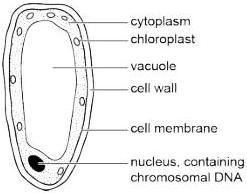
Plant cells possess several structures not found in animal cells: a cellulose cell wall, a large sap vacuole, and, in photosynthetic cells, chloroplasts. The following diagrams illustrate the typical structures of these cells.
Structure and Function Breakdown
Cell Membrane and Cytoplasm
The cell membrane is a partially permeable layer forming the outer boundary of the cytoplasm. Its primary function is to contain the cell contents and regulate the movement of substances. It allows essential nutrients, water, and oxygen () to enter while permitting waste products, such as carbon dioxide (), to exit.
The cytoplasm is a jelly-like region where most chemical reactions occur. It contains dissolved salt ions and sugar molecules, along with suspended proteins, enzymes, and fat molecules. It also stores food reserves, such as glycogen in animal cells or starch in plant cells, and houses the organelles.
The Nucleus and Genetic Material
The nucleus is usually a round or oval organelle enclosed by two nuclear membranes. It contains the chromosomal DNA, which consists of linear pieces of double-stranded DNA. The nucleus regulates cell functions by directing the production of RNA and proteins required for metabolism, cell division, and differentiation.
Mitochondria
A mitochondrion is a small organelle with a double membrane: the outer membrane is smooth, while the inner membrane has many inward-pointing folds. Mitochondria are the site of aerobic respiration, where they control the production and release of ATP, the usable energy for the cell.
Plant-Specific Components
- Cell Wall: A tough, rigid external layer made of cellulose. It is freely permeable to water and salts. Its function is to provide mechanical strength, allowing the cell to resist bursting when it becomes turgid with water.
- Chloroplast: These organelles contain chlorophyll and other pigments. They absorb light energy and convert it into chemical energy through the process of photosynthesis. They are only found in the green, photosynthetic parts of plants.
- Vacuole: A fluid-filled space surrounded by a membrane. The fluid, called sap, is a solution of sugars and salts. It helps store water-soluble chemicals and keeps the plant tissues firm and turgid.
Worked Examples and Exercises
Exercise 1: Comparison
a. Name three cell parts common to both a liver cell and a palisade mesophyll cell. Answer: The cell membrane, cytoplasm, and nucleus are common to both.
b. Which plant cell part is not found in a root hair cell? Explain your answer. Answer: Chloroplasts are not found in root hair cells. This is because root hair cells are located underground and are not exposed to light: therefore, they cannot perform photosynthesis.
Exercise 2: Matching Definitions
- Cell Wall: Tough, non-living layer made of cellulose surrounding the membrane.
- Chloroplast: Organelle containing chlorophyll.
- Cytoplasm: Jelly-like region containing particles and organelles.
- Cell Membrane: Partially permeable layer forming a boundary around the cytoplasm.
- Nucleus: Round or oval structure containing DNA in the form of chromosomes.
- Sap Vacuole: Fluid-filled space surrounded by a membrane.
Key takeaways
- Eukaryotic cells contain linear DNA within a double-membraned nucleus.
- Mitochondria are the site of aerobic respiration and ATP production, found in both plant and animal cells.
- Plant cells are distinguished by the presence of a cellulose cell wall, chloroplasts, and a permanent sap vacuole.
- The cell membrane is partially permeable, meaning it selectively controls the passage of substances into and out of the cell.
In the ESAT, pay close attention to whether a question specifies a 'photosynthetic' plant cell or just a 'plant cell'. Root cells are plant cells but lack chloroplasts.
Do not confuse the cell wall with the cell membrane. All cells have a membrane, but only plants (in this context) have a cellulose cell wall. Also, remember that the cell wall is 'freely permeable' while the membrane is 'partially permeable'.
The presence of double membranes in the nucleus, mitochondria, and chloroplasts is a defining feature of complex eukaryotic life, allowing for the separation of different chemical environments within a single cell.
Frequently asked questions
Do all eukaryotic cells have a nucleus?
Most do, but there are notable exceptions such as mature red blood cells in mammals, which lose their nucleus during differentiation to provide more space for carrying gases.
What is the difference between a cell wall and a cell membrane?
The cell membrane is partially permeable and controls substance entry, while the plant cell wall is a rigid, freely permeable cellulose layer that provides structural support and prevents the cell from bursting.
Why are mitochondria not always visible under a light microscope?
Mitochondria are extremely small sub-cellular components. While they are present in the cytoplasm of all eukaryotic cells, their detailed structure is typically only visible using the higher magnification and resolution of an electron microscope.