Structure and Function of Prokaryotic Cells
Updated July 2026
An exploration of prokaryotic cell biology for the ESAT, focusing on the distinct structures of bacteria. This page covers essential sub-cellular components including the cell wall, circular chromosomal DNA, and plasmids, highlighting the key differences between these simpler organisms and more complex eukaryotic cells.
Prokaryotic cells are small, simple organisms that lack a membrane-bound nucleus and membrane-bound organelles, storing genetic information in circular chromosomal DNA and independent plasmids within the cytoplasm.
Prokaryotic cells, which include bacteria, are typically smaller and simpler in their organisation than the eukaryotic cells found in animals and plants. While they share some fundamental features with eukaryotes, their structural layout is distinct, particularly regarding how they store genetic material and the composition of their external boundaries.
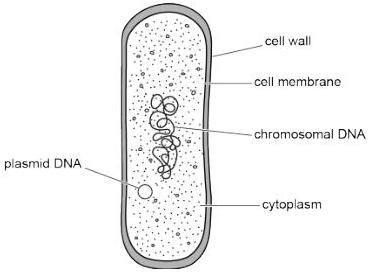
Sub-cellular Components of Prokaryotic Cells
The following components are characteristic of bacterial cells. Each performs a specific role necessary for the survival and reproduction of the organism.
Cell Membrane
The cell membrane is a partially permeable layer that forms a boundary between the internal cytoplasm and the external cell wall. Its primary function is to contain the cell contents and regulate the movement of molecules into and out of the cell. It acts as a selective barrier, restricting the passage of certain materials to maintain the cell's internal environment.
Cytoplasm
The cytoplasm is a jelly-like region surrounded by the cell membrane. It serves as the primary site for chemical reactions and contains the enzymes that control these metabolic processes. It also holds the cell's DNA and may contain food molecules such as lipids (fats), glycogen granules, and other essential substances.
Cell Wall
The cell wall is a tough, rigid external coat that surrounds the cell membrane. In bacteria, this wall is made from a complex mixture of proteins, lipids, and sugars. It is important to note that this composition is different from plant cell walls, which are made of cellulose. The function of the cell wall is to provide structural support and protection. It is freely permeable to small molecules, meaning it does not control the intake or loss of materials.
Chromosomal DNA
Unlike eukaryotes, prokaryotes do not have a true nucleus or an enclosing nuclear membrane. Instead, their genetic material is found as chromosomal DNA located directly within the cytoplasm. This DNA consists of a large, closed, circular, coiled molecule of double-stranded DNA. It carries the genetic information required to regulate most bacterial cell processes.
Plasmid DNA
In addition to the main chromosomal DNA, bacteria often contain plasmids. A plasmid is a small molecule of closed, double-stranded, circular DNA. There are usually multiple copies of plasmids per cell. Plasmids carry genetic information for specialist functions, such as antibiotic resistance. They are capable of replicating and operating independently from the chromosomal DNA and can be easily transferred between different bacterial cells. This property makes them useful tools in biotechnology and genetic engineering.
Comparison Between Animal and Prokaryotic Cells
Understanding the differences in how genetic material is stored is a frequent requirement for the ESAT. Based on the official guide, here is how animal cells and prokaryotic cells differ regarding their DNA:
- Nucleus: An animal cell has a true nucleus surrounded by a membrane that contains the DNA. A prokaryotic cell has DNA but no nucleus or nuclear membrane.
- Shape and Number: Animal cells usually contain several large, linear chromosomes with free ends. Prokaryotic cells typically contain one large circular molecule of DNA with no free ends.
- Plasmids: Prokaryotic cells contain plasmids, which are small circular DNA molecules, whereas animal cells do not.
- Gene Count: The DNA of a prokaryotic cell generally contains fewer genes than the DNA found in an animal cell.
Key takeaways
- Prokaryotes lack a true nucleus and membrane-bound organelles like mitochondria.
- Bacterial cell walls are made of a mixture of proteins, lipids, and sugars, not cellulose.
- Genetic material is stored in one large circular chromosome and several smaller plasmids.
- Plasmids are independent DNA loops that often carry genes for antibiotic resistance.
When asked to compare prokaryotes and eukaryotes, always focus on the 'nucleus'. Use the phrase 'no true nucleus' for prokaryotes to show you understand they have DNA but lack the enclosing membrane.
Do not confuse chromosomal DNA with plasmid DNA. Chromosomal DNA carries the essential genes for life, while plasmids carry 'extra' specialist genes like those for antibiotic resistance.
The independent replication of plasmids and their ability to move between cells is the biological basis for the rapid spread of antibiotic resistance in bacterial populations.
Frequently asked questions
Are bacterial cell walls the same as plant cell walls?
No. While both provide structural support, plant cell walls are made of cellulose, whereas bacterial cell walls are made of a complex mixture of proteins, lipids, and sugars.
What is the function of a plasmid in a bacterial cell?
Plasmids carry genetic information for specialised functions, such as antibiotic resistance. They can replicate independently and be transferred between cells.
Where is the chromosomal DNA located in a prokaryote?
Because prokaryotes lack a 'true' nucleus, the chromosomal DNA is found coiled within the cytoplasm.
Is the cell membrane of a prokaryote different in function from a eukaryote?
Their functions are similar: both act as partially permeable boundaries that control the movement of substances into and out of the cell.