Polymers for the ESAT Chemistry Paper
Updated July 2026
Polymers are large, long-chain molecules formed by joining many smaller units called monomers. This topic explains the mechanisms of addition and condensation polymerisation, including the production of polyalkenes, polyesters, and polyamides. It also covers the biological significance of proteins and the factors affecting polymer biodegradability.
Polymerisation is the chemical process of linking monomer molecules together to form a polymer chain, either through the opening of double bonds (addition) or the reaction of functional groups with the elimination of small molecules (condensation).
Addition Polymerisation and Polyalkenes
Addition polymerisation is a fundamental reaction of alkenes where many small molecules, known as monomers, react together to form a very long chain called a polymer.
The key characteristics of addition polymerisation include:
- The monomers must be unsaturated, meaning they contain at least one double bond.
- During the reaction, one of the bonds in the double bond breaks.
- New single bonds are formed between adjacent monomer molecules, linking them end to end.
- The resulting polymer is a saturated molecule, consisting of single bonds only.
- A polymer chain typically incorporates thousands or tens of thousands of monomer units.
This process is an addition reaction because the monomers simply add together without the loss of any atoms. The name of the resulting polymer is produced by adding the prefix 'poly-' to the name of the monomer, usually in brackets if the name is complex. For example, the polymerisation of ethene produces poly(ethene).
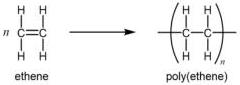
In the equation above, represents a very large number of monomers. The structure shown in square brackets, , is the repeating unit. Although the reaction conditions vary, they typically require high pressures and specific catalysts.
Exercise 111: Polymerisation of Propene
To write the equation for the polymerisation of propene (), we identify the bond. During the reaction, this bond opens to connect to the next unit. The methyl group () remains attached to one of the carbons in the chain. The equation is: .
Exercise 112: Identifying Monomers and Repeating Units
Consider the following section of a polyalkene:
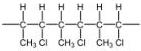
a) The repeating unit is the smallest part of the polymer chain that, when repeated, produces the entire structure. By looking at the chain, we see the pattern repeats every two carbon atoms. The repeat unit is: .
b) To find the monomer, we take the repeating unit and replace the single bond between the chain carbons with a double bond. The monomer is , which is 1-chloroprop-1-ene.
Condensation Polymerisation
In condensation polymerisation, monomers join to form a polymer with the simultaneous elimination of a small molecule, such as water () or hydrogen chloride (). This differs from addition polymerisation, which produces no by-products.
Key features of condensation polymerisation include:
- Each monomer must have at least two functional groups to allow the chain to grow from both ends.
- It often involves two different types of monomers, though it can involve one monomer type if that monomer contains two different functional groups.
- The linkage is formed by a condensation reaction between these functional groups.
Polyesters
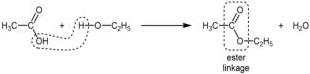
Polyesters are formed when monomers are linked by ester groups. This usually involves a reaction between a carboxylic acid group () and an alcohol group (). When these react, a molecule of water is removed, and an ester linkage () is formed.
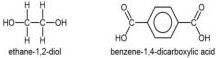
A common example is Terylene, which is used in clothing fibres. It is made from ethane-1,2-diol and benzene-1,4-dicarboxylic acid.
The formation of the ester linkage is shown here:
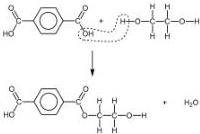
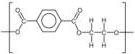
Because both monomers have functional groups at both ends, the process continues, building a long chain. The simplest repeating unit for Terylene is:
Exercise 113: Drawing Polyester Structures
For monomers hexanedioic acid, , and butane-2,3-diol, , the repeating unit is formed by removing the from the acid and the from the alcohol.
Repeating unit: .
Polyamides
Polyamides are formed via amide linkages. These result from the reaction between a carboxylic acid group () and an amine group (), with the elimination of water.
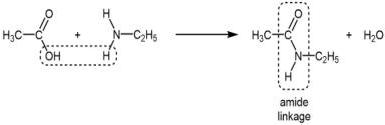
Nylon-6,6 is a well-known polyamide made from hexane-1,6-dioic acid and 1,6-diaminohexane.
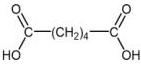
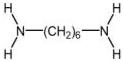
The reaction creates the amide linkage as follows:
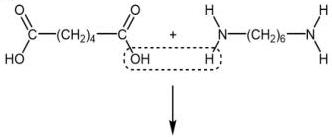
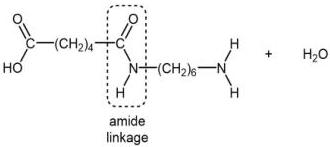
The repeating unit for nylon-6,6 is:
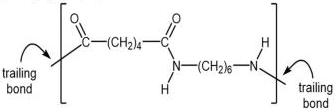
Exercise 114: Determining Polyamide Monomers
Given this polymer section:
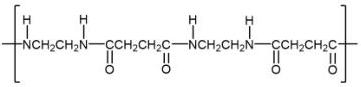
To find the monomers, we 'break' the amide linkage ( bond). We add an back to the carbonyl () to reform the carboxylic acid and an back to the nitrogen to reform the amine. The monomers are propanedioic acid () and 1,2-diaminoethane ().
Proteins and Amino Acids
Proteins are natural polyamides. They consist of long chains of amino acids joined by amide linkages, which in biological contexts are specifically called peptide bonds.
An amino acid contains three key groups attached to a central carbon atom: an amino group (), a carboxyl group (), and a variable organic 'R-group'. A hydrogen atom occupies the fourth bonding position.
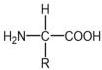
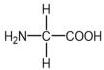
In glycine, the simplest amino acid, the R-group is a hydrogen atom:
Exercise 115: Tripeptide Formation
A tripeptide forms when three amino acids link. For the sequence alanine-glycine-valine (Ala-Gly-Val), we join the carboxyl group of alanine to the amino group of glycine, and the carboxyl group of glycine to the amino group of valine.


The structure will have the pattern .
Biodegradability
Biodegradable polymers are those that microorganisms or enzymes can break down into natural products like , , and . These polymers typically contain ester or amide linkages, which are susceptible to chemical or enzymatic attack. An example is poly(lactic acid) or PLA.
Non-biodegradable polymers do not break down easily. They usually consist of long carbon-hydrogen chains (like polyalkenes) held together by strong, inert and bonds that microorganisms cannot easily process.
Key takeaways
- Addition polymers are formed from unsaturated monomers (alkenes) where the bond opens to form links.
- Condensation polymers, such as polyesters and polyamides, involve the loss of a small molecule like during formation.
- The repeating unit of a polymer is the simplest structural unit that, when repeated, forms the polymer chain.
- Proteins are natural polyamides made from amino acid monomers linked by peptide bonds.
- Biodegradability depends on the presence of reactive linkages: ester and amide bonds usually allow degradation, while polyalkene chains do not.
When drawing repeating units for addition polymers, ensure the 'continuation bonds' extend outside the square brackets to show the chain continues. For condensation polymers, always check if the question asks for a single repeating unit or a section of the polymer chain, as these require different lengths of the structure to be drawn.
A common mistake is forgetting that the double bond disappears in addition polymerisation. The polymer is a saturated molecule. Also, in condensation polymerisation equations, remember to include or molecules of as products to balance the equation correctly.
The biodegradability of polyesters and polyamides is due to the polarity of the bond and the presence of heteroatoms (O and N) in the backbone, which provides a 'handle' for chemical hydrolysis or enzymatic cleavage. In contrast, polyalkenes are purely non-polar hydrocarbon chains, making them chemically inert and environmentally persistent.
Frequently asked questions
What is the difference between a repeating unit and a monomer?
A monomer is the starting molecule used to create the polymer (e.g., ethene, ). A repeating unit is the specific section of the polymer chain that repeats (e.g., for polyethene). Note that for addition polymers, the repeating unit has the same atoms as the monomer but no double bond.
Why is water often a product in condensation polymerisation?
Condensation reactions involve the joining of two functional groups, such as a carboxylic acid () and an alcohol () or an amine (). In these reactions, an from the acid and an from the other group combine to form , which is eliminated as a by-product.
How can I identify the monomers from a given polyester structure?
To identify the monomers, locate the ester linkage (). Imagine 'breaking' the bond between the carbonyl carbon () and the oxygen. Add an group back to the carbonyl carbon to reform the carboxylic acid, and add an atom back to the oxygen to reform the alcohol.
What are the structural requirements for a monomer to undergo condensation polymerisation?
A monomer must be 'bifunctional', meaning it must possess at least two functional groups. This allows it to form a bond at one end and then continue the chain by forming another bond at the other end. These groups can be the same (e.g., a diol) or different (e.g., an amino acid).