Alkenes and Unsaturated Hydrocarbons for the ESAT
Updated July 2026
A guide to alkenes, the homologous series of unsaturated hydrocarbons. Learn about the functional group, naming straight-chain molecules from to , and the characteristic addition reactions with hydrogen, halogens, and steam. This page covers essential reactivity and the diagnostic bromine water test for unsaturation required for the ESAT.
Alkenes are a homologous series of unsaturated hydrocarbons defined by the presence of at least one carbon-to-carbon double bond () and the general formula (for molecules with one double bond).
Introduction to Alkenes
Alkenes are a homologous series of unsaturated hydrocarbons. Unlike alkanes, which only contain single bonds, alkene molecules contain at least one carbon-to-carbon double bond (). Because they consist only of carbon and hydrogen atoms, they are classified as hydrocarbons. The term unsaturated indicates that they do not contain the maximum possible number of hydrogen atoms for the given number of carbon atoms, as two valency positions are occupied by the double bond.
The Homologous Series and General Formula
Alkenes with a single double bond follow the general formula:
where is the number of carbon atoms.
From this formula, we can see that each member of the series has two fewer hydrogen atoms than the corresponding alkane. Every subsequent member of the series differs by a unit.
Nomenclature of Alkenes
The naming of alkenes follows IUPAC guidelines, which build upon the prefixes used for alkanes. The suffix -ene is used to denote the presence of the functional group.
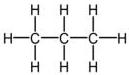
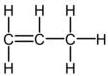
The image above shows propane, a 3-carbon alkane. In contrast, the image below shows propene, the 3-carbon alkene.
Naming C2 to C6 Alkenes
For alkenes with four or more carbon atoms, the position of the double bond must be specified using a number. The rules are as follows:
- The longest continuous carbon chain containing the double bond determines the prefix (e.g., eth-, prop-, but-, pent-, hex-).
- The carbon atoms are numbered from the end that gives the double bond the lowest possible number.
- The position of the double bond is indicated by the lower of the two numbers assigned to the carbon atoms it connects. This number is placed between the prefix and the suffix.
| Name | Molecular Formula | Double Bond Position |
|---|---|---|
| ethene | N/A (Only one position) | |
| propene | N/A (Only one position) | |
| but-1-ene | Between C1 and C2 | |
| but-2-ene | Between C2 and C3 | |
| pent-1-ene | Between C1 and C2 | |
| pent-2-ene | Between C2 and C3 | |
| hex-1-ene | Between C1 and C2 | |
| hex-2-ene | Between C2 and C3 | |
| hex-3-ene | Between C3 and C4 |
If a molecule contains more than one double bond, suffixes like -diene or -triene are used, and the position of every double bond must be numbered.
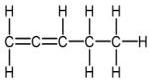
The molecule above is pent-1,2-diene, indicating double bonds starting at carbon 1 and carbon 2.
Worked Example: Exercise 109
Identify the names of the following alkenes, knowing that 7-carbon chains use the prefix 'hept-'.
a) 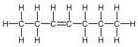
b) 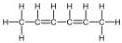
c) 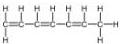
Solution: a) There are seven carbon atoms. Counting from the right to get the lowest number, the double bond is between C3 and C4. Name: hept-3-ene. b) Six carbon atoms. Double bonds are between C2/C3 and C4/C5. Name: hex-2,4-diene. c) Seven carbon atoms. Three double bonds at positions 1, 3, and 5. Name: hept-1,3,5-triene.
Addition Reactions of Alkenes
The reactive site, or functional group, in an alkene is the double bond. In an addition reaction, the double bond 'opens up' (one of the bonds breaks), allowing two new atoms or groups of atoms to bond to the carbon atoms that were previously double-bonded. This converts the unsaturated reactant into a saturated product.
Mechanisms and carbocation stability are not required for the ESAT, but you must be able to write balanced equations for the following four types of reactions, shown here with ethene.
1. Reaction with Hydrogen (Hydrogenation)
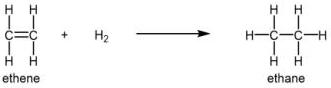
Equation: Product: Ethane (an alkane).
2. Reaction with Halogens (Halogenation)
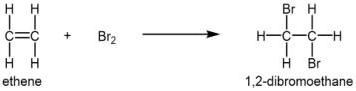
Equation: Product: 1,2-dibromoethane (a dihaloalkane).
3. Reaction with Hydrogen Halides
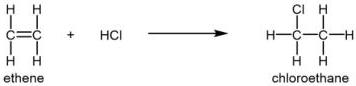
Equation: Product: Chloroethane (a haloalkane).
4. Reaction with Steam (Hydration)
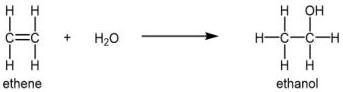
Equation: Product: Ethanol (an alcohol). Note that the molecule adds as an atom to one carbon and an group to the other.
Worked Example: Exercise 110
Write balanced equations and name the products for these reactions:
a) propene + hydrogen: . Product: propane. b) pent-2-ene + chlorine: . Product: 2,3-dichloropentane. c) hex-3-ene + hydrogen bromide: . Product: 3-bromohexane. d) but-2-ene + steam: . Product: butan-2-ol.
The Test for Unsaturation
The reaction with bromine is used as a qualitative chemical test to distinguish between saturated and unsaturated compounds.
When bromine is added to an alkene, a rapid addition reaction occurs. The bromine used is typically bromine water, which is an orange-brown aqueous solution.
- Positive Result (Alkene): If an alkene is bubbled through or shaken with bromine water, the solution turns from orange-brown to colourless. This is because the bromine is consumed as it adds across the bond to form a colourless dibromoalkane.
- Negative Result (Alkane): If an alkane is added to bromine water, no reaction occurs under standard conditions, and the solution remains orange-brown.
For liquid alkenes like pentene or hexene, adding a few drops of bromine water and shaking will yield the same decolourisation effect.
Key takeaways
- Alkenes are a homologous series of unsaturated hydrocarbons with the general formula .
- The reactive functional group in alkenes is the double bond, which undergoes addition reactions.
- Naming involves identifying the longest carbon chain and numbering to give the double bond the lowest possible position number.
- Alkenes react with hydrogen, halogens, hydrogen halides, and steam to form alkanes, haloalkanes, and alcohols respectively.
- Bromine water is the standard test for unsaturation, changing from orange-brown to colourless in the presence of an alkene.
When writing equations for addition reactions, ensure that the final product is fully saturated (all single bonds). A common mistake is to keep the double bond in the product structure by accident.
Do not confuse the colour change of bromine water. It goes from orange-brown to colourless. Do not use the word 'clear', as a solution can be coloured and clear at the same time. The correct term is 'colourless'.
Alkenes are significantly more reactive than alkanes because of the high electron density of the double bond, which attracts electrophilic reagents. This makes them vital industrial intermediates for making plastics (polymers), solvents, and fuels.
Frequently asked questions
Why do ethene and propene not have numbers in their names?
Numbers are only used when structural isomers are possible. In ethene (), the double bond can only be between the only two carbons. In propene (), numbering from either end always results in the double bond being at position 1. Therefore, numbers are unnecessary until you reach butene ().
What is the difference between a saturated and an unsaturated hydrocarbon?
A saturated hydrocarbon (alkane) contains only single carbon-to-carbon bonds and has the maximum possible number of hydrogen atoms. An unsaturated hydrocarbon (alkene) contains at least one double bond, meaning it contains fewer hydrogen atoms than an alkane with the same number of carbons.
What happens during the hydration of an alkene?
During hydration, an alkene reacts with steam () in the presence of a catalyst to form an alcohol. One hydrogen atom from the water molecule bonds to one of the carbons in the double bond, and the hydroxyl group () bonds to the other carbon.