Alcohols and Carboxylic Acids for the ESAT
Updated July 2026
This lesson covers the homologous series of alcohols and carboxylic acids, focusing on their general formulas, C1 to C6 nomenclature, and characteristic reactions. You will learn to predict alcohol-sodium reactions and understand the weak acid behaviour and esterification of carboxylic acids, essential for organic chemistry questions in the ESAT.
Alcohols and carboxylic acids are organic molecules containing the and functional groups respectively. Alcohols follow the formula and react with sodium to form hydrogen gas, while carboxylic acids follow and behave as weak acids that can also form esters when reacted with alcohols.
Alcohols as a Homologous Series
Alcohols are a homologous series of organic compounds characterised by the presence of the hydroxyl functional group, . The first four members of the series demonstrate a clear pattern in their molecular structure:
- Methanol:
- Ethanol:
- Propanol:
- Butanol:
Based on these members, we can derive the general formula for alcohols as , where is the number of carbon atoms.
Worked Example: Determining Alcohol Formulae
1. What is the formula of an alcohol with six carbon atoms? Applying the general formula where : .
2. What is the formula of an alcohol with a total of 20 hydrogen atoms? In the general formula , there are hydrogens in the alkyl chain and 1 hydrogen in the hydroxyl group. Total hydrogens = . Solving for : , so . The formula is .
Nomenclature of Alcohols
Naming alcohols follows the standard IUPAC rules with specific additions:
- The suffix for the name is -ol.
- The prefix indicates the number of carbon atoms, followed by -an- to show the chain is saturated (e.g., methan-, ethan-).
- For chains of 3 or more carbons, a number is inserted between the prefix and suffix to indicate the position of the group (e.g., propan-1-ol).
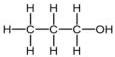
Note that methanol () and ethanol () do not require a number because the hydroxyl group can only be in one possible position.
Worked Example: Naming Alcohols
- : This has a three-carbon chain with the on the second carbon. It is propan-2-ol.
- : This has a six-carbon chain with the on the third carbon. It is hexan-3-ol.
- : This is a four-carbon chain with the on the first carbon. It is butan-1-ol.
For a straight-chain alcohol with five carbon atoms, three structural isomers exist depending on the position:
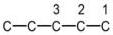
- pentan-1-ol:
- pentan-2-ol:
- pentan-3-ol:
Reaction of Alcohols with Sodium
Alcohols react with sodium metal in a manner similar to water, as both contain an bond. However, while the reaction of sodium with water is fast and vigorous, the reaction with alcohols is significantly slower and more moderate.
Sodium reacts with water to produce sodium hydroxide and hydrogen gas:
Sodium reacts with ethanol to produce sodium ethoxide and hydrogen gas:
Sodium ethoxide is a strong alkali in aqueous solution. This reaction can be used as a chemical test for the presence of the hydroxyl group or as a safer way to dispose of small amounts of sodium metal.
Worked Example: Sodium and Methanol
The balanced equation for the reaction of sodium with methanol is: The organic product is sodium methoxide.
Carboxylic Acids
Carboxylic acids form a homologous series containing the carboxyl functional group, . Their general formula is .
Nomenclature of Carboxylic Acids
- The suffix is -oic acid.
- The prefix indicates the total number of carbon atoms, including the carbon in the carboxyl group.
- No position number is needed because the group always occurs at the end of the chain (position 1).
For example, has two carbons in total and is called ethanoic acid. If in the general formula, the molecule is . This contains 5 carbon atoms in total, making it pentanoic acid. The first member of the series occurs when , giving (methanoic acid).
Chemical Properties of Carboxylic Acids
Carboxylic acids are weak acids. In aqueous solution, they only partially dissociate into ions:
They undergo typical acid reactions:
- With metals: forms a salt and hydrogen. For example: (Magnesium ethanoate).
- With bases: forms a salt and water. For example: (Sodium propanoate).
- With carbonates: forms a salt, water, and carbon dioxide. For example: (Potassium ethanoate).
Note that the salts end in -oate, and the anion is typically written first in the chemical formula (e.g., ).
Formation of Esters
Carboxylic acids react with alcohols in the presence of an acid catalyst (typically concentrated sulfuric acid) to produce esters and water. This is a reversible reaction known as esterification.
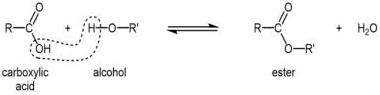
In the naming of an ester, the first part comes from the alcohol (the alkyl group) and the second part comes from the carboxylic acid (the carboxylate salt name).
For example, the reaction between ethanoic acid and methanol:

Worked Example: Predicting Esters
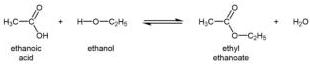
- Ethanoic acid + ethanol: Produces ethyl ethanoate. Formula: .
- Methanoic acid + ethanol: Produces ethyl methanoate. Formula: .
- Propanoic acid + methanol: Produces methyl propanoate. Formula: .
Key takeaways
- The general formula for alcohols is and for carboxylic acids it is .
- Alcohol naming requires a position number for the group for chains with 3 or more carbons (e.g., propan-1-ol vs propan-2-ol).
- Carboxylic acids are weak acids that only partially dissociate in water, reacting with metals, bases, and carbonates to form salts ending in '-oate'.
- Reaction with sodium metal produces hydrogen gas and a sodium alkoxide; this reaction is slower than the reaction of sodium with water.
- Esters are formed from a carboxylic acid and an alcohol using an acid catalyst, producing a molecule of water as a byproduct.
When naming carboxylic acids, students often forget to count the carbon atom within the group itself. For hexanoic acid, the alkyl chain 'prefix' represents only 5 carbons (), while the 6th carbon is in the functional group.
Do not confuse the formula of the salt with the acid. In salts like sodium ethanoate (), the hydrogen of the group is replaced by the metal ion. Ensure you write the organic part first in the formula as is conventional for these salts.
The 'alkoxide' ions formed (like ethoxide, ) are very strong bases, even stronger than the hydroxide ion (). This explains why sodium ethoxide creates a highly alkaline solution when dissolved in water.
Frequently asked questions
Why does the naming of carboxylic acids not require a position number?
The carbon atom in the carboxyl group () is already bonded to two oxygen atoms (one via a double bond and one via a single bond), meaning it can only form one more bond to the rest of the carbon chain. Consequently, it must always be at the end of the chain, so it is always carbon-1 by definition.
How do you distinguish between propan-1-ol and propan-2-ol?
In propan-1-ol, the hydroxyl group is attached to an end carbon of the three-carbon chain. In propan-2-ol, the hydroxyl group is attached to the middle carbon. They are structural isomers with the same molecular formula but different physical and chemical environments.
Is the reaction of sodium with ethanol faster or slower than with water?
The reaction of sodium with ethanol is significantly slower and more moderate than the reaction with water. While sodium reacts vigorously with water to produce a flame or rapid fizzing, its reaction with ethanol is a steady but less intense evolution of hydrogen gas.
What is the role of the acid catalyst in esterification?
The acid catalyst, such as concentrated sulfuric acid, increases the rate of the reaction between the carboxylic acid and the alcohol. Since the reaction is reversible, the catalyst helps reach equilibrium more quickly, though it does not change the position of the equilibrium itself.