General Concepts of Organic Chemistry for the ESAT
Updated July 2026
This lesson covers the fundamentals of organic chemistry required for the ESAT, including the properties and refining of crude oil, systematic IUPAC nomenclature, and the core differences between alkanes and alkenes. You will learn how to identify isomers, write combustion equations, and predict products of alkene addition reactions.
Organic chemistry is the study of hydrocarbons and their derivatives, where molecules are classified into homologous series based on their functional groups and general formulae, such as the alkanes () and alkenes ().
Hydrocarbons and Crude Oil
Hydrocarbons are organic compounds that consist of carbon and hydrogen atoms only. Common examples include methane (), butane (), octane (), and ethene ().
The primary source of these compounds is crude oil. This is a dark, viscous liquid that formed over millions of years from the decaying remains of ancient organisms. In its raw state, crude oil is a complex mixture of many different hydrocarbon molecules, making it largely unusable until it is refined through fractional distillation.
Fractional Distillation
Fractional distillation separates the mixture into useful parts called fractions. The process occurs in a fractionating column, which is hot at the base and progressively cooler towards the top.
- The crude oil is heated until it vaporises.
- The vapour enters the bottom of the column and rises.
- Different molecules condense into liquids at different heights based on their specific boiling points.
- The separated liquids are then collected.
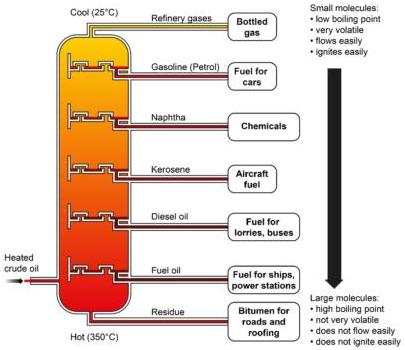
Each fraction contains hydrocarbons with a similar range of boiling points. As the carbon chain length increases, the following physical properties change:
- Boiling Point: Increases with chain length.
- Viscosity: Increases with chain length (the liquid becomes thicker and flows less easily).
- Flammability: Decreases with chain length (larger molecules are harder to ignite).
Exercise 101 The table below shows the boiling points of straight-chain alkanes. State and explain the trend.
| Hydrocarbon | Formula | Boiling Point / °C |
|---|---|---|
| Methane | -164 | |
| Ethane | -88 | |
| Propane | -42 | |
| Butane | 0 | |
| Pentane | 36 | |
| Octane | 126 |
Answer: The boiling point increases as the carbon chain length increases. This is because larger molecules have greater intermolecular forces, requiring more energy to separate the molecules into the gas phase.
Catalytic Cracking
Smaller hydrocarbon molecules are often in higher demand than longer-chain ones. Catalytic cracking is the process of breaking down long-chain alkanes into more useful shorter-chain alkanes and alkenes. This is achieved by passing the long molecules over a heated catalyst.
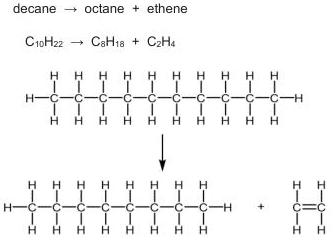
Cracking is a random process. For instance, a long alkane might break into a shorter alkane and an alkene. Equations must always be balanced for the number of carbon and hydrogen atoms.
Exercise 102 When a molecule of dodecane () is cracked, it produces two molecules of ethene (), one molecule of pentane (), and one other molecule. Identify the formula of the final molecule.
Working: Total C: Total H: The remaining molecule is .
Representing Organic Molecules
There are three main ways to write the formula of an organic compound:
- Molecular Formula: Shows the total number of atoms of each element, such as for butane.
- Full Structural Formula (Displayed Structure): Shows every atom and every bond in the molecule.
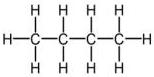
- Condensed Structural Formula: Shows the arrangement of atoms without drawing every bond, such as or for butane.
Exercise 103 Write condensed formulae for: a. Ethane (): b. Hexane (): c. Ethene ():
Structural Isomerism
Structural isomers are compounds that share the same molecular formula but have different structural formulae. This happens when atoms are sequenced in different ways.
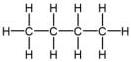 Butane ()
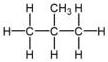 2-methylpropane ()
Exercise 104 Give the structural formulae of the five structural isomers of . Answer: Hexane, 2-methylpentane, 3-methylpentane, 2,2-dimethylbutane, and 2,3-dimethylbutane.
Combustion
Combustion involves reacting a hydrocarbon with oxygen, releasing energy.
Complete Combustion: Occurs in an excess of oxygen. The only products are carbon dioxide and water. To balance the equation:
- Carbon dioxide molecules = number of Carbon atoms.
- Water molecules = half the number of Hydrogen atoms.
- Balance Oxygen atoms last.
Example for pentane:
Exercise 105 Write a balanced equation for the complete combustion of octane, . Answer: (or )
Incomplete Combustion: Occurs when oxygen is limited. Products include carbon monoxide () or carbon soot () along with water. Example for butane:
Exercise 106 Write the equation for the incomplete combustion of pentane where is the only carbon product. Answer:
IUPAC Nomenclature
The International Union of Pure and Applied Chemistry (IUPAC) provides rules for naming compounds. The prefix indicates the number of carbons in the longest chain:
- 1: meth-
- 2: eth-
- 3: prop-
- 4: but-
- 5: pent-
- 6: hex-
- 7: hept-
- 8: oct-
The suffix indicates the series: -ane for alkanes and -ene for alkenes.
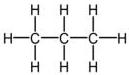 Propane (3 carbons, alkane)
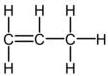 Propene (3 carbons, alkene)
Naming Branches:
- Identify the longest straight carbon chain.
- Number the chain so the branches have the lowest possible numbers.
- Name branches as alkyl groups: methyl (), ethyl ().
- List branches alphabetically (ethyl before methyl) and use prefixes like di- or tri- for multiples.
Examples:
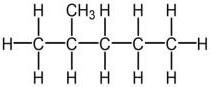
- 2-methylpentane: A 5-carbon chain with a methyl group on the second carbon.
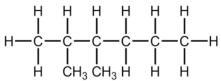
- 2,3-dimethylhexane: A 6-carbon chain with methyl groups on carbons 2 and 3.
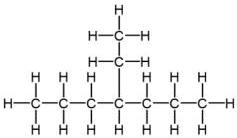
- 4-ethylheptane: A 7-carbon chain with an ethyl group on carbon 4.
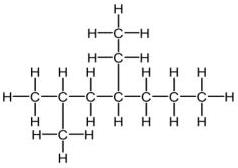
- 4-ethyl-2-methylheptane: Alphabetical order applies.
Exercise 107
Name the following:
a. 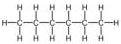 (3-methylhexane)
b.
(3-methylhexane)
b.  (2,2-dimethylbutane)
c.
(2,2-dimethylbutane)
c.  (3-ethyl-2-methylpentane)
d.
(3-ethyl-2-methylpentane)
d.  (2,2,4-trimethylpentane)
Homologous Series and Alkanes
A homologous series is a family of compounds with the same general formula and similar chemical properties because they contain the same functional group. Alkanes are saturated hydrocarbons (containing only single bonds) with the general formula .
Exercise 108 Calculate molecular formulae for: a. 10 carbons: b. 26 total atoms: . Result: . c. 60 hydrogens: . Result: .
Alkenes
Alkenes are unsaturated hydrocarbons containing at least one double bond. Their general formula is . The position of the double bond is indicated by a number (the lower of the two carbons involved).
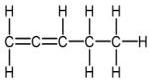 Pent-1,2-diene (Note the use of -diene for two double bonds).
Exercise 109
Name the heptene isomers:
a. 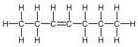 (Hept-1-ene)
b.
(Hept-1-ene)
b. 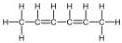 (Hept-2-ene)
c.
(Hept-2-ene)
c. 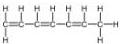 (Hept-3-ene)
Reactions of Alkenes
Alkenes undergo addition reactions where the double bond opens, allowing new atoms to bond to the carbons.
- Hydrogenation: Addition of to form an alkane.
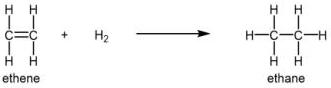
- Halogenation: Addition of halogens (e.g., ) to form a dihaloalkane.
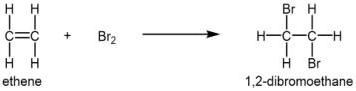
- Hydrogen Halides: Addition of or .
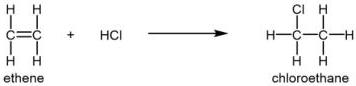
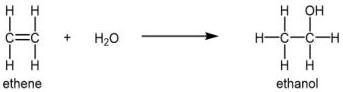
- Hydration: Addition of steam () to form an alcohol ( goes to one carbon, to the other).
Test for Unsaturation: Bromine water is used to distinguish alkanes from alkenes. When added to an alkene, the orange-brown bromine water is decolourised (becomes colourless) because an addition reaction occurs. Alkanes do not react with bromine water in the dark, so the solution remains orange-brown.
Key takeaways
- Crude oil is separated into fractions by fractional distillation based on the differing boiling points of hydrocarbons.
- As hydrocarbon chain length increases, boiling point and viscosity increase, while flammability decreases.
- Alkanes are saturated () while alkenes are unsaturated with at least one bond ().
- Complete combustion produces and ; incomplete combustion can produce or .
- Bromine water is decolourised by alkenes but not by alkanes, providing a test for unsaturation.
In the ESAT, when asked to name a branched molecule, always find the absolute longest carbon chain first. Sometimes this chain is not written in a straight horizontal line; it might turn a corner. Numbering from both ends and comparing locants is the best way to ensure you have the lowest possible numbers.
A common mistake is forgetting that 'decolourised' means 'turns colourless'. Do not say 'turns clear', as a solution can be clear (transparent) but still have a colour (like orange bromine water). Use the term 'colourless' specifically.
The physical property trends in hydrocarbons are due to London forces (a type of van der Waals force). As molecules get longer, they have more electrons and a larger surface area, leading to stronger temporary dipoles and thus higher boiling points and viscosity.
Frequently asked questions
What is the difference between a displayed formula and a condensed formula?
A displayed formula (full structural formula) shows every atom and every covalent bond as a line. A condensed structural formula groups atoms together, such as writing for propane, to show the layout without drawing every single bond line.
How do you determine the numbering of the carbon chain when naming an alkene?
The longest chain containing the double bond is chosen as the main chain. The chain is numbered from the end that gives the double bond the lowest possible number. For example, a double bond between carbons 2 and 3 results in the name 'alk-2-ene'.
Why does cracking produce alkenes as well as alkanes?
Cracking involves breaking a long-chain alkane. Since there are not enough hydrogen atoms to produce two saturated alkanes from one starting alkane, at least one of the products must be an unsaturated alkene containing a bond.