Alkanes and Saturated Hydrocarbons for the ESAT
Updated July 2026
Alkanes are the fundamental homologous series of saturated hydrocarbons, defined by the general formula . This guide covers their naming from methane to hexane, their structural representation, and their chemical reactions. Understanding their physical properties and combustion is essential for mastering organic chemistry in the ESAT.
Alkanes are saturated hydrocarbons containing only single carbon-to-carbon bonds, forming a homologous series with the general formula .
Understanding Alkanes and Homologous Series
Hydrocarbons are organic compounds consisting exclusively of carbon and hydrogen atoms. Alkanes represent the simplest family within this group. They are classified as saturated hydrocarbons, which means that every carbon-to-carbon bond in the molecule is a single bond. Because they have no functional group, their reactivity is relatively low compared to other organic families.
Alkanes form a homologous series. A homologous series is a family of compounds that share similar chemical properties because they possess the same functional group (or lack thereof, in the case of alkanes). Members of such a series share a common general formula and differ only by the length of their carbon skeleton, with each successive member typically differing by a unit.
The general formula for any alkane is:
where is the number of carbon atoms in the molecule. For example, if an alkane has 10 carbon atoms, it will have hydrogen atoms, resulting in the molecular formula .
The First Six Straight Chain Alkanes
For the ESAT, you must be able to name and recognise the first six straight-chain alkanes. The name is determined by a prefix indicating the number of carbon atoms and the suffix -ane.
| Number of Carbons | Prefix | Name | Molecular Formula |
|---|---|---|---|
| 1 | meth- | Methane | |
| 2 | eth- | Ethane | |
| 3 | prop- | Propane | |
| 4 | but- | Butane | |
| 5 | pent- | Pentane | |
| 6 | hex- | Hexane |
IUPAC Nomenclature and Naming Rules
The International Union of Pure and Applied Chemistry (IUPAC) provides systematic guidelines for naming organic compounds. To name an alkane, follow these steps:
- Identify the longest continuous carbon chain to determine the stem name (e.g., a five-carbon chain is pentane).
- Identify any branches (alkyl groups) attached to the main chain. A one-carbon branch is a methyl group, and a two-carbon branch is an ethyl group.
- Number the main chain starting from the end that gives the branches the lowest possible position numbers.
- Combine the names, listing branches in alphabetical order (ethyl before methyl). Use prefixes like di- or tri- if there are multiple identical branches, but these do not affect the alphabetical ordering.
Examples of Naming
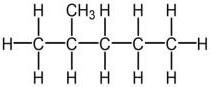
In this example, the longest chain has 5 carbons (pentane). Numbering from the left puts the methyl group on carbon 2. Thus, the name is 2-methylpentane.
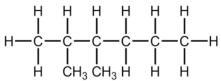
This molecule is 2,3-dimethylhexane, using 'di-' to indicate two methyl branches.
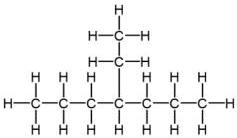
This molecule is 4-ethylheptane.
Representing Alkanes: Formulae Types
There are three primary ways to represent an organic molecule:
- Molecular Formula: Shows the actual number of atoms of each element. For butane, this is .
- Full Structural Formula (Displayed Structure): Shows every atom and every bond in the molecule.
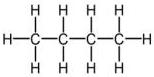
- Condensed Structural Formula: Shows the arrangement of atoms in a more compact way without drawing all the bonds, such as or for butane.
Structural Isomerism
Structural isomerism occurs when compounds share the same molecular formula but have different structural formulae. This happens because the atoms are sequenced differently.
For example, both butane and 2-methylpropane have the molecular formula , but they are different molecules:
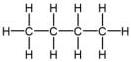 Butane
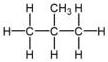 2-methylpropane
Physical Properties and Trends
Alkanes are obtained primarily from crude oil, a complex mixture of hydrocarbons separated by fractional distillation. This process relies on differences in boiling points. As the carbon chain length increases, several trends emerge:
- Boiling Point: Increases with chain length. Larger molecules have stronger intermolecular forces, requiring more energy to overcome.
- Viscosity: Larger molecules are more viscous (they do not flow easily).
- Flammability: Larger molecules are less flammable.
Chemical Reactions
Combustion
Combustion is the reaction of a fuel with oxygen, releasing energy. There are two types:
- Complete Combustion: Occurs in a plentiful supply of oxygen. The only products are carbon dioxide () and water ().
Method for balancing complete combustion equations:
- The number of molecules equals the number of carbon atoms in the hydrocarbon.
- The number of molecules is half the number of hydrogen atoms.
- Balance the oxygen atoms last.
Worked Example (Exercise 105): Write a balanced equation for the complete combustion of octane, .
- 8 carbons produce .
- 18 hydrogens produce .
- Total oxygen atoms on right: .
- Left side needs .
- Final equation: (or double all coefficients for whole numbers).
- Incomplete Combustion: Occurs when oxygen is limited. Products can include carbon monoxide () or solid carbon (soot, ), alongside water.
Catalytic Cracking
Longer chain alkanes are less useful than shorter ones. Cracking involves passing long chain molecules over a heated catalyst to break them into shorter, more useful alkanes and alkenes (hydrocarbons with double bonds). This is a random process.
Worked Example (Exercise 102): Cracking produces two molecules of ethene () and one of pentane (). Find the remaining product .
- Total carbons: .
- Total hydrogens: .
- is (propene).
Key takeaways
- Alkanes follow the general formula and are saturated hydrocarbons.
- The first six prefixes are meth- (1), eth- (2), prop- (3), but- (4), pent- (5), and hex- (6).
- Complete combustion in excess oxygen always yields carbon dioxide and water.
- Structural isomers have the same molecular formula but different arrangements of atoms.
- Boiling point and viscosity increase with chain length, while flammability decreases.
When naming branched alkanes, always look for the longest continuous chain first, even if it is not drawn in a straight line. Mistakes often happen by assuming the horizontal line is the main chain.
Be careful when balancing combustion equations for alkanes with an even number of carbons, as you will often end up with a '.5' for the oxygen coefficient. You can leave it as a decimal or multiply the entire equation by 2 to get whole numbers.
Branching significantly affects physical properties. A branched isomer typically has a lower boiling point than its straight-chain counterpart because the branches prevent the molecules from packing as closely together, which weakens the intermolecular forces.
Frequently asked questions
What is the difference between a molecular formula and a structural formula?
A molecular formula (e.g. ) counts the atoms of each element in a molecule, while a structural formula (displayed or condensed) shows how those atoms are specifically arranged and bonded to each other.
Why do boiling points increase as the alkane chain gets longer?
Longer alkanes have larger molecules, which results in stronger intermolecular forces of attraction between them. More thermal energy is required to overcome these forces and separate the molecules into the gas phase.
How do you distinguish between complete and incomplete combustion in an equation?
Complete combustion equations will only show and as products. Incomplete combustion equations will include (carbon monoxide) or (carbon/soot) as products due to a limited oxygen supply.