Chemical Bonding, Structure and Properties for the ESAT
Updated July 2026
This lesson covers the fundamental models of ionic, covalent, and metallic bonding. You will learn to predict ion charges, deduce chemical formulae, and understand how macroscopic physical properties like melting points and electrical conductivity arise from the microscopic arrangement of atoms, ions, and delocalised electrons.
Chemical bonding occurs when atoms achieve stable electron configurations, resulting in either giant lattices or discrete molecular structures. The strength and nature of the attractive forces within these structures determine the physical properties of the substance.
Formation of Ionic Compounds
When a metal reacts with a non-metal, electrons are transferred from the metal atoms to the non-metal atoms. This process forms ions: the metal loses electrons to become a positively charged cation, while the non-metal gains electrons to become a negatively charged anion. An ionic compound is the resulting giant lattice of these oppositely charged ions, held together by strong electrostatic attractions.
Ion Charges and Electron Configuration
Atoms typically form ions to obtain the stable electron configuration of a noble gas. The charge of an ion can be predicted from its Group in the Periodic Table:
- Group 1: Elements have one outer electron and lose it to form ions (e.g., , , ).
- Group 2: Elements have two outer electrons and lose them to form ions (e.g., , , ).
- Group 13 (Aluminium): Aluminium loses three electrons to form .
- Group 16: Elements have six outer electrons and gain two to form ions (e.g., , ).
- Group 17: Elements have seven outer electrons and gain one to form ions (e.g., , , , ).\n\nSome metals can exist in multiple oxidation states. In these cases, Roman numerals are used in the name to indicate the charge. For example, iron(II) oxide contains ions, while iron(III) oxide contains ions.
Compound Ions and Chemical Formulae
Groups of atoms can carry an overall charge, known as compound ions. You must memorise the following:
- Hydrogen:
- Ammonium:
- Hydroxide:
- Nitrate:
- Sulfate:
- Carbonate:
- Phosphate: \n\nTo determine the formula of an ionic compound, the total positive and negative charges must balance to zero. For example, in aluminium oxide, two ions (total ) balance three ions (total ), giving the formula . In magnesium hydroxide, one balances two ions, requiring brackets in the formula: .
Properties of Ionic Compounds
Ionic compounds exist as a giant lattice, a regular, continuous structure of alternating positive and negative ions.
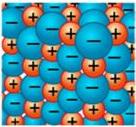
Their physical properties are a direct result of this structure:
- Melting Points: They have high melting points because the strong electrostatic attractions between ions throughout the lattice require significant energy to overcome.
- Conductivity: As solids, they are insulators because the ions are fixed in position. When melted (molten) or dissolved in water (aqueous), the ions are mobile and can carry an electrical charge.
Covalent Bonding and Molecular Substances
Covalent bonds form when non-metal atoms share one or more pairs of electrons. Most covalent substances exist as small molecules, such as methane () or glucose (). Within these molecules, atoms are held by strong covalent bonds, but the individual molecules are only held to each other by weak intermolecular forces.
Because these intermolecular forces are easy to overcome, molecular substances typically have low melting and boiling points. They do not conduct electricity because they lack mobile ions or delocalised electrons. Methane can be represented by 2D stick diagrams (), 3D diagrams showing spatial arrangement, or space-filling models showing relative atom sizes.
Giant Covalent Structures
Some covalent substances form a continuous lattice of atoms. Examples include diamond (carbon), graphite (carbon), and silicon dioxide ().
- Diamond and Silicon Dioxide: These have extremely high melting points and are very hard because every atom is linked to others by strong covalent bonds in a rigid 3D network.
- Graphite: While it has a high melting point, it is soft because it consists of layers that can slide over each other. It conducts electricity because it contains delocalised electrons that can move along these layers.
Metallic Bonding
Solid metals consist of a giant structure of positive metal ions surrounded by a "sea" of delocalised electrons. These are outer shell electrons that are free to move throughout the entire structure.
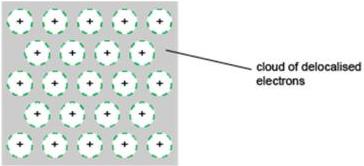
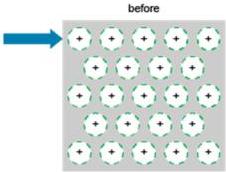
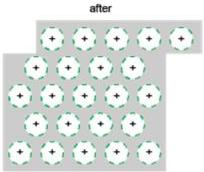
Metals have high melting points due to the strong attraction between the positive ions and the delocalised electron cloud. They are excellent conductors because the delocalised electrons carry charge. Metals are also malleable: the layers of ions can slide over each other without breaking the metallic bond, as the electron sea simply adjusts to the new positions.
Intermolecular Forces and Phase Changes
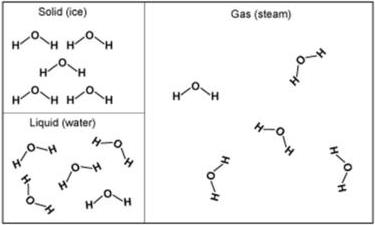
It is vital to distinguish between covalent bonds and intermolecular forces. When water () boils to form steam, the intermolecular forces between molecules are overcome, but the covalent bonds between the hydrogen and oxygen atoms within the molecule remain intact.
Worked Examples: Identifying Structure from Properties
Consider a substance with a melting point of that is an insulator as a solid but conducts when liquid. This fits the profile of an ionic structure. Conversely, a substance like diamond, with a melting point of that is an insulator in both states, is a giant covalent structure. Ethane (), which has a very low boiling point, has such properties because the forces between its molecules are weak, even though the internal bonds are strong.
Key takeaways
- Ionic bonds involve electron transfer, creating giant lattices with high melting points that conduct only when molten or aqueous.
- Covalent molecular substances have low melting points because only weak intermolecular forces must be broken during phase changes.
- Giant covalent structures like diamond have high melting points because strong covalent bonds must be broken throughout the lattice.
- Metallic bonding involves a lattice of positive ions and delocalised electrons, allowing for electrical conductivity and malleability.
When asked to explain melting points in the ESAT, always identify the specific force being broken: electrostatic attraction between ions (ionic), metallic bonds (metallic), covalent bonds (giant covalent), or intermolecular forces (molecular covalent).
A common mistake is stating that covalent bonds are broken when boiling water or melting wax. Covalent bonds are very strong; only the weak intermolecular forces between molecules are overcome during these state changes.
The delocalised electron model in metals explains both electrical and thermal conductivity. Since electrons are free to move, they can transfer kinetic energy (heat) as well as electrical charge rapidly through the lattice.
Frequently asked questions
Why do ionic compounds not conduct electricity when they are solid?
In the solid state, the ions are held in fixed positions within the giant lattice by strong electrostatic forces. Because the ions cannot move, they cannot carry an electrical charge through the substance.
What is the difference between a covalent bond and an intermolecular force?
A covalent bond is a strong attraction formed by the sharing of electrons between atoms within a molecule. An intermolecular force is a much weaker attraction between separate molecules. Melting or boiling a molecular substance breaks the intermolecular forces, not the covalent bonds.
How does graphite conduct electricity if it is a non-metal?
In graphite, each carbon atom only uses three of its four outer electrons to form covalent bonds within a layer. The fourth electron becomes delocalised and is free to move along the layers, carrying an electrical charge.
How can I determine the formula for ammonium sulfate?
Ammonium is ( charge) and sulfate is ( charge). To balance the charges, you need two ammonium ions for every one sulfate ion. The formula is .
Why are metals malleable while ionic crystals are brittle?
In metals, the delocalised electrons allow layers of ions to slide past one another while maintaining the bond. In ionic crystals, sliding layers brings ions of the same charge next to each other, causing strong repulsion that shatters the lattice.