Chemical Bonding and Structure for the ESAT
Updated July 2026
Chemical bonding describes how atoms achieve stable noble gas electron configurations through electron transfer or sharing. This page explains ionic, covalent, and metallic bonding, detailing how these interactions form giant lattices or small molecules. Understanding these structures is vital for predicting physical properties like melting points and electrical conductivity in ESAT Chemistry.
Atoms bond to achieve the stable electron configuration of a noble gas (Group 18), forming ionic, covalent, or metallic structures depending on whether electrons are transferred, shared, or delocalised.
The Principles of Chemical Bonding
Chemical reactions occur because atoms seek the stability of a full outer electron shell, which corresponds to the configuration of a noble gas. The specific way atoms interact depends on the elements involved. Metals typically react with non-metals through electron transfer, whereas non-metals react with each other by sharing electrons. In pure metals, electrons become delocalised across a lattice of ions.
Ionic Bonding and Ion Formation
Ionic bonding occurs when metal atoms transfer electrons to non-metal atoms. This process creates ions: atoms with a net charge. Metals lose electrons to become positive ions (cations), while non-metals gain electrons to become negative ions (anions). These oppositely charged ions are then held together by strong electrostatic forces in a giant ionic lattice.
Predicting Ion Charges
The charge of an ion is determined by its position in the Periodic Table as it moves towards the nearest noble gas configuration:
- Group 1 elements possess one outer electron and lose it to form ions, such as , , and .
- Group 2 elements lose two electrons to form ions, such as , , and .
- Group 13 elements, specifically aluminium, lose three electrons to form .
- Group 16 elements gain two electrons to form ions, such as and .
- Group 17 elements gain one electron to form ions, such as , , , and .
Some metals can form multiple ions with different charges. In these cases, Roman numerals indicate the oxidation state. For example, iron(II) oxide contains , while iron(III) oxide contains . Additionally, groups of atoms can form 'compound ions' with an overall charge, including hydrogen (), ammonium (), hydroxide (), nitrate (), sulfate (), carbonate (), and phosphate ().
Determining Ionic Formulae
In any ionic compound, the total positive charge must equal the total negative charge. To determine a formula, you must balance the ions:
- Iron(III) bromide: requires three ions to balance the charge. Formula: .
- Potassium sulfide: Two ions are needed for every one ion. Formula: .
- Aluminium oxide: Two ions (total ) balance three ions (total ). Formula: .
- Magnesium hydroxide: One balances two ions. Note that brackets are used for compound ions. Formula: .
- Ammonium sulfate: Two ions balance one ion. Formula: .
Properties of Ionic Compounds
Ionic compounds form giant lattices, which are large, regular, repeating structures. Because the electrostatic attraction between oppositely charged ions is strong and acts in all directions, these substances have very high melting and boiling points. Significant energy is required to break these many strong attractions.
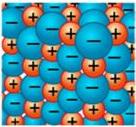
Regarding electrical conductivity, ionic compounds do not conduct when solid because the ions are fixed in position. However, once melted (molten) or dissolved in water (aqueous), the ions are free to move and carry an electrical charge through the substance.
Covalent Bonding and Molecular Structures
Covalent bonds form when non-metal atoms share one or more pairs of electrons. Most covalent substances exist as small molecules, such as methane () or water (). Within these molecules, atoms are held together by very strong covalent bonds. However, the forces between separate molecules, known as intermolecular forces, are weak.
Because of these weak intermolecular forces, molecular substances have low melting and boiling points. When these substances change state, only the weak intermolecular forces are overcome; the strong covalent bonds within the molecules remain intact. For example, when water boils, molecules stay as but move further apart.
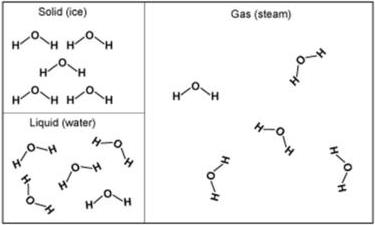
Molecular substances do not conduct electricity because they lack mobile ions or delocalised electrons.
Giant Covalent Structures
Some covalent substances do not form small molecules but instead form giant lattices where every atom is linked by strong covalent bonds. Examples include diamond, graphite, and silicon dioxide ().
These substances have extremely high melting points because every strong covalent bond must be broken to melt the solid. Diamond and silicon dioxide are very hard due to their rigid 3D networks. Graphite, however, is soft because its atoms are arranged in layers that can slide over one another. While most giant covalent structures are insulators, graphite conducts electricity because it contains delocalised electrons that move along its layers.
Metallic Bonding and Properties
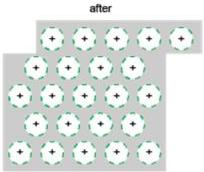
Metals consist of a giant lattice of positive metal ions surrounded by a 'sea' of delocalised outer shell electrons. These electrons are free to move throughout the entire structure. The metallic bond is the strong attraction between the positive ions and the negative delocalised electrons.
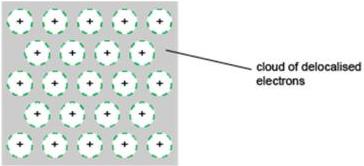
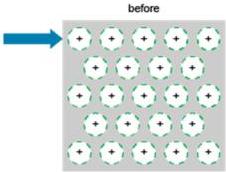
Metals typically have high melting points due to the strength of this attraction. They are excellent conductors of electricity and heat because the delocalised electrons can move to carry charge or thermal energy. Furthermore, metals are malleable, meaning they can be shaped without shattering. This is because the layers of ions can slide over each other while the delocalised electrons maintain the bond.
Summary of Bonding Types and Physical Properties
- Ionic: Giant lattice of ions. High melting points. Conducts only when molten or aqueous.
- Molecular Covalent: Small molecules. Low melting points due to weak intermolecular forces. Does not conduct.
- Giant Covalent: Giant lattice of atoms. Very high melting points. Generally does not conduct, except for graphite.
- Metallic: Giant lattice of ions with delocalised electrons. High melting points. Conducts as both solid and liquid.
Key takeaways
- Ionic compounds form giant lattices with high melting points and conduct electricity only when ions are mobile.
- Molecular covalent substances have low melting points because only weak intermolecular forces must be overcome to change state.
- Giant covalent structures like diamond have extremely high melting points because many strong covalent bonds must be broken.
- Metallic bonding involves a lattice of positive ions and delocalised electrons, allowing for high conductivity and malleability.
- The formula of an ionic compound is determined by balancing the total positive and negative charges of the constituent ions.
When asked to explain melting points, distinguish clearly between 'breaking bonds' (ionic, giant covalent, metallic) and 'overcoming intermolecular forces' (molecular covalent).
A common error is stating that ionic solids conduct electricity. They only conduct when the lattice is broken down by melting or dissolving, allowing ions to move.
The transition between ionic and covalent bonding is not always absolute; the type of bonding is influenced by the difference in the atoms' ability to attract electrons, though the ESAT focuses on the clear distinctions between the main types.
Frequently asked questions
Why does graphite conduct electricity while diamond does not?
In graphite, each carbon atom forms three covalent bonds, leaving one delocalised electron per atom that is free to move and carry charge. In diamond, each carbon atom forms four covalent bonds, meaning there are no free electrons.
Does boiling a molecular substance break covalent bonds?
No. Boiling a molecular substance only overcomes the weak intermolecular forces between the molecules. The strong covalent bonds holding the atoms together within the molecules remain unbroken.
How do you identify an ionic compound from a list of formulae?
Ionic compounds are typically formed from a metal and a non-metal (e.g., , ) or contain compound ions like or .
What determines the melting point of a metal?
The melting point is determined by the strength of the attraction between the positive metal ions and the delocalised electrons. Stronger attractions result in higher melting points.