Intermolecular Forces and Physical Properties
Updated July 2026
This lesson explains the critical distinction between strong covalent bonds and weak intermolecular forces in chemistry. You will learn how these forces govern the melting and boiling points of substances and how to identify different structural types based on their physical properties like conductivity and state changes.
Intermolecular forces are weak attractive forces that exist between separate molecules, distinct from the strong covalent bonds that hold atoms together within a molecule. These weak forces are what must be overcome for a molecular substance to melt or boil.
The Nature of Intermolecular Forces
In a molecular substance, the atoms inside each individual molecule are held together by covalent bonds. These bonds involve the sharing of electrons and are extremely strong. However, there is a separate set of forces acting between the molecules themselves. These are known as intermolecular forces.
It is important to understand that there are no actual bonds between separate molecules, only these relatively weak attractive forces. Because they are weak, it does not take a large amount of energy to push the molecules apart. This is why many molecular substances are gases or liquids at room temperature.
Phase Changes in Molecular Substances
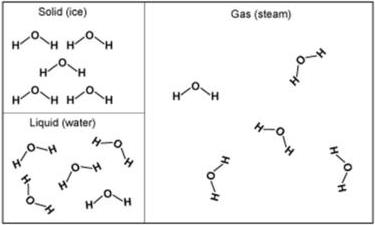
When you provide thermal energy to a molecular solid or liquid, it will eventually melt or boil. During these physical changes, it is only the weak intermolecular forces that are being overcome. The strong covalent bonds within the molecules remain completely intact.
Consider the example of water. When ice is heated, it melts to form liquid water. If the heating continues, the liquid water boils to form steam (water vapour). Throughout this entire process, the covalent bonds between the hydrogen and oxygen atoms in the molecules do not break. If those bonds were to break, the substance would decompose into hydrogen and oxygen gases rather than simply changing state.
Relating Structure and Bonding to Physical Properties
To succeed in the ESAT, you must be able to link the specific type of bonding and structure in a substance to its physical properties, such as melting point and electrical conductivity. There are four main types of structures you must recognise:
-
Ionic Structures: These consist of a giant lattice of positive and negative ions. Because there is a very strong electrostatic attraction between these oppositely charged ions throughout the entire structure, ionic substances have high melting and boiling points. They do not conduct electricity as solids because the ions are fixed in place, but they become conductors when molten or dissolved in water because the ions are then free to move and carry charge.
-
Molecular Structures (Simple Covalent): These consist of many separate molecules. Each molecule is held together by strong covalent bonds, but there are only weak intermolecular forces between the molecules. This results in low melting and boiling points. Since they do not contain mobile ions or delocalised electrons, they are electrical insulators in all states.
-
Giant Covalent Structures: These consist of a giant lattice of atoms all linked by strong covalent bonds. Because these strong bonds must be broken to melt the substance, they have very high melting and boiling points. Most do not conduct electricity, with the notable exception of graphite, which contains delocalised electrons.
-
Metallic Structures: These consist of a giant lattice of positive metal ions surrounded by a sea of delocalised outer shell electrons. There is a strong attraction between the positive ions and the negative delocalised electrons. This results in high melting and boiling points. They are excellent conductors in both solid and liquid states because the delocalised electrons are free to move and carry charge.
Worked Example: Identifying Substances from Data
The table below shows the properties of several substances. We can use this data to identify their structure type.
| Substance | Melting point / °C | Boiling point / °C | Conductivity (Solid) | Conductivity (Liquid) |
|---|---|---|---|---|
| A | 711 | 1250 | Insulator | Conductor |
| B | 3550 | 4830 | Insulator | Insulator |
| C | -57 | 125 | Insulator | Insulator |
| D | 44 | 281 | Insulator | Insulator |
| E | 1085 | 2562 | Conductor | Conductor |
| F | 2072 | 2977 | Insulator | Conductor |
Analysis and Solutions:
a) Which substances are made of covalent molecules? Substances C and D. We know this because they have relatively low melting and boiling points (below 300 °C) and do not conduct electricity. This indicates weak intermolecular forces.
b) Which substances have giant covalent structures? Substance B. It has an extremely high melting point (3550 °C) and does not conduct electricity in either state.
c) Which substance has a metallic structure? Substance E. It is the only substance that conducts electricity while in the solid state.
d) Which substances have an ionic structure? Substances A and F. These are insulators as solids but become conductors when they are melted into liquids.
Key takeaways
- Intermolecular forces act between molecules, while covalent bonds act within molecules.
- Melting and boiling molecular substances only requires overcoming weak intermolecular forces, not breaking strong covalent bonds.
- Substances with giant structures (ionic, metallic, or giant covalent) have high melting points because strong chemical bonds must be broken throughout the lattice.
- Conductivity requires mobile charged particles: ions in molten/aqueous ionic compounds, or delocalised electrons in metals and graphite.
When identifying a substance from a table of data, check the solid conductivity first. If it conducts as a solid, it is almost certainly metallic. If it only conducts when liquid, it is ionic.
Never say that covalent bonds are broken when water boils. This is a common error. You must specify that it is the intermolecular forces being overcome.
The strength of intermolecular forces is much lower than the strength of covalent, ionic, or metallic bonds. This explains why molecular substances like or are gases at temperatures where ionic salts like are still solid.
Frequently asked questions
Why don't simple covalent molecules conduct electricity?
Simple covalent molecules are neutral overall and do not contain any delocalised electrons or mobile ions that could move to carry an electrical charge.
What is the difference between a giant covalent structure and a molecular structure?
A molecular structure consists of small, separate units held together by weak intermolecular forces. A giant covalent structure is one continuous lattice where every atom is bonded to its neighbours by strong covalent bonds, meaning there are no individual molecules.
Why do ionic compounds only conduct when liquid or dissolved?
In the solid state, the ions are locked in a rigid lattice by strong electrostatic forces and cannot move. When molten or in solution, the lattice breaks down, allowing the ions to move freely towards electrodes.