Metallic Bonding and Properties for the ESAT
Updated July 2026
Metallic bonding explains the structure and behavior of metals as a giant lattice of positive ions within a sea of delocalised electrons. This topic is essential for the ESAT as it provides the basis for understanding why metals are conductive, malleable, and have high melting points compared to molecular substances.
Metallic bonding is the strong electrostatic attraction between a giant lattice of positively charged metal ions and a cloud of delocalised (free) electrons that can move throughout the entire structure.
The Structure of Metallic Bonding
In both solid and liquid states, metals exist as a giant structure. The atoms in a metal lose their outer shell electrons, which become delocalised. These delocalised electrons are not bound to any single atom and are free to move throughout the entire metallic lattice. Consequently, a solid metal consists of a regular arrangement, or lattice, of positively charged metal ions surrounded by a cloud of these mobile, negative electrons.
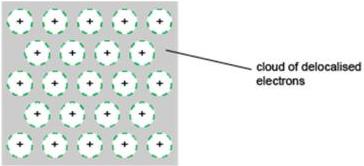
The bonding itself is the result of the strong electrostatic attraction between the positive metal ions and the negative delocalised electron cloud. This attraction acts in all directions throughout the giant structure.
Physical Properties of Metals
The specific arrangement of ions and electrons in a metal gives rise to several characteristic physical properties:
1. High Melting and Boiling Points
Most metals possess high melting and boiling points. This is because the metallic bonding is very strong. To melt a metal, a significant amount of energy is required to overcome the powerful electrostatic attractions between the positive ions and the delocalised electrons.
The strength of the metallic bond can vary. For example, in Group 1 elements (the alkali metals), the melting points decrease as you go down the group. This occurs because the metal ions increase in size as the group is descended. As the distance between the positive nucleus of the ion and the delocalised electrons increases, the electrostatic attraction becomes weaker, making it easier to break the lattice.
2. Electrical Conductivity
Metals are excellent conductors of electricity in both solid and liquid states. This is because the outer shell electrons are delocalised and free to move. When a potential difference is applied, these electrons can carry a charge through the giant structure. Unlike ionic compounds, which only conduct when molten or in solution, metals conduct as solids because their charge carriers (electrons) are always mobile.
3. Malleability
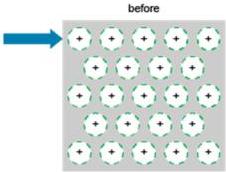
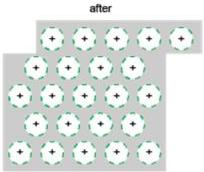
Metals are malleable, meaning they can be hammered or rolled into different shapes without shattering. They are also ductile, meaning they can be drawn into wires. This is possible because the metal ions are arranged in layers that can slide over one another. Because the delocalised electrons are free to move, the metallic bond is maintained even when the ions shift positions.
Summary of Metallic Properties
| Property | Observation | Reason |
|---|---|---|
| Melting Point | High | Strong attraction between positive ions and delocalised electrons. |
| Conductivity | Conductor (Solid and Liquid) | Delocalised electrons are free to move and carry charge. |
| Malleability | Malleable and Ductile | Layers of ions can slide while maintaining the metallic bond. |
Worked Examples
Exercise 69: Identifying Metallic Structures
Which of the following substances have a metallic structure based on their properties?
| Substance | Melting Point / C | Boiling Point / C | Conductivity as Solid | Conductivity as Liquid |
|---|---|---|---|---|
| A | 747 | 1396 | Insulator | Conductor |
| B | 650 | 1091 | Conductor | Conductor |
| C | -39 | 357 | Conductor | Conductor |
| D | 1414 | 3265 | Insulator | Insulator |
| E | 2572 | 2850 | Insulator | Conductor |
| F | 3422 | 5555 | Conductor | Conductor |
Solution: To identify a metal, we look for substances that conduct electricity as a solid. This immediately excludes A, D, and E. Substances B, C, and F are conductors in both states, which is the defining characteristic of metallic bonding. Substance C is mercury, which is a liquid at room temperature but still maintains metallic bonding.
Exercise 70: Explaining Melting Points
Iron is a metal with a high melting point. Which of the following is the best explanation of this? A. The forces between atoms are strong. B. The forces between the metal ions are strong. C. The covalent bonds between the atoms are strong. D. The forces between the metal ions and delocalised electrons are strong.
Solution: The correct answer is D. Metallic bonding is specifically defined as the attraction between the positive metal ions and the delocalised electrons. Options A and B are imprecise, and option C is incorrect as metals do not contain covalent bonds.
Key takeaways
- Metallic bonding consists of a giant lattice of positive ions in a sea of delocalised electrons.
- The strong electrostatic attraction between ions and delocalised electrons results in high melting points.
- Metals conduct electricity in both solid and liquid states because the delocalised electrons are free to move.
- Malleability occurs because the layers of ions can slide over each other without breaking the non-directional metallic bonds.
In data-based questions, the quickest way to identify a metallic substance is to check for electrical conductivity in the solid state. If a substance conducts as a solid, it is almost certainly a metal (or graphite).
Do not say that 'metals contain atoms' when describing the lattice. In the metallic bonding model, the atoms have lost their outer electrons to become positive ions. Always refer to them as 'positive ions' or 'cations'.
The decrease in melting point down Group 1 is a classic example of how increasing ionic radius weakens metallic bonding. Since each Group 1 metal only provides one electron per ion to the delocalised sea, the charge density decreases as the ions get larger, leading to weaker attractions.
Frequently asked questions
Why do metals conduct electricity as solids while ionic compounds do not?
Metals have delocalised electrons that are always free to move throughout the structure and carry charge. In solid ionic compounds, the ions are fixed in a lattice and cannot move; they only become mobile when the compound is melted or dissolved.
Does the number of delocalised electrons affect the strength of the bond?
Yes. Generally, the more electrons an atom contributes to the delocalised sea (e.g., vs ), and the smaller the ion, the stronger the electrostatic attraction and the higher the melting point.
Why are metals described as having a giant structure?
They are called giant structures because the metallic bonding extends throughout the entire piece of metal, involving a vast and indefinite number of ions and electrons, rather than existing as discrete molecules.