Reversible Reactions and Dynamic Equilibrium for the ESAT
Updated July 2026
This lesson explains why many chemical reactions do not go to completion but instead reach a state of dynamic equilibrium. It covers how to predict shifts in equilibrium position when changes are made to concentration, temperature, or pressure. Understanding these concepts is essential for mastering industrial chemical synthesis questions in the ESAT.
A reversible reaction in a closed system reaches dynamic equilibrium when the forward and reverse reactions occur at the same rate, resulting in no net change in the concentration of reactants and products. The position of equilibrium shifts to oppose any external change in concentration, temperature, or pressure.
Reversible Reactions and the Nature of Equilibrium
Many chemical reactions are reversible, meaning the products formed can react together to re-form the original reactants. This is indicated in a chemical equation by a double arrow symbol: . A classic example is the production of ammonia from nitrogen and hydrogen gases:
In a closed system, where no matter can enter or leave, these reactions eventually reach a state of dynamic equilibrium. At this point, the forward and reverse reactions are happening simultaneously and at the exactly same rate. While the reaction appears to have stopped on a macroscopic level, molecules are still reacting constantly.
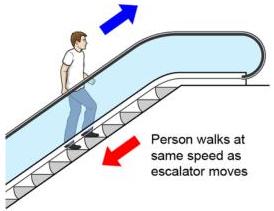
An everyday analogy for dynamic equilibrium is a person walking up a descending escalator. If the person walks up at the same speed the escalator moves down, their position relative to the floor remains constant. They are in motion, but there is no net change in their location.
The Position of Equilibrium
The position of equilibrium describes the relative amounts of reactants and products present when equilibrium is reached. If the equilibrium lies to the left, the mixture contains more reactants than products. If it lies to the right, products predominate. When conditions are changed, the system moves to oppose that change, shifting the equilibrium position.
Factors Affecting Equilibrium
1. Changing Concentration
If the concentration of a substance in the equilibrium mixture is changed, the system will shift to either remove the added substance or replace what was lost:
- Add more reactant: The equilibrium moves to the right to use up the extra reactant and form more product.
- Remove reactant: The equilibrium moves to the left to replace the lost reactant.
- Add more product: The equilibrium moves to the left to remove the extra product.
- Remove product: The equilibrium moves to the right to replace the lost product.
Example: Chromate and Dichromate Ions Yellow chromate ions react with hydrogen ions to form orange dichromate ions :
If acid (adding ) is introduced, the equilibrium moves to the right to remove the added , making the solution more orange. If an alkali is added, it reacts with and removes ions. The equilibrium then shifts to the left to replace them, turning the solution yellow.
2. Changing Temperature
The effect of temperature depends on whether the forward reaction is exothermic (releases heat, negative ) or endothermic (absorbs heat, positive ). The system will always act to restore the original temperature:
- Increase temperature: The equilibrium shifts in the endothermic direction to absorb the extra heat.
- Decrease temperature: The equilibrium shifts in the exothermic direction to release more heat.
Worked Example: Sulfur Trioxide Synthesis In the reaction , the forward reaction is exothermic. If the temperature is increased, the system shifts in the endothermic (reverse) direction to the left. This results in a decrease in the amount of produced.
3. Changing Overall Pressure
Pressure changes only affect equilibria involving gases. Pressure is determined by the number of gas molecules in a given volume. Increasing the number of gas molecules increases the pressure.
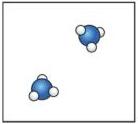
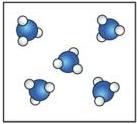
- Increase pressure: The equilibrium moves to the side with the fewer total number of gas molecules to lower the pressure.
- Decrease pressure: The equilibrium moves to the side with the more total number of gas molecules to increase the pressure.
Worked Example: Methane and Steam Consider the reaction . On the left, there are 2 gas molecules. On the right, there are 4 gas molecules. If the pressure is increased, the equilibrium shifts to the left (the side with fewer molecules), which decreases the yield of hydrogen gas.
Key takeaways
- Dynamic equilibrium occurs only in closed systems when the forward and reverse reaction rates are equal.
- Increasing temperature always shifts the equilibrium in the endothermic direction.
- Increasing pressure shifts the equilibrium towards the side of the equation with fewer gas molecules.
- Changing the concentration of a reactant or product causes the system to shift to counteract that change.
When answering pressure questions, always count the stoichiometric coefficients of gaseous reactants and products first. Ignore any substances in the solid (s) or liquid (l) states, as they do not contribute to gas pressure.
Be careful with temperature shifts. Students often forget that if the forward reaction is exothermic, the reverse must be endothermic. Always identify the sign of for the forward reaction before predicting the shift.
In industrial chemistry, such as the Haber process for ammonia, conditions are often a compromise. For an exothermic reaction, a low temperature would give a high equilibrium yield but a very slow reaction rate. Therefore, a compromise temperature is used to ensure the product is made quickly enough to be profitable.
Frequently asked questions
What happens to the equilibrium if the number of gas molecules is the same on both sides?
If the total number of gas molecules is identical on both sides of the balanced equation, changing the overall pressure will have no effect on the position of equilibrium.
Does a catalyst change the position of equilibrium?
No. A catalyst increases the rate of both the forward and reverse reactions equally. It helps the system reach equilibrium faster, but it does not change the final concentrations of reactants or products.
What is the difference between a static and dynamic equilibrium?
In a static equilibrium, nothing is moving or reacting. In a dynamic equilibrium, the reactions are still occurring at a high rate, but because the forward and backward rates are balanced, there is no net change in the amounts of substances.