Constructing and Balancing Chemical Equations for the ESAT
Updated July 2026
Mastering chemical equations is essential for the ESAT Chemistry paper. This guide explains how to construct and balance full chemical equations, simplify reactions into ionic equations by removing spectator ions, and write half-equations for redox and electrolysis. These skills ensure you can accurately represent the conservation of mass and charge.
A chemical equation is balanced when the total number of atoms of each element and the total electrical charge are identical on both the reactant and product sides, satisfying the law of conservation of mass.
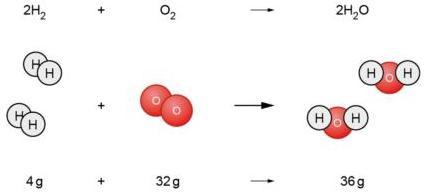
Chemical reactions involve the rearrangement of atoms and their electrons to form new substances. Crucially, no nuclei are destroyed or created during this process. This means that the total mass of the reactants must always equal the total mass of the products. For instance, if 4 g of hydrogen reacts with 32 g of oxygen, the atoms rearrange to produce exactly 36 g of water.
How to Construct Balanced Equations
Balanced equations use coefficients to show how many particles of each substance are involved. For example, the following equation demonstrates that two molecules of react with one molecule of to form two molecules of .
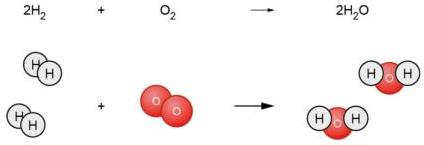
In a balanced equation, the count of atoms for each element must be identical on both sides. In the water example above, there are 4 H atoms and 2 O atoms on both the reactant and product sides.
To balance an equation correctly, follow these three steps:
- Write the formula of each substance. For the combustion of methane, we write: .
- Count the atoms of each element on each side. In the initial equation, the reactants have C = 1, H = 4, O = 2. The products have C = 1, H = 2, O = 3. The hydrogen and oxygen are not balanced.
- Add coefficients to balance the atoms. You must never change the chemical formula itself, such as changing to , as this creates a different substance. Instead, add more of the existing substances.
- To balance H, we add another on the right: .
- Now count again: Reactants (C=1, H=4, O=2); Products (C=1, H=4, O=4).
- To balance O, we add another on the left: . The equation is now balanced.
State Symbols
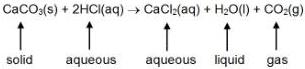
State symbols provide essential information about the physical state of the reactants and products. These are typically written in parentheses after the formula:
- (s) for solid
- (l) for liquid
- (g) for gas
- (aq) for aqueous solution (dissolved in water)
Writing Ionic Equations
When ionic compounds dissolve in water, their ions separate and act independently. In many reactions, some ions do not participate in the chemical change. These are called spectator ions. An ionic equation omits spectator ions to focus only on the species that react.
Neutralisation Reactions
In the reaction between hydrochloric acid and sodium hydroxide:
- Full equation:
- Showing ions:
- Removing spectator ions ( and ):
Common ionic equations include:
- Acid + Carbonate:
- Acid + Ammonia:
Precipitation Reactions
When two solutions react to form an insoluble solid (a precipitate), we only show the ions that form that solid. For example, forming a blue precipitate of copper(II) hydroxide:
Constructing Half-Equations
Half-equations are used in redox reactions, displacement, and electrolysis to show the gain or loss of electrons separately.
Electrolysis
In the electrolysis of molten aluminium oxide, ions gain electrons at the cathode, and ions lose electrons at the anode:
- Reduction:
- Oxidation: Note that for oxygen, two ions are required to form one molecule, resulting in the loss of 4 electrons in total.
Displacement
When copper displaces silver from silver nitrate, copper atoms lose electrons and silver ions gain them:
- Silver half-equation:
- Copper half-equation:
Key takeaways
- The Law of Conservation of Mass dictates that atoms are neither created nor destroyed, only rearranged.
- Balancing must be achieved by changing the coefficients (the numbers in front of formulae), never the subscripts (the small numbers within formulae).
- Ionic equations simplify reactions by excluding spectator ions that remain in the aqueous state throughout the process.
- Half-equations describe the movement of electrons, where oxidation is the loss of electrons and reduction is the gain of electrons.
When balancing a complex equation, balance the atoms that appear in the fewest substances first. Leave elements like oxygen and hydrogen until the end, as they often appear in multiple reactants and products.
A common error in half-equations is the direction of electrons. Remember OIL RIG: Oxidation Is Loss, Reduction Is Gain. In an oxidation half-equation, electrons should be on the product (right) side. In a reduction half-equation, they should be on the reactant (left) side.
Ionic equations reveal that different acid-alkali reactions are often chemically identical at the molecular level, always reducing to the formation of water from hydrogen and hydroxide ions, regardless of the specific acid or base used.
Frequently asked questions
What happens if I change the subscripts while balancing?
Changing the subscripts changes the chemical identity of the substance. For example, is the oxygen we breathe, but is ozone, a different molecule with different properties. You must only change the coefficients.
How do I identify spectator ions in a reaction?
Spectator ions are ions that appear in the same state (usually aqueous) on both the reactant and product sides of a full chemical equation without changing their charge or bonding.
Must I always include state symbols in my equations?
In the ESAT, state symbols are often required, especially in ionic equations, to distinguish between substances that are dissolved (aq) and those that have formed a solid precipitate (s).
How do I balance the charge in a half-equation?
The total charge on the left side must equal the total charge on the right side. You use electrons (), which have a charge, to balance any positive charges. For example, in , the and on the left sum to , matching the neutral on the right.