State Symbols in Chemical Reactions for the ESAT
Updated July 2026
State symbols are essential notations in chemistry that describe the physical form of reactants and products. For the ESAT, you must be able to identify and use symbols for solids, liquids, gases, and aqueous solutions. Correct application of these symbols is vital for describing reactions accurately, such as distinguishing between pure liquids and substances dissolved in water.
State symbols indicate the physical state of a substance in a chemical equation. These are for solid, for liquid, for gas, and for aqueous solution, which refers to a substance dissolved in water.
The Purpose of State Symbols
In chemical equations, it is not enough to simply state which atoms are rearranging. To fully describe a reaction, chemists use state symbols to show the physical state of each substance involved. These symbols are written in parentheses immediately following the chemical formula of the element or compound.
The Four Physical States
There are four primary state symbols that you must know and be able to apply in the ESAT:
- Solid: This symbol is used for substances in a solid state at the temperature of the reaction. Examples include metals like magnesium ribbon or precipitates like silver chloride.
- Liquid: This is reserved for pure liquids. The most common example is liquid water, , but it also applies to molten substances, such as molten sodium chloride.
- Gas: This symbol denotes substances in the gaseous state, such as oxygen, , or carbon dioxide, .
- Aqueous Solution: This symbol comes from the Latin word 'aqua' meaning water. It is used when a substance is dissolved in water. Most acids, such as hydrochloric acid, are handled as aqueous solutions, .
Applying Symbols in Equations
Consider the reaction between sodium metal and chlorine gas to form sodium chloride. The sodium is a solid, the chlorine is a gas, and the resulting salt is a solid. The balanced equation with state symbols is shown below:
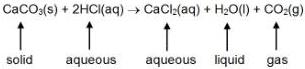
As seen in the diagram, the notation provides a complete picture of the physical transformation taking place during the chemical change.
Worked Example: Metal and Acid Reaction
A common task in the ESAT is to construct a full balanced equation from a text description. Let us look at the reaction between magnesium and sulfuric acid.
Example: When magnesium metal reacts with sulfuric acid, hydrogen is given off and a solution of magnesium sulfate is formed. Write a balanced equation for this reaction including state symbols.
- Identify the formulae and states: Magnesium metal is a solid element, so its formula is . Sulfuric acid is a common reagent used in water, so it is .
- Identify the products: The text states hydrogen gas is released, which is a diatomic molecule, . It also mentions a solution of magnesium sulfate is formed. Since it is a solution, we use .
- Construct the equation: Combine these into a balanced format.
In this reaction, the magnesium atoms displace the hydrogen from the acid. The state symbols allow us to see that a solid reactant is 'dissolving' into the solution while a gas is being produced as effervescence.
Key takeaways
- The symbol specifically means 'dissolved in water' and is distinct from the symbol for pure liquids.
- State symbols are written in lowercase letters inside parentheses after the chemical formula.
- Common substances like acids and alkalis are almost always written as in standard laboratory reactions.
- When a solid forms from the reaction of two aqueous solutions, it is called a precipitate and is marked with .
Always check for keywords in the question like 'solution', 'molten', 'precipitate', or 'gas evolved'. These are direct clues for , , , and respectively.
A very common error is writing acids like as . Hydrochloric acid is a gas dissolved in water, so it must be . Only use for pure liquid water or substances that have been melted.
State symbols are not just descriptive; they are functionally important for thermodynamics. The energy change of a reaction depends on the states of the reactants and products, as energy is required or released during phase changes like boiling or melting.
Frequently asked questions
What is the difference between and ?
The symbol refers to a substance that is a pure liquid, such as or molten . The symbol refers to a solute that is dissolved in water to form a solution, such as .
Do I need to include state symbols if the question does not explicitly ask for them?
In the ESAT, you should include state symbols whenever you are asked to provide a 'complete' or 'balanced' equation, as they are a standard part of chemical notation and demonstrate a full understanding of the reaction.
How do I know if a product is or in a precipitation reaction?
If the reaction occurs in water and the product is insoluble, it will form a solid precipitate marked as . If the product is soluble, it remains in the solution as ions and is marked as .