The Halogens Group 17 for the ESAT
Updated July 2026
Group 17 elements, known as the halogens, exhibit distinct trends in reactivity and physical properties. For the ESAT, you must understand why reactivity decreases down the group from fluorine to iodine. This allows you to predict the outcomes of displacement reactions where more reactive halogens displace less reactive halide ions from their salts.
The halogens are non-metals that react by gaining one electron to achieve a noble gas electron configuration. Reactivity decreases down the group because the increasing atomic radius and shielding make it harder for the nucleus to attract an incoming electron.
The Relative Positions and Configurations of the Halogens
The halogens are found in Group 17 of the Periodic Table. The group includes the elements fluorine (), chlorine (), bromine (), and iodine (). In line with IUPAC conventions, these are vertical columns, as shown in the complete Periodic Table below:
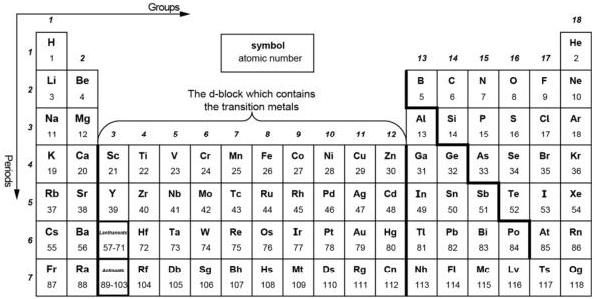
Every halogen atom has seven electrons in its outermost shell. For example, the electron configuration of a fluorine atom (atomic number 9) is 2,7, while a chlorine atom (atomic number 17) is 2,8,7. Because they have similar outer shell arrangements, they share similar chemical properties. They exist naturally as diatomic molecules, such as , , , and .
Trends in Physical Properties
As you descend Group 17, there is a clear trend in the physical state and melting/boiling points of the elements at room temperature and pressure (rtp):
- Fluorine (): A pale yellow gas.
- Chlorine (): A green-yellow gas.
- Bromine (): A red-brown liquid.
- Iodine (): A grey-black solid that produce purple vapours when heated.
The melting and boiling points increase down the group. This is because the molecules become larger and have more electrons, leading to stronger intermolecular forces that require more energy to overcome.
Trends in Chemical Reactivity
In contrast to the alkali metals (Group 1), where reactivity increases down the group, the reactivity of the halogens decreases as you go down Group 17.
Halogens react by gaining one electron to form a negative ion with a charge (a halide ion), reaching a stable noble gas configuration (e.g., becomes ). The ease with which an atom attracts this electron determines its reactivity. As you move down the group:
- The atomic radius increases (there are more electron shells).
- The outer shell is further from the positive attraction of the nucleus.
- There is increased shielding by inner electron shells.
Consequently, it becomes harder for the nucleus to attract and capture an incoming electron, making the element less reactive. Fluorine is the most reactive halogen, while iodine is significantly less reactive.
Displacement Reactions of Halogens
A displacement reaction occurs when a more reactive element takes the place of a less reactive element in a compound. In Group 17, this is a competition for electrons between a halogen atom and a halide ion.
A more reactive halogen will displace a less reactive halogen from an aqueous solution of its halide ions. For example, if chlorine gas is bubbled through a solution of potassium bromide, the chlorine will displace the bromine because chlorine is higher in the group and more reactive.
Worked Example: Chlorine and Potassium Bromide
- Full Equation:
- Ionic Equation:
In this reaction, the solution changes from colourless to orange-brown as bromine is produced. This is a redox reaction. The chlorine molecules are reduced as they gain electrons to become chloride ions (). The bromide ions are oxidised as they lose electrons to become bromine molecules (). Therefore, chlorine acts as the oxidising agent.
Predicting Outcomes
You can use the relative positions in the group to predict if a reaction will occur:
- Chlorine + Sodium Iodide: Reaction occurs. Chlorine is above iodine, so it displaces the iodide ions. The solution turns brown ( produced).
- Bromine + Sodium Chloride: No reaction occurs. Bromine is below chlorine and is less reactive, so it cannot displace chloride ions.
- Iodine + Sodium Bromide: No reaction occurs. Iodine is the least reactive of the common halogens.
Key takeaways
- The halogens have 7 outer shell electrons and exist as diatomic molecules.
- Melting and boiling points increase down Group 17 as the molecular size increases.
- Chemical reactivity decreases down the group due to increased shielding and atomic radius.
- A more reactive halogen (higher in the group) will displace a less reactive halogen (lower in the group) from its halide solution.
- Displacement reactions are redox processes where the more reactive halogen acts as the oxidising agent.
When answering displacement questions, always write out the ionic equation. It helps you see exactly which species is being oxidised and which is being reduced, and ensures you do not include spectator ions like or .
Be careful with terminology: 'halogen' refers to the elemental molecule (like ), while 'halide' refers to the ion in a compound (like ). In a displacement, the halogen becomes a halide, and the halide becomes a halogen.
The trend in halogen reactivity is the exact opposite of the Group 1 alkali metals. While metals react by losing electrons (easier when the outer shell is far away), non-metals react by gaining electrons (easier when the outer shell is close to the nucleus).
Frequently asked questions
Why are the halogens considered oxidising agents in displacement reactions?
An oxidising agent is a substance that gains electrons (is reduced) while causing another substance to lose them. In a displacement reaction, the more reactive halogen atom attracts electrons from the halide ions of a less reactive halogen to form a stable ion.
What would you observe if chlorine water was added to a solution of potassium iodide?
Since chlorine is more reactive than iodine, a displacement reaction occurs. The colourless solution of potassium iodide will turn brown due to the formation of iodine ().
Does bromine displace fluorine from a fluoride solution?
No. Fluorine is the most reactive element in Group 17. Since bromine is lower in the group than fluorine, it is less reactive and cannot displace fluorine.