Quantitative Chemistry: Concentration and Solubility
Updated July 2026
This section covers the essential calculations for solution chemistry in the ESAT. It explains how to determine concentration in both mass and molar units, define and identify saturated solutions, and use solubility curves to predict the amount of precipitate formed when conditions change.
Concentration is the amount of solute (in grams or moles) per cubic decimetre of solution. A saturated solution is one in which the maximum possible mass of solute has dissolved in a given volume of solvent at a specific temperature.
Concentration of Solutions
The concentration of a solution is a measure of how many solute particles are present in a specific volume of solution. In quantitative chemistry, concentration is most commonly expressed in one of two ways: the amount in moles of a solute present in 1 of solution () or the mass of solute in 1 of solution ().
It is important to note that these measurements are based on the volume of the final solution, not the volume of the solvent. This is because the total volume often changes slightly when a solute dissolves. When performing calculations, volumes are frequently provided in . Since there are 1000 in 1 , you must divide the volume in by 1000 to convert it to .
Calculating Concentration from Mass
To calculate the concentration in , use the following relationship:
Worked Example: Exercise 37
What is the concentration, in , of a solution containing 8.0 g of sodium hydroxide dissolved in 5.0 of solution?
Worked Example: Exercise 38
Normal saline has a concentration of 9.0 of . Calculate the mass of sodium chloride required to make 250 of this solution.
-
Convert volume to : .
-
Calculate mass: .
Calculating Molar Concentration
To find the concentration in (often called molarity), you first determine the number of moles of solute and then divide by the volume.
Worked Example: Exercise 40
What is the concentration, in , of a solution formed when 5.6 g of potassium hydroxide () is dissolved in 500 ?
-
Find the molar mass () of : .
-
Calculate the number of moles: .
-
Convert volume: .
-
Calculate concentration: .
Rearranging the Concentration Formula
If you know the concentration and the volume, you can find the amount of solute:
Worked Example: Exercise 42
Calculate the volume of a 0.05 solution that contains 0.1 mol of solute.
.
Saturated Solutions and Solubility
A saturated solution is defined as a solution in which no more solute can be dissolved at a given temperature. Solubility is the measure of the maximum mass of a substance that will dissolve in a specific amount of solvent, usually expressed as grams of solute per 100 grams of solvent ().
Interpreting Solubility Data
Solubility varies with temperature. For most solids, solubility increases as temperature increases. However, for gases, solubility typically decreases as temperature rises.
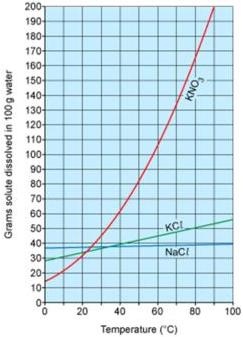
Any point on the curves shown in the diagram above represents a saturated solution at that specific temperature. For example, if you cool a hot saturated solution, the solubility decreases and the excess solute will precipitate out of the solution as a solid.
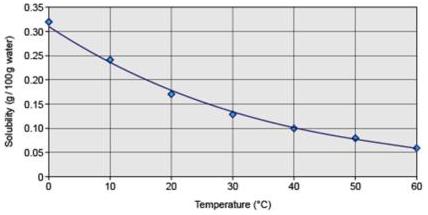
Calculating Solubility and Precipitation
Worked Example: Exercise 47
What is the maximum mass of copper(II) chloride () that will dissolve in 250 of water at ? (Solubility is 73 g per 100 g , and the density of water is 1.0 ).
-
Mass of water: .
-
Calculate mass of solute: .
Worked Example: Exercise 48
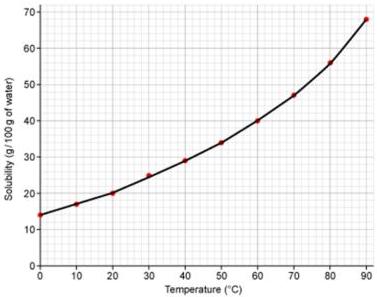
Using the solubility curve below, what mass of copper(II) sulfate will precipitate if a saturated solution made with 50 g of water at is cooled to ?
-
At , solubility is 50 g per 100 g water. For 50 g water, the mass dissolved is .
-
At , solubility is 22 g per 100 g water. For 50 g water, the mass that can remain dissolved is .
-
Mass precipitated: .
Key takeaways
- Concentration can be calculated as or .
- Always convert volumes from to by dividing by 1000 before using them in concentration formulas.
- A solution is saturated when no additional solute can dissolve at that specific temperature.
- Solubility is typically measured in grams of solute per 100 grams of solvent.
- The mass of precipitate formed upon cooling a solution can be found by calculating the difference in solubility between the two temperatures.
When reading solubility curves, pay close attention to the y-axis units. Most curves are for 100 g of water. If the question asks about a different mass of water (like 50 g or 250 g), you must scale the solubility value proportionally.
The most frequent error in concentration calculations is forgetting to convert to . Always check your units before starting the calculation.
Solubility data is inherently temperature-dependent. In industrial processes like the Crystallisation of salts, cooling rates are carefully controlled to manage the size and purity of the resulting crystals based on these solubility gradients.
Frequently asked questions
What is the difference between dm³ and litres?
In chemistry, is exactly equal to 1 litre. They are interchangeable units, though the ESAT specification prefers the use of .
Does the volume of a solution always equal the volume of the solvent?
No. When a solute dissolves in a solvent, the particles of the solute occupy space between solvent molecules, which can cause the total volume to increase or decrease. This is why concentration is defined per volume of the final solution.
Why does solubility decrease for gases as temperature increases?
Increasing temperature provides gas molecules with more kinetic energy, allowing them to overcome the attractive forces of the solvent and escape the liquid phase into the gas phase.
How do I calculate the concentration of a diluted solution?
Since the number of moles of solute remains constant during dilution, you can use the formula , where is concentration and is volume.