Quantitative Chemistry and Titrations for the ESAT
Updated July 2026
Quantitative chemistry enables the calculation of substance amounts using masses, volumes, and concentrations. This topic covers the fundamental mole concept, reacting ratios, and stoichiometry necessary for performing accurate titration calculations. Understanding these relationships is vital for predicting reaction outcomes and determining unknown concentrations in chemical analysis.
The mole provides a bridge between the microscopic number of atoms and the macroscopic mass of a substance, where one mole contains particles. This relationship allows chemists to use balanced equations to calculate reacting masses, gas volumes, and solution concentrations.
Relative Molar Mass and the Mole
Chemical reactions involve vast numbers of particles that are measured by weighing. The fundamental unit for the amount of substance is the mole (mol). One mole of any substance contains the Avogadro constant, , which is approximately particles per mole. The mass of one mole of a substance is its relative atomic mass () or relative molar mass () expressed in grams.
The relative molar mass () is determined by summing the relative atomic masses of all atoms within a formula unit. For example, for barium nitrate, , the calculation is . In hydrated compounds like , the mass of the water of crystallisation must be included: .
Converting Mass to Moles
The relationship between mass, molar mass, and the number of moles is defined by the formula:
When working with larger scales, such as kilograms or tonnes, units must be converted to grams. There are grams in a kilogram and grams in a tonne. For instance, to find the moles in tonnes of aluminium: mol.
Percentage Composition and Formulae
The percentage composition by mass of an element in a compound is calculated using the formula:
An empirical formula represents the simplest whole number ratio of atoms in a compound. It can be found from percentage masses by dividing each percentage by the element to find the molar ratio, then simplifying to the smallest integers. A molecular formula shows the actual number of atoms and is a multiple of the empirical formula, found by comparing the empirical formula mass to the actual of the compound.
Reacting Masses and Limiting Reactants
Balanced equations provide the molar ratio of reactants and products. This allows for the calculation of the maximum mass of a product formed from a given mass of reactant. A limiting reactant is the substance that is completely consumed first, thereby determining the maximum theoretical yield of the product. To identify it, calculate the moles of all reactants and compare them to the stoichiometric ratios in the balanced equation.
Molar Gas Volume
For an ideal gas, the volume occupied depends on temperature and pressure rather than the identity of the gas. At room temperature and pressure (rtp), one mole of any gas occupies dm. The number of moles is calculated as:
Solutions and Titrations
Concentration measures the amount of solute in a specific volume of solution, typically expressed in mol dm or g dm. Note that dm is equal to cm.
Titration calculations use the known concentration and volume of one solution to find the unknown concentration of another. The process involves:
- Calculating the moles of the reactant with a known concentration.
- Using the balanced equation to find the molar ratio and thus the moles of the unknown reactant.
- Calculating the concentration of the unknown solution using its measured volume.
Example: cm of is neutralised by cm of mol dm .
- Moles mol.
- Ratio is , so moles mol.
- Concentration mol dm.
Solubility and Yield
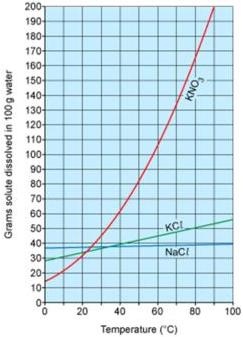
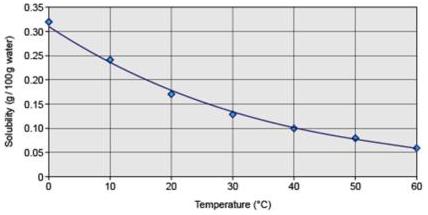
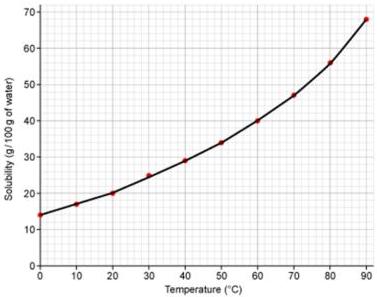
A saturated solution is one where no more solute can dissolve at a specific temperature. Solubility is usually measured in grams of solute per g of solvent. Solubility often changes with temperature, as seen in the following charts:
The percentage yield compares the mass of product actually obtained to the theoretical maximum:
Key takeaways
- One mole corresponds to particles and is equivalent to the relative molar mass in grams.
- Reacting ratios from balanced chemical equations are essential for converting between the amounts of different substances in a reaction.
- The molar gas volume at room temperature and pressure is dm per mole.
- Concentration must be calculated using volumes in dm, where dm cm.
- Percentage yield accounts for losses during reactions, such as incomplete reactions or separation processes.
Always ensure your chemical equation is balanced before starting any quantitative calculation. A common error is using the wrong molar ratio, which will lead to an incorrect final answer.
Remember to convert all volumes to dm when using concentration formulas (). Using cm instead of dm is the most frequent calculation error in titration problems.
The concept of molar gas volume is a specific application of the Ideal Gas Law. It assumes that the identity of the gas does not matter because the space between particles is significantly larger than the particles themselves at standard conditions.
Frequently asked questions
What is the difference between a dm3 and a cm3?
A decimetre cubed (dm) is a unit of volume equivalent to centimetres cubed (cm). In concentration calculations, you must divide the volume in cm by to convert it to dm.
How do you identify the limiting reactant?
Calculate the number of moles for each reactant. Divide the moles of each by their respective coefficient in the balanced equation. The reactant with the smallest resulting value is the limiting reactant.
Why is the actual yield usually lower than the predicted yield?
Yields are often less than because reactions may be reversible and reach equilibrium, products can be lost during filtration or transfer, or side reactions may occur.