The Periodic Table and IUPAC Conventions for the ESAT
Updated July 2026
An essential guide to the structure of the Periodic Table, covering the IUPAC 1 to 18 group numbering system. This page explains the arrangement of elements by atomic number, the distinction between metals and non-metals, and the predictable reactivity trends within groups like the alkali metals and halogens.
The Periodic Table organises elements by increasing atomic number into horizontal Periods and vertical Groups. Elements in the same Group share similar outer electron configurations and chemical properties, with reactivity trends differing between metal and non-metal groups.
Structure of the Periodic Table
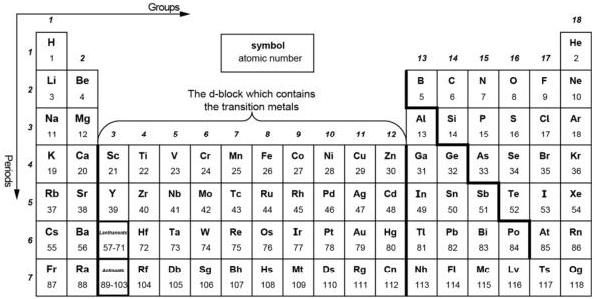
The Periodic Table is a systematic arrangement of all known chemical elements. These elements are sequenced in order of increasing atomic number. This sequence is not a simple list but is broken at specific intervals to create a grid of columns and rows.
- Periods are the horizontal rows. The number of a Period identifies the outermost occupied electron shell for the atoms of the elements within that row. For example, elements in Period 2 have their outer electrons in the second shell.
- Groups are the vertical columns, labelled 1 to 18 according to IUPAC conventions. Elements within the same Group share a similar arrangement of electrons in their outermost shell, which results in similar chemical behaviour.
Classifying Elements by Group
The position of an element in the table allows us to classify it into specific families with shared characteristics:
- Alkali Metals (Group 1): These elements have one electron in their outermost shell. They are highly reactive metals.
- Alkaline Earth Metals (Group 2): These elements have two electrons in their outermost shell.
- Transition Metals: These are found in the central block of the table, between Groups 2 and 13.
- Group 16 Non-metals: These elements have six electrons in their outermost shell.
- Halogens (Group 17): These are highly reactive non-metals with seven electrons in their outermost shell.
- Noble Gases (Group 18): These elements have a complete outermost shell of electrons, making them exceptionally stable and unreactive.
Reactivity Trends within Groups
Because elements in the same Group have the same number of outer-shell electrons, they react in similar ways. However, the intensity of these reactions changes as you move up or down a Group:
- Metal Groups (e.g. Groups 1 and 2): Reactivity increases as you descend the Group.
- Non-metal Groups (e.g. Groups 16 and 17): Reactivity decreases as you descend the Group.
Case Study: Group 1 Reactions with Water
The increase in reactivity down Group 1 is clearly demonstrated by how these metals react with cold water:
- Lithium: Reacts slowly. It floats and gradually dissolves to form an alkaline solution of lithium hydroxide. Hydrogen gas is released and burns with a crimson red flame.
- Sodium: Reacts more vigorously. It melts into a ball, moves rapidly on the surface, and dissolves quickly. Hydrogen gas is released and burns with a yellow-orange flame.
- Potassium: Reacts very vigorously. It moves rapidly and dissolves almost instantly. The hydrogen gas produced self-ignites, burning with a lilac flame.
Electron Configuration and Position
There is a direct relationship between an atom's electron configuration and its place in the table. We can determine an element's position if we know its electron count or ion state.
Worked Example 1: Finding an Element from an Ion An ion has 18 electrons. Work out the position of element in the Periodic Table.
- If the ion has 18 electrons, it must have gained one electron. Therefore, the neutral atom has 17 electrons.
- The electron configuration for 17 electrons is 2,8,7.
- Because there are three shells, the element is in Period 3.
- Because there are seven electrons in the outer shell, it is in Group 17.
Worked Example 2: Finding an Element from Reactivity An atom of element has two electrons in its outermost shell and is the least reactive element in its Group. Work out its position.
- Two electrons in the outer shell places the element in Group 2.
- Group 2 is a metal group. Reactivity increases down a metal group, so the least reactive element must be at the top.
- The top element of Group 2 is in Period 2. Therefore, is in Period 2, Group 2.
Key takeaways
- Periods correspond to the number of electron shells, while Groups correspond to the number of outer-shell electrons.
- Reactivity increases down Groups 1 and 2 (metals) but decreases down Groups 16 and 17 (non-metals).
- Group 18 elements (Noble Gases) are unreactive because they possess a complete outer shell of electrons.
- The IUPAC system numbers Groups 1 to 18, replacing older notation systems.
Always use the IUPAC group numbers 1 to 18 for the ESAT. If a question mentions a Group 17 element, immediately think 'Halogen' and 'seven outer electrons'.
Do not confuse the trends for metals and non-metals. Metals get more reactive downwards, but non-metals get more reactive upwards. Forgetting this inversion is a frequent source of error.
The transition from metal to non-metal character across a period is driven by the increasing nuclear charge, which holds electrons more tightly and eventually leads to atoms that prefer to gain rather than lose electrons.
Frequently asked questions
What determines the chemical properties of an element?
The chemical properties are primarily determined by the number of electrons in the outermost shell. Elements in the same group have the same number of outer electrons, leading to similar reactions.
Why does reactivity increase down Group 1?
As you move down Group 1, the outermost electron is further from the nucleus and more shielded by inner shells. This makes it easier for the atom to lose that electron, increasing reactivity.
Where are the non-metals located in the Periodic Table?
Non-metals are generally located on the right-hand side of the Periodic Table, primarily in Groups 14 to 18, with the exception of Hydrogen, which is often placed above Group 1.