Periodic Table Position and Electron Configuration
Updated July 2026
Understanding the Periodic Table is fundamental for the ESAT. Elements are arranged by atomic number, with their position in Groups and Periods directly relating to their electron configurations. This relationship determines their chemical properties, such as the high reactivity of Group 1 metals and the stability of Group 18 noble gases.
The position of an element in the Periodic Table is defined by its Period (horizontal row) and Group (vertical column, labelled 1 to 18). The Period number corresponds to the number of electron shells in use, while the Group number indicates the number of electrons in the outermost shell.
The Periodic Table is an organised arrangement of all known elements, sequenced by increasing atomic number. This structure is not random; it is broken into regular intervals to create a grid of horizontal rows called Periods and vertical columns called Groups. Elements in the same Group share similar chemical properties because of the arrangement of electrons in their outermost shell.
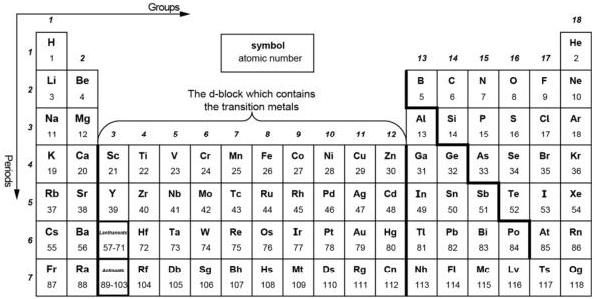
The Relationship between Periods and Shells
The horizontal rows, or Periods, indicate the highest occupied energy level or shell for the atoms of that element. For example, any element in Period 2 has its outermost electrons in the second shell. Any element in Period 3 has its outermost electrons in the third shell.
The Relationship between Groups and Electrons
The vertical columns, or Groups, are labelled 1 to 18 according to IUPAC conventions. For the first 20 elements, the Group number tells us about the number of electrons in the outermost shell:
- Group 1 (Alkali Metals): These atoms have 1 electron in their outermost shell. Examples include Lithium (2,1), Sodium (2,8,1), and Potassium (2,8,8,1).
- Group 2 (Alkaline Earth Metals): These atoms have 2 electrons in their outermost shell. Examples include Beryllium (2,2), Magnesium (2,8,2), and Calcium (2,8,8,2).
- Group 16: These atoms have 6 electrons in their outermost shell, such as Oxygen (2,6) and Sulfur (2,8,6).
- Group 17 (Halogens): These atoms have 7 electrons in their outermost shell, such as Fluorine (2,7) and Chlorine (2,8,7).
- Group 18 (Noble Gases): These atoms have a complete outermost shell, making them very stable. Examples are Helium (2), Neon (2,8), and Argon (2,8,8).
Between Groups 2 and 13, you will find the transition metals.
Trends in Chemical Reactivity
Because elements in the same Group have the same number of outer shell electrons, they behave similarly in chemical reactions. However, the reactivity changes as you move down a Group:
- In Metal Groups (e.g. Groups 1 and 2): Reactivity increases as you move down the Group. This is because the outer electron is further from the nucleus and more easily lost.
- In Non-metal Groups (e.g. Groups 16 and 17): Reactivity decreases as you move down the Group. This is because it becomes harder for the nucleus to attract an incoming electron into the outer shell.
Case Study: Group 1 Metals and Water
The trend of increasing reactivity down Group 1 is clearly seen when these metals react with cold water to form an alkaline solution and hydrogen gas:
- Lithium (Li): Reacts slowly, floats, and gives off hydrogen which burns with a crimson red flame if ignited.
- Sodium (Na): Reacts more vigorously, melts into a ball, moves on the surface, and gives off hydrogen which burns with a yellow-orange flame.
- Potassium (K): Reacts very vigorously, moves rapidly, and the hydrogen produced self-ignites, burning with a lilac flame.
Worked Example: Identifying Position from Electrons
Question: An ion has 18 electrons. Work out the position of element in the Periodic Table.
Step 1: Determine the number of electrons in the neutral atom. Since the ion has a charge and 18 electrons, the neutral atom must have electrons. Step 2: Write the electron configuration. Following the 2,8,8 rule, 17 electrons are arranged as 2,8,7. Step 3: Identify the Period. There are three occupied shells, so is in Period 3. Step 4: Identify the Group. There are 7 electrons in the outermost shell, so is in Group 17.
Worked Example: Identifying Position from Reactivity
Question: Atom has two electrons in its outermost shell and is the least reactive in its Group. Where is located?
Step 1: Use the outer electron count. Two outer electrons place in Group 2. Step 2: Use the reactivity trend. Group 2 consists of metals. Reactivity in metal groups increases as you move down. Therefore, the least reactive element must be at the top of the Group. Step 3: Identify the position. The top element in Group 2 is in Period 2. Thus, is in Period 2, Group 2.
Key takeaways
- The Period number indicates the number of electron shells occupied by an atom.
- The Group number (1, 2, and 13 to 18) identifies the number of electrons in the outer shell for the first 20 elements.
- Reactivity increases as you descend Groups 1 and 2 (metals).
- Reactivity decreases as you descend Groups 16 and 17 (non-metals).
- Group 18 elements are known as Noble Gases and possess a full outer electron shell.
When answering ESAT questions about ions, always convert the ion's electron count back to the neutral atom's count before determining its position in the Periodic Table.
Do not confuse the Group number with the Period number. Remember that Periods are horizontal rows (think of a 'full stop' or 'period' at the end of a line) and Groups are vertical columns.
The increase in metal reactivity down a group occurs because the atomic radius increases. With more shells, the outer electron is further from the positive nucleus and experience more 'shielding' from inner shells, making the electrostatic attraction weaker and the electron easier to lose.
Frequently asked questions
What does the atomic number tell us about an element's position?
The elements are arranged in the Periodic Table in order of increasing atomic number. Since the atomic number is the number of protons, and a neutral atom has the same number of electrons as protons, the atomic number determines the electron configuration, which in turn determines the element's Group and Period.
Why is Helium in Group 18 if it only has 2 electrons in its outer shell?
Group 18 elements are defined by having a complete outermost shell. For the first shell, the maximum capacity is 2 electrons. Since Helium has 2 electrons, its outer shell is full, giving it the stable chemical properties characteristic of the noble gases.
How do I know if an element is a metal or a non-metal based on its Group?
Generally, metals are found on the left and center of the table (Groups 1 to 12 and some in 13 to 15), while non-metals are found on the right (Groups 14 to 18). Groups 1 and 2 are always metals, and Groups 17 and 18 are always non-metals.