States of Matter Density and Pressure for the ESAT
Updated July 2026
This study guide covers the physical properties of matter for the ESAT Physics section. It explores the particle models of solids, liquids, and gases, ideal gas behaviour, and state changes. You will learn to calculate density, pressure, and latent heat while understanding the microscopic causes of macroscopic observations.
Macroscopic properties of matter, such as pressure, temperature, and density, are determined by the microscopic arrangement, motion, and interactions of its constituent particles.
Ideal Gases: Pressure and Temperature
According to the particle model, an ideal gas consists of identical particles in random motion. These particles do not exert forces on one another except during collisions. This model relies on several key assumptions: the particles occupy a negligible volume, they obey Newton's laws, and collisions are the only source of interaction. Under conditions similar to room temperature and atmospheric pressure, many real gases behave like ideal gases.
Temperature is a macroscopic measure of a substance's 'hotness'. At the microscopic level, the temperature of a gas is directly related to the average speed of its particles. When the temperature increases, the average speed of the particles also increases. It is important to note that temperature is a property of the gas as a whole; individual particles do not have a temperature, only a specific speed.
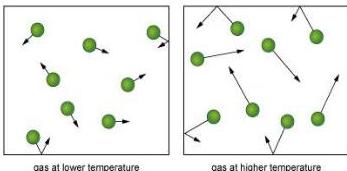
Pressure is the average force per unit area exerted by gas particles as they collide with the surfaces of their container. Like temperature, pressure is a macroscopic property. When a gas is heated in a sealed container, the pressure increases for two reasons:
- The particles move faster on average, meaning they collide with the walls more frequently.
- The collisions are more forceful because the particles possess higher average speeds.
The Relationship Between Pressure and Volume
For a fixed mass of gas at a constant temperature, the relationship between pressure () and volume () is inversely proportional. This is expressed as:
If the volume of a sealed container is decreased, the particles have less distance to travel between the walls. This increases the frequency of collisions. Since the temperature is constant, the average force of each collision remains the same, but the increased frequency leads to a higher pressure.
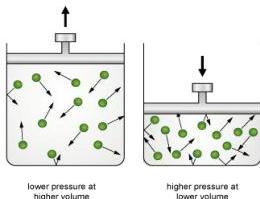
This relationship, often called Boyle's Law, can be used to compare two states of the same gas:
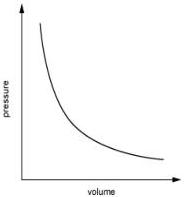
This holds true provided the temperature remains the same and no gas escapes. In real scenarios, compressing a gas often increases its temperature, but the formula applies once the gas returns to thermal equilibrium with its surroundings. The graph of against is an inverse proportion curve.
Worked Example: Calculating Gas Pressure A sample of gas in a sealed container has an initial pressure of Pa and a volume of 60 cm³. If the volume is reduced to 40 cm³ without gas escaping, what is the new pressure?
Using : Pa.
States of Matter and State Changes
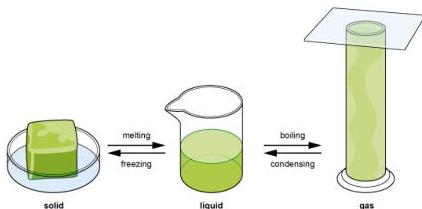
Pure substances have specific melting and boiling points. The melting point is the temperature where a substance transitions between solid and liquid. The boiling point is the temperature where it transitions between liquid and gas throughout the bulk of the liquid. Impure substances do not have fixed points; they melt or boil over a range of temperatures.
| Temperature of substance | State of substance |
|---|---|
| below its melting point | solid |
| at its melting point | solid/liquid |
| between its melting and boiling point | liquid |
| at its boiling point | liquid/gas |
| above its boiling point | gas |
Latent Heat of Fusion and Vaporisation
When a pure substance changes state, its temperature remains constant despite the transfer of thermal energy. This energy, known as latent heat, is used to change the separation between particles rather than their speed.
- Latent heat of fusion: Involved in melting (absorbed) or freezing (released).
- Latent heat of vaporisation: Involved in boiling (absorbed) or condensing (released).
During these transitions, the solid and liquid (or liquid and gas) parts of the sample stay at the same fixed temperature until the entire sample has changed state.
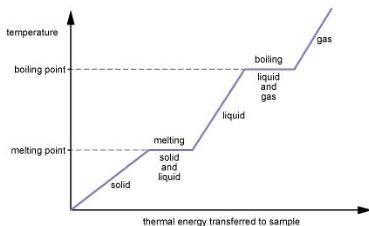
The formula for the energy transferred during a state change is:
Where is thermal energy in Joules (J), is mass in kilograms (kg), and is specific latent heat in J kg⁻¹.
Worked Example: Latent Heat Calculation Calculate the energy needed to turn 3.0 kg of ice at 0°C into liquid water at 0°C. (Specific latent heat of fusion of water is 330 kJ kg⁻¹).
J (or 990 kJ).
Density of Materials
Density () is defined as mass per unit volume:
Density is a characteristic property used to identify materials. Standard units are kg m⁻³ or g cm⁻³. To convert from g cm⁻³ to kg m⁻³, multiply by 1000. For example, aluminium has a density of 2.7 g cm⁻³, which is kg m⁻³.
Most substances are denser as solids than as liquids because particles are closer together. Water is a notable exception: ice is less dense than liquid water because its molecules are held further apart in a regular structure.
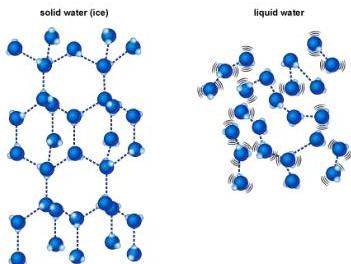
Gases are significantly less dense (typically by a factor of 1000) because their particles have much larger separations.
Measuring Density Experimentally
Density is found by measuring mass with a balance and volume using various methods:
- Regular solids: Use a ruler to measure dimensions and calculate volume.
- Irregular solids: Use the displacement method. Submerge the object in a measuring cylinder or displacement can filled with water. The volume of displaced water equals the object's volume.
- Liquids: Weigh a measuring cylinder empty, then with the liquid, to find the mass. Read the volume directly from the cylinder.
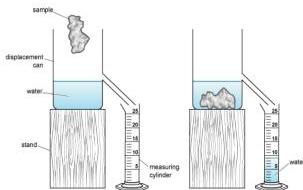
For objects that float, a sinker (a heavy block of known volume) must be attached. The volume of the object is the total displaced volume minus the sinker's volume.
Pressure in Solids and Fluids
Pressure is the force per unit area acting on a surface:
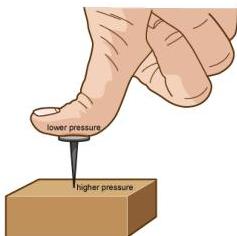
In SI units, pressure is measured in Pascals (Pa), where 1 Pa = 1 N m⁻². Pressure can be increased by increasing the force or decreasing the contact area (e.g., a needle). It can be decreased by increasing the area (e.g., snowshoes).
Worked Example: Table Legs A table weighs 250 N and has four legs, each with a square base 5.0 cm wide. Calculate the pressure on the ground.
Total area = . Pressure = Pa.
Hydrostatic Pressure in Fluids
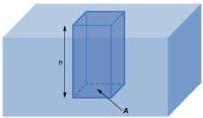
In liquids and gases, pressure acts in all directions and increases with depth (). The hydrostatic pressure is calculated by:
This formula is derived by considering a cuboid of liquid of area and height . The weight of this liquid is . The pressure at the bottom is .
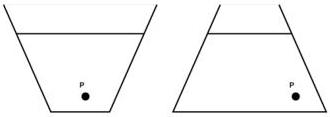
Total pressure at a depth includes the pressure from the fluid plus any atmospheric pressure above it.
Key takeaways
- The temperature of a gas is a measure of the average speed of its microscopic particles.
- For a fixed mass of gas at constant temperature, pressure is inversely proportional to volume ().
- During a state change, a pure substance absorbs or releases latent heat while its temperature remains constant.
- Density is mass per unit volume; gases are approximately 1000 times less dense than solids or liquids due to large particle separation.
- Hydrostatic pressure in a fluid depends on depth, density, and gravity (), regardless of the container shape.
Always check your units before starting a calculation. For pressure in Pascals, you must use area in square metres (). To convert to , divide by . To convert to , divide by .
A common mistake is forgetting to add atmospheric pressure when an exam question asks for 'total pressure' at a certain depth in a liquid. If the question asks for 'pressure due to the liquid', only use .
While we treat as 10 N/kg for most ESAT problems, remember that hydrostatic pressure is what causes buoyancy (upthrust). The difference in pressure between the top and bottom of a submerged object creates a net upward force.
Frequently asked questions
Why does the temperature of a boiling liquid stay at 100°C even if I keep heating it?
The thermal energy being added is used as latent heat of vaporisation. Instead of increasing the kinetic energy (speed) of the particles, which would raise the temperature, the energy is used to overcome the attractive forces between particles and increase their separation to turn them into a gas.
How do I calculate the total pressure at the bottom of a 10 m deep pool?
The total pressure is the sum of the hydrostatic pressure () and the atmospheric pressure (). For water, this is approximately Pa.
What is the difference between an ideal gas and a real gas?
The ideal gas model assumes particles have zero volume and no intermolecular forces. Real gases approximate this behaviour at high temperatures and low pressures, where particles are far apart and moving fast enough that attractive forces are negligible.