Ideal Gases and the Relationship Between Pressure and Volume
Updated July 2026
This lesson explains the macroscopic properties of gases using the microscopic particle model. It details how temperature relates to particle speed and how pressure arises from collisions. For the ESAT, you must be able to apply Boyle's Law, which states that for a fixed gas at constant temperature, pressure and volume are inversely proportional.
An ideal gas is a theoretical model where particles are in constant random motion and interact only through collisions. At a constant temperature, the pressure and volume of a fixed mass of gas satisfy the relationship , meaning pressure is inversely proportional to volume.
The Particle Model of an Ideal Gas
According to the particle model, a gas is composed of identical particles in continuous random motion. In this model, particles do not exert any forces on each other except during collisions. Several specific assumptions define an ideal gas: the particles occupy a negligible volume compared to the container, they undergo elastic collisions, and they obey Newton's laws of motion. While theoretical, many real gases behave like ideal gases when they are at conditions near room temperature and atmospheric pressure.
Explaining Temperature and Pressure Through Particles
Temperature is a macroscopic property that describes the 'hotness' of a gas, which can be measured with a thermometer. On a microscopic level, temperature is directly related to the movement of the gas particles. The higher the temperature of the gas, the higher the average speed of its particles. It is important to note that temperature is a property of the gas as a whole; it is incorrect to describe an individual particle as being hot or cold. Instead, we describe the behaviour of individual particles in terms of their average speed.
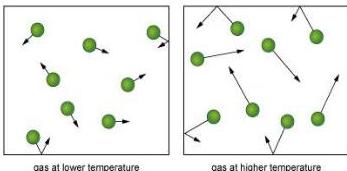
Pressure is also a macroscopic property. A gas exerts a force on any surface it touches because of the random motion of its particles. When these particles collide with the walls of a container, each collision exerts a tiny force. The sum of these individual microscopic collisions results in a steady average force per unit area, which we define as pressure. Like temperature, pressure is not a property of a single particle but of the entire gas sample.
Example: Increasing Temperature in a Sealed Container
Consider a sample of gas held in a sealed container. If the temperature of the gas is increased, the pressure it exerts on the container walls also increases. This happens for two reasons:
- The particles move faster on average, meaning they collide with the container walls more frequently.
- Because they are moving faster, the collisions with the walls are more forceful on average.
Both effects combine to increase the average force per unit area, resulting in higher pressure.
The Relationship Between Pressure and Volume
When the volume of a sealed container of gas is decreased (for example, by pushing in a plunger) while keeping the temperature constant, the gas pressure increases. This is because the average speed of the particles remains the same due to the constant temperature, but the particles have less distance to travel between the walls. Consequently, the frequency of collisions between the gas particles and the container walls increases. Since the average force of each collision is unchanged but the collisions happen more often, the pressure rises.
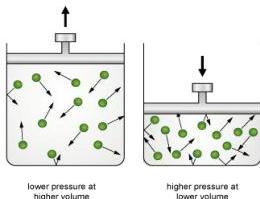
Conversely, if the volume is increased at a constant temperature, the gas pressure decreases. For a fixed amount of ideal gas at a constant temperature, the relationship is:
In practical scenarios, compressing a gas often causes its temperature to rise. However, if the gas is allowed to return to its original temperature: such as by reaching thermal equilibrium with its surroundings: the relationship will hold true for the initial and final states.
Applying Boyle's Law
For a fixed mass of gas at a constant temperature, if the initial pressure and volume are and , and the final pressure and volume are and , we can state:
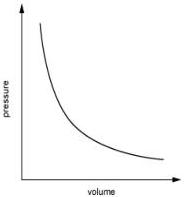
This shows that pressure is inversely proportional to volume, which can be written as:
or
When plotted on a graph, the relationship between and for a fixed mass of gas at a constant temperature forms an inverse proportion curve.
Worked Example: Calculating Changes in Pressure
Question: A sample of gas in a sealed container has a pressure of Pa and a volume of 60 cm³. The volume is reduced to 40 cm³ without any gas escaping. What is the new pressure of the gas?
Step 1: Calculate the constant using initial values. Initial .
Step 2: Use the constant to find the new pressure. Since remains constant: . .
Alternative Method: Using directly: .
Key takeaways
- Temperature is a macroscopic measure of the average speed of microscopic gas particles.
- Gas pressure is caused by the frequent and forceful collisions of particles with the walls of their container.
- For a fixed mass of gas at constant temperature, pressure is inversely proportional to volume ().
- The equation allows for the calculation of pressure or volume changes in a sealed system.
- An ideal gas assumes particles have negligible volume and do not exert forces on each other except during collisions.
In calculations, you do not need to convert units to SI (like m³) as long as you use the same units for both and and the same units for both and .
Remember that only applies if the temperature remains the same. If the question mentions a temperature change, this specific relationship cannot be used alone.
The relationship between pressure and volume is known as Boyle's Law. It is a specific case of the Ideal Gas Law where the product of pressure and volume is proportional to the absolute temperature and the number of moles of gas.
Frequently asked questions
What does 'fixed mass' mean in the context of gas laws?
It means the amount of gas is constant; no gas particles are added to or removed from the container during the process.
Why does pressure increase when a gas is compressed at a constant temperature?
While the particles move at the same average speed, the smaller volume means they hit the walls more frequently, increasing the total force per unit area.
Do real gases always follow the rule?
Real gases behave like ideal gases at room temperature and standard pressure, but they deviate at very high pressures or very low temperatures where particle volume and intermolecular forces become significant.
If I double the volume of a gas at constant temperature, what happens to the pressure?
The pressure will be halved, because pressure is inversely proportional to volume according to the relation .