Force and Extension for the ESAT
Updated July 2026
This page explores the relationship between force and deformation in materials, focusing on Hooke's law and energy storage. Understanding these concepts is essential for ESAT Physics, particularly for calculating spring constants and elastic potential energy. It covers both elastic behaviour and permanent plastic deformation.
A material undergoes extension when subjected to tension, obeying Hooke's law () up to its limit of proportionality, while the energy stored is the area under the force-extension graph.
When a spring, string, or wire is pulled by equal and opposite external forces at each end, it is subjected to a tension force . This force usually results in an increase in length known as the extension. The relationship between the force and the extension can be visualised using a force-extension graph.
The gradient of a force-extension graph indicates the stiffness of the material. A steeper graph represents a more rigid material, meaning a large force is required to produce a small extension. Conversely, a shallower graph indicates that the material is more easily stretched. A material is defined as rigid if its deformation is negligible even under a large tension force. As a material is stretched, its characteristics may change, and eventually, it will reach a breaking point where no further extension is possible.
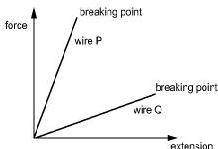
In the graph provided, wire P is more rigid than wire Q. Different materials exhibit unique characteristics: copper wire stretches uniformly at first but then extends significantly just before breaking: glass is highly rigid and breaks after very little deformation.
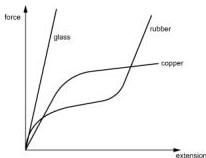
Rubber is a specific example of a material that stretches non-uniformly. It is also important to note that springs can experience compression forces, which lead to a contraction instead of an extension. Regarding the forces involved, if a hand pulls the end of a spring with a force to the right, the spring exerts an equal and opposite force to the left on the hand. This pair of forces is a clear example of Newton's third law of motion.
Elastic and Inelastic Extension
An extension is considered elastic if the material returns to its original, unstretched length once the tension force is removed. If the material remains permanently stretched and does not return to its original length, the deformation is inelastic or plastic. Materials that undergo significant plastic deformation before breaking are described as ductile.
The transition between elastic and inelastic behaviour occurs at the elastic limit. While often the same, this is distinct from the limit of proportionality.
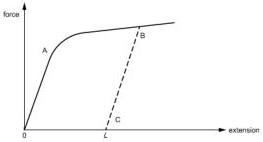
Consider the copper wire graph above. If the wire is stretched to point A and then released, it returns to zero extension. Point A is the elastic limit. If the wire is stretched further to point B, it undergoes inelastic extension. When the force is removed, it contracts along the path BC, which is parallel to the initial linear portion OA. The wire ends with a permanent extension, labelled .
Hooke's Law and the Spring Constant
For many springs and wires, the extension is directly proportional to the tension force, provided the elastic limit has not been reached. This relationship is known as Hooke's law:
In this equation, is the tension force, is the extension, and is the spring constant. The spring constant is defined as the force per unit extension and is the gradient of the linear part of a force-extension graph. Common units include , , or . The limit of proportionality is the specific point on the graph where the linear relationship between force and extension ends.
Worked Example: Calculating the Spring Constant
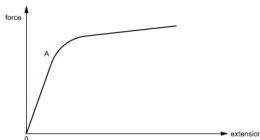
Suppose for the wire shown above, the limit of proportionality (point A) occurs at a force of and an extension of . To find the spring constant :
- Convert the extension to metres: .
- Apply the formula: .
- Result: (which is equivalent to ).
Factors Affecting Spring Constant
The spring constant depends on the dimensions of the material. For a given material, a greater cross-sectional area results in a higher spring constant, while a longer wire results in a smaller spring constant.
When multiple identical springs are combined, the effective spring constant changes:
- Series: Two springs in series result in double the extension for the same force, so the effective spring constant is halved to .
- Parallel: Two springs in parallel require double the force for the same extension, so the effective spring constant is doubled to .
Energy Stored in a Stretched Spring
Work is done when a tension force extends a spring. This work is equal to the area under the force-extension graph. If the extension is within the elastic limit, this energy is stored as elastic potential energy.
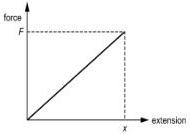
For a material obeying Hooke's law, the area under the graph is a triangle. The energy stored can be calculated using:
Substituting gives:
Consistency in units is vital: using Newtons and metres will result in energy in Joules.
Retrievable and Irretrievable Energy
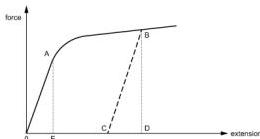
If a wire is stretched to point A, the energy stored (area of triangle OAE) is fully retrievable. However, if stretched to point B (past the elastic limit), the total work done is the entire area under the curve OAB. Upon unloading, only the energy represented by the area of triangle BCD is recovered. The remaining area (OABC) represents energy that is irretrievable, having been converted into heat due to permanent deformation.
Worked Example: Mass on a Spring
A steel spring has a spring constant of and supports an object with a mass of .
-
Find the extension: The force is the weight of the object: (assuming ). (or ).
-
Find the stored energy: .
Key takeaways
- Hooke's law states that force is proportional to extension () up to the limit of proportionality.
- The spring constant is the gradient of the linear part of a force-extension graph and represents material rigidity.
- Elastic potential energy is equal to the area under the force-extension graph, calculated as .
- Stretching a material beyond its elastic limit leads to permanent (plastic) deformation and irretrievable energy lost as heat.
- Spring constants double in parallel and halve in series for two identical springs.
Always check your units before using or . Extensions are frequently given in millimetres or centimetres, but must be converted to metres if you want the energy in Joules or the spring constant in Newtons per metre.
Ensure you use the extension (the change in length) in calculations, not the total length of the spring. If a question provides the original and final lengths, subtract the original from the final to find .
The area under the force-extension graph represents work done. When plastic deformation occurs, work is done to permanently rearrange the internal structure of the material, which increases the internal energy (heat) of the system, a classic application of the first law of thermodynamics.
Frequently asked questions
What is the difference between the limit of proportionality and the elastic limit?
The limit of proportionality is the point where the linear relationship () ends. The elastic limit is the point beyond which the material will not return to its original length. While often very close or identical in practice, they are conceptually distinct.
How do I determine the energy lost as heat from a graph?
The energy lost is the area between the loading curve and the unloading curve on a force-extension graph. It represents the work done that was not recovered as elastic potential energy.
Why is the unloading line on a graph parallel to the initial loading line?
When a material is unloaded after plastic deformation, the bonds between atoms still behave elastically as they are released, which is why the gradient of the unloading line matches the original spring constant.