Newton's Laws of Motion for the ESAT
Updated July 2026
Newton's three laws provide the fundamental framework for classical mechanics. This guide covers how resultant forces cause acceleration, the concept of mass as inertia, and the often misunderstood symmetry of force pairs in Newton's third law. Understanding these principles is vital for solving complex dynamics problems in the ESAT.
Newton's laws define the relationship between the motion of an object and the forces acting upon it: an object maintains its velocity unless a resultant force acts (First Law), acceleration is proportional to the resultant force and inversely proportional to mass (Second Law), and every force is matched by an equal and opposite force of the same type acting on a different body (Third Law).
Newton's laws of motion are the foundation of classical mechanics. They describe how forces interact with matter to determine its state of motion.
Newton's First Law
Newton's first law states: 'a body will remain at rest or in a state of uniform motion in a straight line unless acted on by a resultant external force'.
There are two critical elements to this law:
- The law focuses on the resultant force. The specific individual forces acting on a body are irrelevant on their own. For example, if a book is resting on a table, the weight acting downwards and the normal contact force acting upwards exist, but their resultant is zero. Only the resultant determines the change in motion.
- The law establishes that a resultant force changes velocity, meaning it causes acceleration. A common misconception is that a resultant force is needed to maintain velocity. This is incorrect. If an object is moving at a constant velocity, no resultant force is acting on it. If a resultant force does act, the velocity will change.
Example 1: Constant Velocity Flight
Consider an aircraft in level flight at a constant speed in a straight line. Because its velocity is constant, the resultant force must be zero. However, multiple forces are acting: weight downwards, lift upwards, thrust forwards, and drag backwards. For the resultant to be zero:
- Vertical forces balance: weight = lift.
- Horizontal forces balance: thrust = drag.
While the engines must produce thrust to maintain speed, this thrust is not the resultant force. It is required simply to balance the drag. In contrast, a spacecraft in deep space (Example 2) experiences no drag. Once it is moving, it requires no thrust to stay in motion and will continue at constant velocity forever unless a force acts.
Example 3: The Diving Bird
A bird is diving at a constant velocity of at an angle of to the horizontal as shown below.
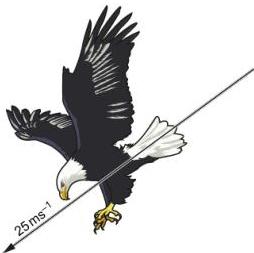
Because the bird is moving at a constant velocity (not accelerating), Newton's first law tells us that the resultant force on the bird must be zero. While individual forces like weight, lift, and drag act on the bird, they sum as vectors to exactly zero.
Mass and Inertia
Mass is defined as the property of an object that resists acceleration or changes in motion. This property is also known as inertia.
- The larger the mass, the greater the force required to produce a specific acceleration.
- Mass is directly related to the amount of matter in an object.
- Mass is distinct from weight. Weight is the force of gravity. You sense weight when lifting an object, but you sense mass (inertia) when trying to accelerate an object horizontally on a frictionless surface.
Newton's Second Law
Newton's second law is defined as: ().
A force of 1 Newton is the force required to accelerate a 1 kg mass at . When using this equation, ensure units are consistent: mass in kg, acceleration in , and force in N. Crucially, represents the resultant force. The acceleration always occurs in the same direction as the resultant force.
Newton's second law is a more general case of the first law: if the resultant force is zero, the acceleration is zero. It quantifies inertial mass by showing that acceleration is inversely proportional to mass for a given force.
Example: Resultant Force Calculation
Consider the aircraft mentioned previously. If its weight is 160 kN, its mass is 16,000 kg. If the resultant force horizontally is 60 kN forwards, the acceleration is: forwards.
Example: Motion of a Car
The diagram shows all forces acting on a car of mass 1200 kg.
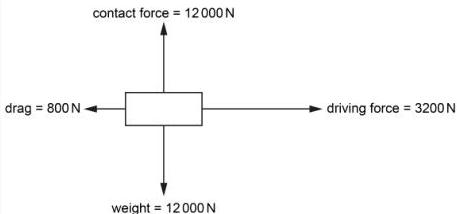
The resultant force is to the right. The acceleration is to the right. This means the car is either moving to the right and speeding up, or moving to the left and slowing down.
Newton's Third Law
Newton's third law states: 'if body A exerts a force on body B then body B exerts an equal and opposite force of the same type on body A'.
This law is frequently misunderstood due to the phrasing 'action and reaction'. You should avoid these terms because they suggest one force causes the other. In reality, both forces happen simultaneously.
For two forces to be a Newton's third law pair, they must meet these criteria:
- They must be of the same type (e.g., both gravitational, or both normal contact).
- They must act on different objects (one on body A, one on body B).
A common error is thinking the weight of an object and the normal contact force from a surface form a third law pair. They do not: they are different types of forces, and they both act on the same object.
Example: Person in a Lift
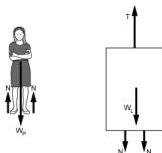
In this system, the person experiences weight downwards and a normal contact force upwards from the lift floor. These are not a third law pair. If the person is not accelerating, these forces are equal, but that is due to Newton's first law, not the third.
The actual third law pair consists of:
- The normal contact force exerted by the lift on the person (upwards).
- The normal contact force exerted by the person on the lift (downwards).
These are the same type (normal contact), equal and opposite, and act on different bodies (person and lift).
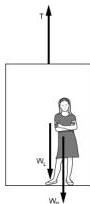
Example: Component Systems
If we treat the person and lift as a single compound system, the internal third law pair forces cancel out. The external forces are the combined weights and the tension in the cable.
Example: Apple on Ground
An apple rests on the ground. The forces on the apple are weight (downwards) and contact force (upwards). The third law pairs are:
- The Earth pulls the apple down (gravitational); the apple pulls the Earth up (gravitational).
- The ground pushes the apple up (contact); the apple pushes the ground down (contact).
Key takeaways
- Newton's First Law states that constant velocity implies a zero resultant force.
- Mass (inertia) is a measure of an object's resistance to acceleration, distinct from weight.
- Newton's Second Law, , applies specifically to the resultant force acting on a constant mass.
- Newton's Third Law force pairs must act on different objects and be of the same physical type.
When solving ESAT dynamics problems, always draw a free body diagram to identify all individual forces before calculating the resultant force for .
Never assume that equal and opposite forces on a single object are a Newton's Third Law pair; equality of forces on one object usually results from Newton's First Law (equilibrium).
Newton's Second Law is more fundamentally expressed as force being the rate of change of momentum. is a simplified version that only holds true when the mass of the object remains constant.
Frequently asked questions
If an object is moving, must there be a resultant force acting on it?
No. According to Newton's First Law, an object in motion will continue at a constant velocity if the resultant force is zero. A resultant force is only required to change its velocity (accelerate it).
Are weight and normal contact force a Newton's Third Law pair?
No. They are different types of forces (gravitational vs. contact) and they act on the same object. Third law pairs must act on different objects and be of the same type.
What happens to acceleration if I double the mass but keep the force the same?
According to , acceleration is . If mass doubles while remains constant, the acceleration will be halved.
Does the direction of acceleration always match the direction of velocity?
No. Acceleration is in the same direction as the resultant force. If the force acts opposite to the velocity, the object will slow down (decelerate).