Kinematics for the ESAT
Updated July 2026
Kinematics focuses on describing motion through quantities like displacement, velocity, and acceleration. This guide covers the distinction between scalars and vectors, the interpretation of motion graphs, and the application of key equations of motion, such as , which are fundamental for the ESAT Physics section.
Kinematics is the study of motion without regard to its causes, defined by the relationships between displacement (), velocity (), acceleration (), and time ().
Scalar and Vector Quantities
A scalar quantity is defined as one that possesses magnitude (size) only, without direction. Examples include mass, time, energy, temperature, power, density, pressure, speed, and distance. It is important to note that a scalar can be negative. For example, a temperature below 0 degrees Celsius is negative, as is potential energy measured below an arbitrary reference point. However, some scalars like mass can never be negative, though their change can be.
A vector quantity possesses both magnitude and direction. Examples include force, velocity, acceleration, displacement, and momentum. Vectors are often defined relative to a specific direction. For instance, if upwards is defined as positive, a force acting downwards is negative. When a vector changes, that change is itself a vector with a direction. If an object moves at to the left and increases to to the left, the change is to the left.
Worked Example: Identifying Vectors
Consider this narrative: "It was -5 degrees Celsius. It took 10 minutes to defrost the car. I was 25 minutes late getting to work, which is 750m away in a direct line. I never exceeded 20 mph, though walking the 3 mile shorter footpath at 2 mph might have been faster." Which quantity is the magnitude of a vector?
The temperature and times are scalars. The figures 20 mph and 2 mph are speeds (scalars). The 3 mile figure is a distance (scalar). The 750m figure, representing a straight-line measurement from home to work, is displacement. Displacement is a vector, so 750m is the answer.
Worked Example: Displacement Directions
A person walks 5.0m north, 6.0m east, 7.0m south, and 8.0m west. What is the final displacement north of the starting point?
We ignore east and west components as they do not affect the north-south displacement. The person moves +5.0m (north) and -7.0m (south). The net displacement is .
Distance, Displacement, Speed, and Velocity
Distance is a scalar, while displacement is a vector. Displacement is distance in a specific direction. Similarly, speed is the scalar magnitude of velocity, which is speed in a given direction.
Circular Motion Example
Consider a car on a circular track with a radius of 100m and a circumference of 630m.
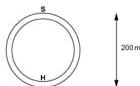
At the halfway point H, the car has travelled a distance of 315m, but its displacement from the start S is +200m. Upon returning to S, the distance is 630m, but the displacement is zero. On the second lap at point H, the distance is 945m, but the displacement remains +200m.
Suppose the car moves at a constant speed of . At S, its velocity is to the right. At H, its velocity is to the right (meaning to the left).
Worked Example: The Lift
A lift starts at floor 2, moves to floor 8, then 6, then 9, and finally floor 1. Each floor is 5.0m apart. What is the distance and displacement?
- Up 6 floors (+30m).
- Down 2 floors (10m).
- Up 3 floors (+15m).
- Down 8 floors (40m).
Total distance = . Net displacement = .
Worked Example: Bouncing Ball
A ball hits the ground at and rebounds at . What is the change in speed and velocity (upwards is positive)?
Change in speed = . Initial velocity = . Final velocity = . Change in velocity = .
Calculations of Speed and Velocity
The following formulae apply when speed or velocity is constant:
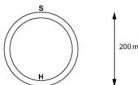
Using the circular track (630m circumference, 20s per lap): For a full lap: Speed = . Velocity = . For a half lap: Speed = . Velocity = in the direction.
Worked Example: Train Velocity
A train travels east at for 40 minutes from X to Y. It then travels west to Z (144km from X) in 16 minutes. What is the velocity from Y to Z?

Distance . Distance , so distance . Since Z is west of Y, displacement . Velocity = .
Acceleration
Acceleration is the rate of change of velocity:
The unit is . This formula applies only to constant acceleration. Note that an object can have acceleration even if its velocity is momentarily zero, or if it moves at a constant speed in a circle (because the direction changes).
Pendulum Motion Analysis
Consider a pendulum bob swinging between points 1 and 5 (right is positive):
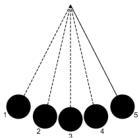
| Position | Velocity | Acceleration | Description |
|---|---|---|---|
| 1 | Zero | Positive | At rest, accelerating right |
| 2 | Positive | Positive | Moving right, speeding up |
| 3 | Positive | Zero | Max speed to the right |
| 4 | Positive | Negative | Moving right, slowing down |
| 5 | Zero | Negative | At rest, accelerating left |
Worked Example: Acceleration of a Ball
A ball hits a bat at and rebounds at in the opposite direction. Impact time is 0.30s. Initial direction is positive.
Initial velocity = . Final velocity = . Change in velocity = . Acceleration = .
Interpreting Motion Graphs
- Distance-time graphs: Always positive and always increasing (or flat). The gradient is the speed.
- Displacement-time graphs: Can be positive or negative. The gradient is the velocity.
- Speed-time graphs: Magnitude only. The area is the distance.
- Velocity-time graphs: Shows direction. The gradient is acceleration, and the area is the change in displacement.
Displacement-Time Features
- Zero gradient: stationary.
- Positive/Negative gradient: moving in the positive/negative direction.
- Increasing/Decreasing gradient: increasing/decreasing velocity.
Velocity-Time Features
- Zero value: stationary.
- Positive/Negative value: moving in the positive/negative direction.
- Positive/Negative gradient: accelerating in the positive/negative direction.
Worked Example: Graph Interpretation
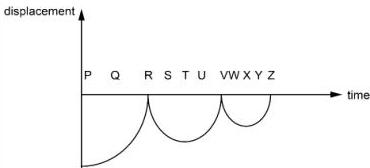
In this displacement-time graph (downwards is positive), the ball has an increasing downward speed at points Q, U, and Y (steeper positive gradient). It is momentarily at rest at P, T, and X.
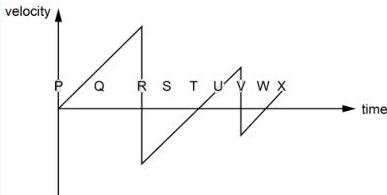
In this velocity-time graph (downwards is positive), the ball is at the top of a bounce when velocity is zero at T and W.
Calculations using Gradients and Areas
Worked Example: Gradient
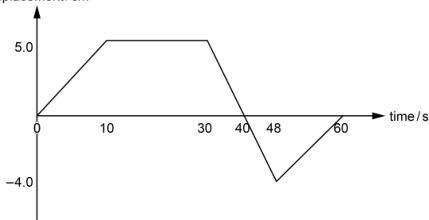
To find the velocity at , calculate the gradient between 30s and 40s: Change in displacement = . Time = 10s. Velocity = .
Worked Example: Area under a Velocity-Time Graph
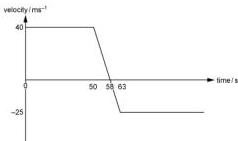
For a ball hitting a bat, the net displacement is the sum of the areas:
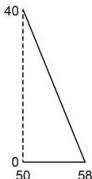 Area 1 (Positive) = .
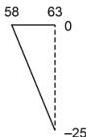 Area 2 (Negative) = .
Net displacement = .
Average Speed, Velocity, and Acceleration
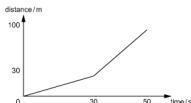
For the graph above, distance in first 30s is 30m (). Distance in next 20s is 70m (). Average speed = .
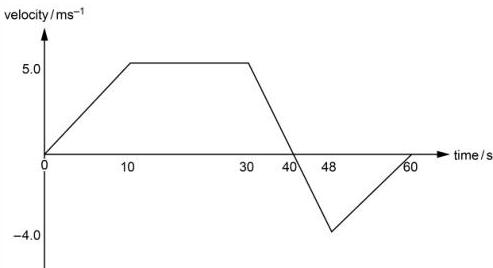
From the complex graph above: Total displacement = . Average velocity = . Total distance = . Average speed = . Average acceleration = (since and are both ).
Equations of Uniform Motion
When acceleration is constant, we use the equations of motion:
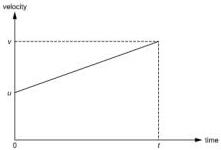
These are derived from velocity-time graphs. The gradient is , giving . The area under the graph is the displacement . Combining these leads to .
Worked Example: Stone thrown from a Cliff
A stone is thrown up at from a 30m cliff. Acceleration is downwards. At what speed does it hit the sea? (Downwards is positive).
, , . .
Worked Example: Car Braking
A car accelerates from to at . Find the distance. . .
Key takeaways
- Scalar quantities have magnitude only, while vector quantities have both magnitude and direction.
- The gradient of a displacement-time graph represents velocity, while the gradient of a velocity-time graph represents acceleration.
- The area under a velocity-time graph represents the total change in displacement.
- Average speed is calculated as total distance divided by total time, whereas average velocity is net displacement divided by total time.
- The equation is used for constant acceleration when time is unknown.
Always define a positive direction at the start of a problem and stick to it. This is especially important for vector quantities like displacement, velocity, and acceleration in the equations of motion.
Be careful not to confuse distance-time graphs with displacement-time graphs. Distance-time graphs can never decrease, whereas displacement-time graphs can return to zero or become negative.
An object moving in a circle at a constant speed is still accelerating. Because velocity is a vector, a change in its direction constitutes a change in velocity, which by definition is acceleration.
Frequently asked questions
Can a distance-time graph ever have a negative gradient?
No. Distance is a scalar quantity and can only increase as an object moves, regardless of its direction. Therefore, the gradient of a distance-time graph (which is speed) must always be zero or positive.
What is the difference between average speed and the average of the initial and final speeds?
Average speed is always total distance divided by total time. You can only take the arithmetic average of initial and final speeds (or velocities) to find the average if the acceleration is constant throughout the motion.
When should I use the equation instead of other equations of motion?
This equation is most useful when you are dealing with constant acceleration and you know the initial velocity, final velocity, and displacement, but you do not know (and do not need to find) the time taken.
Does zero velocity always mean zero acceleration?
No. For example, a ball thrown vertically upwards has a velocity of zero at its maximum height, but it is still accelerating downwards at approximately due to gravity.