Mass Weight and Terminal Velocity for the ESAT
Updated July 2026
This lesson explains the critical distinction between mass and weight, the role of gravitational field strength, and the physics of free-fall. You will learn to calculate weight using , identify factors affecting air resistance, and understand how balanced forces result in terminal velocity, which are core skills for the ESAT.
Mass is a scalar measure of inertia (resistance to acceleration), while weight is a vector force defined as . An object reaches terminal velocity when its weight is exactly balanced by resistive forces like air resistance, resulting in zero acceleration.
Understanding the Difference Between Mass and Weight
Mass and weight are frequently confused in everyday language, but they are distinct physical concepts. Mass is a measure of an object's resistance to acceleration, also known as inertia. It reflects the actual amount of matter present in a sample. The greater the mass, the harder it is to change the object's motion. Mass is a scalar quantity measured in kilograms () or grams (), and it remains constant regardless of where the object is located in the universe.
Weight, conversely, is a force. Specifically, it is the gravitational force acting on an object placed within a gravitational field. Since weight is a force, it is a vector quantity measured in Newtons () or kilonewtons (). Its direction is always determined by the gravitational field, which near the surface of a planet like Earth is directed downwards toward the centre of the planet.
Measuring instruments often contribute to the confusion. Household scales and laboratory balances usually measure the force exerted on them (weight). However, they are calibrated to display a mass value in that corresponds to that weight on Earth. If you took these scales to an accelerating lift or to the Moon, the reading would be incorrect because, while the mass of the object has not changed, the force it exerts on the scale has.
Gravitational Field Strength
In a gravitational field, the force acting on an object is proportional to its mass. The gravitational field strength, denoted by , is defined as the magnitude of gravitational force acting per unit mass. Its unit is the Newton per kilogram ().
For the ESAT, you should approximate the gravitational field strength near the Earth's surface as . The strength of the field depends on the mass and radius of the planet. For comparison:
- The Moon: .
- Jupiter: .
- The Sun: .
It is important to note the equivalence of inertial mass (resistance to acceleration) and gravitational mass (the property upon which gravity acts). While these concepts are theoretically different, scientists have found no practical difference between them; they are treated as equivalent.
Applying the Relationship
Weight is calculated as the product of mass and gravitational field strength: . When using this equation, ensure units are consistent: if is in and is in , will be in Newtons ().
It is a common error to say that 1 kg equals 10 N. They are not equal because they represent different concepts, just as a distance cannot equal a time. A mass of 1 kg simply experiences a weight of 10 N in the Earth's field, but it would experience only 1.6 N on the Moon.
Worked Example: Field Variation
The Earth's field varies slightly by location. In Oslo, , while in Kuala Lumpur, . A person weighs 812 N in Oslo. What is their mass, and what would they weigh in Kuala Lumpur?
- Find mass in Oslo: .
- Use the same mass for Kuala Lumpur: .
Free-fall Acceleration
An object is in free-fall if the only force acting on it is its weight. In this state, the resultant force equals , which is . According to Newton's Second Law (), we can state that . By dividing both sides by , we find that . Therefore, an object falling freely accelerates at a rate numerically equal to the gravitational field strength. On Earth, this is .
Apparent Weightlessness
True weightlessness only occurs in deep space where there is no gravitational field. However, we often discuss apparent weightlessness. We sense our weight through the contact force (normal reaction) from a floor or chair. If that support force is removed, such as in a lift accelerating downwards at , we stop sensing our weight and feel weightless even though gravity is still acting on us. Astronauts in orbit are in a state of constant free-fall toward the Earth, which is why they appear to float.
Worked Example: Statements on Weightlessness
Which of these statements are correct?
- A hammer and feather dropped on the Moon hit the surface at the same time.
- ISS astronauts are weightless because they are outside the atmosphere.
- Passengers in a plane diving at feel weightless.
Solution: Statement 1 is correct because the Moon has no atmosphere, so both objects are in free-fall and accelerate at the same rate. Statement 2 is incorrect; they have weight, but they are in free-fall, leading to apparent weightlessness. Statement 3 is correct; they are falling at the acceleration of free-fall, so the support forces from the plane become zero.
Factors Affecting Air Resistance
Air resistance is a drag force that opposes motion. Its magnitude depends on:
- Speed: Resistance increases as speed increases.
- Cross-sectional Area: A larger area normal to the direction of motion increases the air resistance.
- Flow Type: Streamlined (laminar) flow generally makes resistance proportional to speed. Turbulent flow, common at higher speeds, makes resistance proportional to .
- Aerodynamics: The shape of the surface determines how easily air flows over it, affecting the transition from streamlined to turbulent flow.
Terminal Velocity
When an object falls from rest through air, its weight is initially the only force. As it speeds up, air resistance increases. This reduces the resultant downward force, meaning the acceleration decreases.
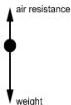
Eventually, the air resistance becomes equal to the weight. At this point, the resultant force is zero, and the acceleration becomes zero. The object continues to fall at a constant speed called the terminal velocity. If a parachutist opens their parachute, the increased area creates a much larger air resistance force at the current speed. This creates a resultant upward force, slowing the parachutist down until a new, lower terminal velocity is reached.
Worked Example: The Parachutist
A parachutist falls at a constant , then opens the parachute and later falls at a constant . Is the resultant force upward at any point?
Solution: Yes. When the parachute first opens, the air resistance suddenly exceeds the weight. This produces a brief resultant upward force that causes deceleration until the forces balance again at the lower speed of .
Key takeaways
- Mass is a scalar measure of inertia in , while weight is a vector force in calculated as .
- On Earth, gravitational field strength is approximated as , which is numerically equal to the acceleration of free-fall ().
- Apparent weightlessness occurs when an object is in free-fall because the normal contact force from the surroundings becomes zero.
- Terminal velocity is reached when the upward air resistance force exactly balances the downward weight, resulting in zero acceleration.
- Air resistance increases with speed and cross-sectional area, often becoming proportional to during turbulent flow.
In ESAT questions, always check if the motion is in a vacuum or in air. If air resistance is mentioned, the acceleration will not be a constant but will decrease as the object speeds up.
Do not treat 'weightless' as having no mass. Even in a state of weightlessness, an object still has mass and therefore still has inertia, meaning it still requires a force to be accelerated.
The relationship between speed and air resistance is non-linear. Because drag often depends on in turbulent conditions, doubling your speed can quadruple the resistive force, which explains why vehicles require significantly more power to maintain higher speeds.
Frequently asked questions
If I go to the Moon, does my mass change?
No. Your mass is the amount of matter in your body and your resistance to acceleration, which remains constant. However, your weight would decrease because the Moon's gravitational field strength is only about , compared to Earth's .
Why do a heavy and light object fall at the same rate in a vacuum?
In a vacuum, the only force is weight (). Using , we get . The mass cancels out from both sides, leaving . This means acceleration is independent of mass.
Does air resistance always equal weight?
No. Air resistance only equals weight when the object has reached terminal velocity. During the initial stages of a fall, air resistance is less than weight, allowing the object to accelerate. If a parachute is opened, air resistance can temporarily be greater than weight.