Convection and Fluid Density in Thermal Physics
Updated July 2026
Convection is a primary mechanism of heat transfer in fluids, driven by temperature-induced changes in density. This page covers how fluid expansion leads to buoyancy, the formation of convection currents, and practical applications like home insulation and refrigeration, which are essential for the ESAT Physics syllabus.
Convection is the transfer of heat through the macroscopic or bulk movement of a fluid. It occurs when a fluid is heated, causing it to expand, become less dense, and rise, allowing cooler, denser fluid to take its place in a continuous cycle called a convection current.
The Effect of Temperature on Fluid Density
When the temperature of a fluid (a liquid or a gas) increases, the average speed of its microscopic particles also increases. These particles collide with each other more frequently and with greater force. If the fluid is not restricted by a rigid container, the particles will move further apart on average.
It is important to understand that the fluid expands because the average separation between particles increases, not because the particles themselves expand. When the separation increases, the volume of a given mass of fluid increases. Since density is mass per unit volume, the density of the fluid decreases because there are fewer particles in a specific unit of volume.
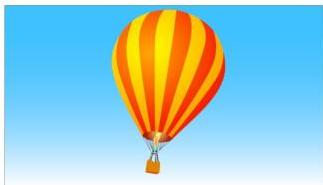
A practical application of this principle is the hot air balloon. The air inside the balloon is heated by a flame, making it hotter and therefore less dense than the cooler surrounding air. This lower density, even accounting for the mass of the balloon and basket, allows the balloon to float upwards. To descend, the flame is extinguished, letting the air cool and its density increase.
Fluid Flow Caused by Differences in Density
Convection is the process where heat is transferred by the bulk movement of the fluid itself. This process follows a specific sequence of events:
- A region within a fluid is heated (for example, air near a radiator or water at the bottom of a beaker). Initially, heat transfers from the source to the fluid via conduction.
- The heated fluid expands and its density decreases.
- The warmer, less dense fluid moves upwards through the cooler, denser surrounding fluid.
- This upwards movement displaces cooler fluid, which moves in to take the space originally occupied by the warmer fluid.
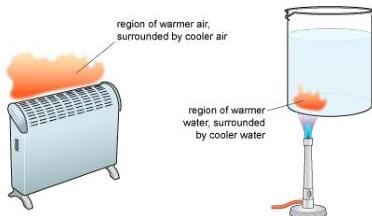
As the warmer fluid rises, it gradually cools by conducting heat to its surroundings. This cooling causes the fluid to become denser again, eventually leading it to sink. If the heat source continues to supply energy, this creates a continuous cycle known as a convection current. Fluid near the source is constantly warmed and rises, while cooler fluid is constantly drawn in to be heated in turn.
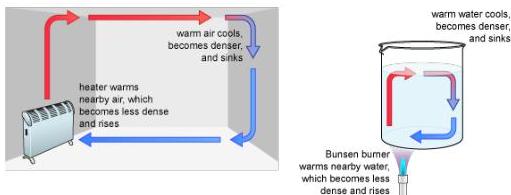
Note that if a heat source is placed at the top of a container, a convection current will not form. The warmer, less dense fluid will simply remain at the top, and heat will only be able to transfer downwards through the much slower process of conduction.
Comparing Conduction and Convection
While both conduction and convection are mechanisms of thermal energy transfer, they behave differently depending on the state of matter.
| Conduction | Convection |
|---|---|
| Requires the presence of particles. | Requires the presence of particles. |
| Can occur in fluids. | Can occur in fluids. |
| Can occur in solids. | Cannot occur in solids. |
| Heat is transferred by microscopic motions: kinetic energy passes from particle to particle. | Heat is transferred by macroscopic (bulk) motion: large numbers of particles move together. |
In fluids, both processes can happen simultaneously, but convection typically transfers heat much more rapidly than conduction.
Using Convection in Household Design
Many appliances are positioned to exploit convection currents. Room heaters are usually placed near the floor so the warmed air can rise and circulate. Conversely, air conditioning units are often placed near the ceiling so the cooled, denser air can sink and circulate throughout the room.
Reducing Heat Transfer by Reducing Convection
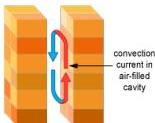
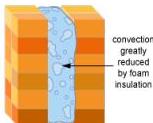
Modern building techniques use cavity walls (two layers of wall with a space between them) to reduce heat loss. Originally, these were filled with air because air is a good thermal insulator (reducing conduction). However, air in a large cavity can still circulate via convection, which speeds up heat transfer from the inner wall to the outer wall.
To prevent this, the cavity can be filled with insulating foam. The foam contains many tiny pockets of trapped air. Because convection can only occur within each tiny pocket, the macroscopic movement of air is prevented, significantly reducing the rate of heat loss.
Worked Examples
Example 1: Refrigerator Design
Question: Some refrigerators have a small freezer compartment containing cooling coils. What is the best position for this compartment: the top, middle, or bottom? Explain your answer.
Answer: The best position is at the top. The cooling coils cool the air surrounding them, making it denser. This cooler, denser air sinks to the bottom of the fridge. Warmer air (from food or heat entering through the walls) rises to the top to take its place and is cooled in turn. This establishes a convection current that effectively circulates cold air throughout the entire appliance.
Example 2: Sea and Land Breezes
Question: During a sunny day, the land reaches a higher temperature than the sea. State and explain the direction of the resulting breeze at the surface and explain the breeze at higher altitudes.
Answer: The air above the land is warmed by conduction from the hot ground. This air expands, becomes less dense, and rises. Cooler air from over the sea moves in to replace it, creating a surface breeze blowing from the sea towards the land. At higher altitudes, the rising air from the land flows horizontally back towards the sea to complete the convection cycle, creating a breeze in the opposite direction (from land to sea).
Key takeaways
- Fluids expand when heated because particle separation increases, leading to a decrease in density.
- Convection requires the bulk movement of particles, which is why it cannot occur in solids where particles are fixed in a lattice.
- A convection current is formed when a fluid is heated from below, causing a cycle of rising warm fluid and sinking cool fluid.
- Convection can be suppressed by trapping small volumes of fluid in porous materials like foam to prevent bulk circulation.
In exam questions about convection, always mention the change in density. Simply saying 'hot air rises' is often insufficient; you must explain that the air expands, becomes less dense, and is then displaced upwards by denser, cooler air.
Never say that the particles themselves expand. The particles (atoms or molecules) stay the same size; it is the space between them that increases as they collide more energetically.
Convection is the driving force behind many large scale natural phenomena, including atmospheric wind patterns, ocean currents, and even the movement of tectonic plates caused by convection in the Earth's mantle.
Frequently asked questions
Why does convection not happen in solids?
In a solid, particles are held in a fixed arrangement by strong attractive forces and can only vibrate about fixed positions. Convection requires the particles to change places and move in bulk, which is only possible in fluids (liquids and gases).
Does the temperature of a fluid always decrease when it rises during convection?
Yes, as the warmer fluid rises, it transfers thermal energy to the surrounding cooler fluid via conduction. This loss of thermal energy causes its temperature to drop and its density to increase, eventually causing it to sink.
What happens if you heat a beaker of water from the top instead of the bottom?
If heated from the top, the water at the surface becomes less dense and stays at the top. No convection current is formed because the denser, cooler water is already at the bottom. Heat would only reach the bottom via the much slower process of conduction.