Thermal Radiation for the ESAT
Updated July 2026
Thermal radiation involves the transfer of energy through electromagnetic waves in the infrared region. It is unique among heat transfer methods because it requires no medium, allowing energy to travel through a vacuum. Understanding how surfaces absorb and emit radiation is essential for solving ESAT physics problems involving energy balance.
Thermal radiation is energy transfer via infrared electromagnetic waves. All objects above absolute zero emit this radiation, and the net rate of thermal energy change depends on the balance between emission and absorption, governed by temperature, surface area, and surface texture.
Thermal Radiation as Infrared Electromagnetic Waves
Thermal radiation, commonly referred to as infrared (IR) radiation, is a specific type of wave found within the electromagnetic spectrum. As with all electromagnetic waves, it travels at the speed of light and does not require a physical medium to propagate. This distinguishing characteristic allows thermal radiation to transfer energy through a vacuum, which is fundamentally different from conduction and convection.
This process is the mechanism by which energy from the Sun reaches the Earth through the vacuum of space.
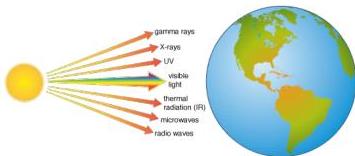
Radiation enables the direct transfer of heat from one object to another without the need to heat or pass through an intervening medium. A common example is a radiant heater, which warms nearby objects directly via infrared radiation without necessarily heating the air between them first. While the human eye cannot see infrared radiation, it is easily detected by the sensation of warmth it creates when it interacts with the skin.
Worked Example: Identifying Thermal Radiation Properties
Which of the following statements apply to thermal radiation?
- It can travel through a vacuum.
- It is a type of ionising radiation.
- It travels slower than light.
Solution: Thermal radiation is a form of electromagnetic radiation. All electromagnetic waves can travel through a vacuum and move at the speed of light. Thermal radiation is not produced by the decay of unstable nuclei, meaning it is not ionising. Therefore, only statement 1 is correct.
Absorption and Emission of Radiation
Emission of Thermal Radiation
Every object or substance with a temperature higher than absolute zero (the theoretical minimum temperature) emits thermal radiation. The rate at which an object emits this radiation, measured as power or energy per second, is directly related to its temperature: the higher the temperature, the higher the rate of emission.
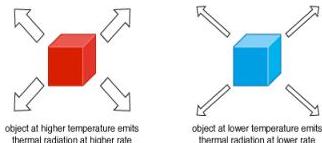
During emission, the thermal energy of the object is converted into the energy of the radiation, provided the object is not undergoing a change of state. Consequently, if an object emits radiation without receiving energy from another source, its internal thermal energy decreases, leading to a drop in temperature.
Absorption of Thermal Radiation
When thermal radiation strikes an object, there are three potential outcomes: the radiation may be absorbed, reflected (bouncing off the surface), or transmitted (passing through the object).
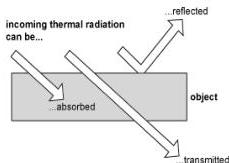
When radiation is absorbed, its energy is converted back into the thermal energy of the object. If absorption occurs without other energy transfers, the object's temperature will increase.
Combined Effect of Emission and Absorption
Objects are constantly emitting and absorbing thermal radiation simultaneously. The net change in temperature is determined by the balance between these two rates.
- Higher temperature than surroundings: The object emits radiation at a higher rate than it absorbs it. This results in a net loss of thermal energy and a decrease in temperature.
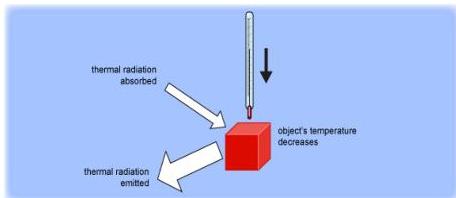
- Lower temperature than surroundings: The object absorbs radiation at a higher rate than it emits it. This leads to a net gain in thermal energy and an increase in temperature.
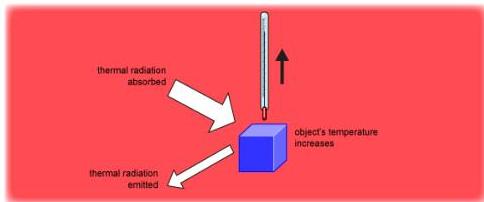
It is worth noting that air is a weak absorber of thermal radiation. This property allows solar radiation to pass through the Earth's atmosphere and reach the surface effectively.
Worked Example: Net Energy Transfer Calculation
Thermal radiation is incident on a window at a rate of W. The window reflects this radiation at a rate of W and transmits it at a rate of W. Simultaneously, the window emits its own thermal radiation at a rate of W. Calculate the net rate of change of the window's thermal energy.
Step 1: Calculate the rate of absorption. Of the W incident, we subtract the reflected and transmitted portions: W. The window absorbs W.
Step 2: Calculate the net rate. The window gains W through absorption but loses W through emission. Net change = W. The window experiences a net loss of energy at a rate of W.
Factors Affecting Rates of Absorption and Emission
While temperature is a primary driver of emission, the physical characteristics of an object also dictate the rates of energy transfer. Generally, a surface that is a good absorber is also a good emitter, while a poor absorber is a poor emitter but a good reflector.
| Factor affecting rates | Lower rates of absorption and emission | Higher rates of absorption and emission |
|---|---|---|
| Surface Texture | Shiny surfaces | Matt (dull) surfaces |
| Surface Area | Smaller surface area | Larger surface area |
Practical Applications
Survival Blankets: These are used to prevent hypothermia. The blanket's surface is shiny, making it a poor absorber and emitter but a highly effective reflector. It reflects the person's own body heat back toward them and emits very little thermal radiation to the cold surroundings.

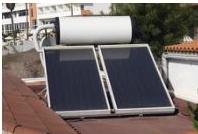
Solar Water Heaters: These systems use pipes painted matt black to transport water. Because matt surfaces are excellent absorbers, they maximise the heat taken in from the Sun. While they are also good emitters, the rate of absorption from solar radiation is significantly higher than the rate of emission, resulting in a net energy gain for the water.
Thermal Radiation and the Earth
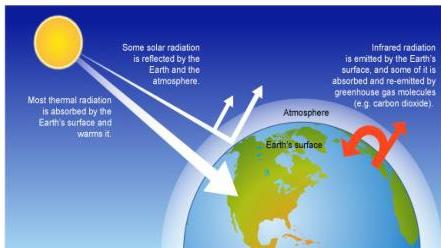
The Earth's temperature is primarily determined by the long term balance between the rates at which the surface and atmosphere absorb solar radiation and emit thermal radiation back into space. Global warming, or the greenhouse effect, occurs when the rate of energy transfer to the Earth and its atmosphere exceeds the rate at which energy is radiated away.
Key takeaways
- Thermal radiation consists of infrared electromagnetic waves that can travel through a vacuum at the speed of light.
- The rate of thermal radiation emission increases significantly as the temperature of an object increases.
- Matt black surfaces are the most effective absorbers and emitters, while shiny surfaces are the most effective reflectors and the poorest emitters.
- An object's temperature changes based on the net balance between the rate of absorption and the rate of emission.
In exam questions involving energy balance, always identify the 'Incident Power' first, then subtract any power that is reflected or transmitted to find the power actually absorbed. Only then compare the absorbed power to the emitted power to find the net change.
Do not assume that an object stops emitting radiation just because it is cold. Every object above K ( degrees Celsius) emits thermal radiation; the rate just becomes lower as the temperature drops.
The rate of emission is proportional to the fourth power of the absolute temperature (). This means that even a small increase in temperature results in a massive increase in the rate of thermal radiation emission.
Frequently asked questions
Does thermal radiation require a medium like air or water to transfer heat?
No. Unlike conduction and convection, thermal radiation is an electromagnetic wave and can travel through a vacuum, which is how heat from the Sun reaches Earth.
Can an object emit and absorb radiation at the same time?
Yes. All objects above absolute zero are constantly emitting and absorbing thermal radiation. The change in the object's temperature depends on which of these two rates is higher.
Why are radiators often painted white if black is a better emitter?
In many domestic settings, most heat from a 'radiator' is actually transferred by convection. However, in terms of pure radiation, a matt black surface would indeed be a more efficient emitter than a shiny white one.
What is the relationship between being a good absorber and being a good reflector?
They are opposites. A surface that is a good absorber (like matt black) will be a very poor reflector. Conversely, a good reflector (like a mirror or polished silver) will be a very poor absorber.