DNA and Gene Mutations for the ESAT
Updated July 2026
This lesson explains how gene mutations alter the nucleotide sequence in DNA. It covers the link between the genetic code and protein folding, illustrating why mutations can have no effect, a small impact, or entirely determine an organism's phenotype through changes in protein structure.
A gene mutation is a permanent change in the sequence of nucleotide bases in DNA, which can alter the amino acid sequence of a protein, changing its three dimensional shape and biological function.
Chromosomes and Genes
DNA is stored within the nucleus of a cell in long, thread like structures known as chromosomes. These structures are typically visible only when a cell is dividing, at which point they appear as X like shapes. Each chromosome in this state consists of two identical DNA molecules.
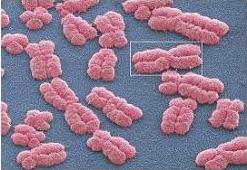
To fit within the nucleus, each DNA double helix is wrapped tightly around proteins. Most of the time, a chromosome consists of just one DNA molecule, but it is copied just before cell division so that each daughter cell receives a full set of genetic information. Because DNA molecules are exceptionally large, a single chromosome contains millions of base pairs. This length is divided into shorter functional units called genes.
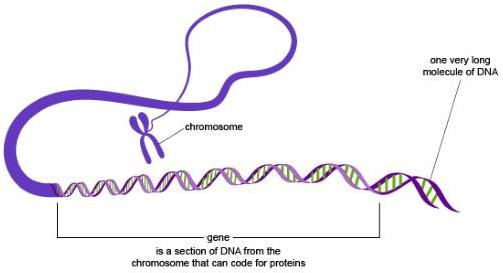
A gene is a specific section of a chromosome that stores the genetic code required to build a protein. Therefore, genes are the instructions for protein synthesis.
The Genetic Code and Protein Synthesis
Proteins are large polymers made of chains of smaller molecules called amino acids. Every amino acid contains the elements carbon (), hydrogen (), oxygen (), and nitrogen (). The specific sequence of these amino acids determines the identity and function of the protein.
Cells build proteins by reading the genetic information in a gene. While a gene consists of two DNA strands, the cell only uses the base sequence of one strand, known as the template strand. The cell reads this code in groups of three bases called triplets.
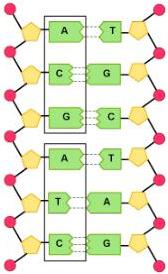
Each triplet codes for one specific amino acid. By reading the sequence of triplets, the cell ensures that amino acids are joined in the precise order required. For example, if a gene section has the sequence , it is read as five triplets:

Note that the genetic code is degenerate, meaning different triplets can code for the same amino acid. For instance, both and code for the same amino acid.
Worked Example: Hierarchy of Genetic Structures
When organising genetic terms by size from smallest to largest, the correct order is: base, nucleotide, triplet, gene, and then the DNA molecule. A base is a component of a nucleotide. Three nucleotides form a triplet. A gene is made of many triplets, and a DNA molecule contains many genes.
Protein Folding and 3D Structure
Once the chain of amino acids, or polypeptide, is assembled, it must fold into a specific three dimensional shape to become functional. This folding is driven by the properties of the amino acids: some are attracted to water (hydrophilic) while others are repelled by it (hydrophobic).
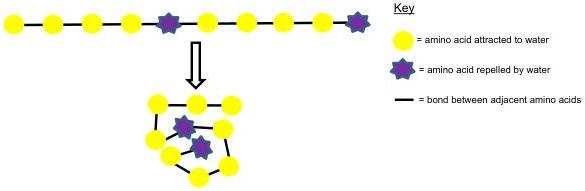
In the watery environment of the cytoplasm or blood, the polypeptide folds so that hydrophobic amino acids are tucked inside, away from water, while hydrophilic ones stay on the outside. This precise folding creates structures like the active site of an enzyme.
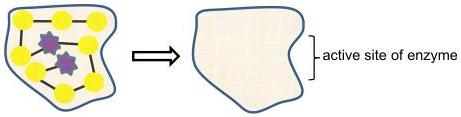
If the sequence or number of amino acids changes, the folding will change, leading to a different three dimensional shape. Since the shape of a protein determines its function, any change in the DNA sequence can alter how a protein works or make it non functional.
Understanding Gene Mutations
A gene mutation is a change in the order of nucleotide bases in an organism's DNA. This change can alter a DNA triplet, which might then code for a different amino acid. If the amino acid is different, the three dimensional structure of the resulting protein may be compromised.
For enzymes, which are biological catalysts, structure is everything. An enzyme's active site must be perfectly complementary to its substrate. A mutation that changes even one amino acid in the active site can prevent the enzyme from binding to its substrate, rendering it useless.
Impact on Phenotype
The phenotype is the set of observable characteristics of an individual. The effect of a mutation on the phenotype can vary widely:
- No Effect: Most mutations are neutral. This often happens because much of our DNA is non coding and does not provide instructions for proteins. Additionally, some mutations are silent, meaning the changed triplet still codes for the same amino acid.
- Small Effect: Some mutations result in minor changes. An example is polydactyly, where a mutation causes an organism, such as a cat, to grow extra toes. This affects the phenotype but does not typically hinder the organism's overall survival.
- Determining the Phenotype: Occasionally, a mutation can entirely determine a trait. For example, if a mutation makes an enzyme responsible for petal pigment non functional, the flower will lack that colour entirely.

Worked Example: Analysing a Mutation
Consider a gene sequence: . During copying, it changes to: .
By comparing the two, we see the fourth triplet changed from to . Referring to a genetic code table, codes for phenylalanine, while codes for leucine. Because a different amino acid is incorporated, the protein's structure could be altered. If this gene codes for an enzyme, the active site may no longer fit the substrate, causing the enzyme to fail in its biological role.
Key takeaways
- A mutation is defined as a change in the sequence of nucleotide bases in the DNA.
- The sequence of bases in a gene determines the sequence of amino acids in a protein via triplets.
- A protein's function is dependent on its specific three dimensional shape, which is determined by its amino acid sequence.
- Most mutations have no effect on the phenotype, while others have small effects or can completely determine a trait.
- Silent mutations change the DNA sequence but do not change the amino acid produced due to the redundancy of the genetic code.
In the ESAT, you may be asked to compare two DNA sequences. Always divide the sequences into triplets of three bases first to identify exactly which triplet has changed and determine if it would result in a different amino acid.
Do not assume that all mutations are harmful. Many students forget that most mutations are 'neutral' or 'silent' and have no effect on the phenotype at all.
The folding of proteins is a thermodynamic process. Hydrophobic amino acids hide from water to reach a stable, low energy state. This is why a single base change that swaps a hydrophilic amino acid for a hydrophobic one can cause a massive structural collapse of the protein.
Frequently asked questions
Why do most mutations have no observable effect on an organism?
Most mutations occur in non coding regions of DNA that do not provide instructions for proteins. Furthermore, because multiple triplets can code for the same amino acid, some mutations within genes do not change the resulting protein's structure.
How does a mutation specifically stop an enzyme from working?
A mutation can change the DNA triplet so it codes for a different amino acid. If this amino acid is located in the active site, it may change the site's shape so it is no longer complementary to the substrate, preventing the chemical reaction from being catalysed.
What is the difference between a gene and a chromosome?
A chromosome is a very long, thread like structure made of a DNA molecule wrapped around proteins. A gene is a short, specific section of that DNA molecule that codes for a single protein.