Digestive Enzymes and the Mechanism of Enzyme Action
Updated July 2026
This page covers the essential role of biological catalysts in the human body. It explores how amylases, proteases, and lipases facilitate the digestion of complex macronutrients. You will learn about the lock and key hypothesis, the impact of temperature and pH on enzyme activity, and the process of denaturation.
Enzymes are protein-based biological catalysts that increase reaction rates via a specific active site. In digestion, amylases, proteases, and lipases break down carbohydrates, proteins, and fats into smaller, soluble molecules through hydrolysis.
Enzymes as Biological Catalysts
Metabolic processes within cells consist of chemical reactions that require catalysts to increase their rate. Without enzymes, these reactions would occur far too slowly to support life. Enzymes are involved in almost every essential process, including respiration, protein synthesis, photosynthesis, and digestion. Because they are not consumed in the reactions they facilitate, they are referred to as biological catalysts. The specific set of enzymes present within a cell determines which metabolic pathways can take place.
The Active Site and Enzyme Specificity
Enzymes are primarily proteins that possess a unique three-dimensional area called the active site. This site is where the chemical reaction occurs.
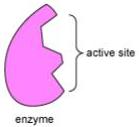
Enzymes exhibit specificity, meaning they only interact with a particular substrate or a specific type of molecule. The substrate fits into the active site much like a key fits into a lock. For instance, the enzyme amylase binds specifically with starch, while proteases bind with proteins. This is known as the lock and key hypothesis.


During a reaction, enzymes convert substrate molecules into different molecules called products. The combination of the enzyme and substrate is known as the enzyme substrate complex (). After the reaction, the enzyme remains unchanged and is free to catalyse further reactions.





An enzyme may break one substrate into two products or join two substrates into a single product.


Hydrolysis and Condensation
Substrates can be broken down through the addition of water, a process called a hydrolysis reaction. Conversely, products can be formed by the removal of water, known as a condensation reaction.
Induced Fit Theory
While the lock and key model emphasizes fixed shapes, the induced fit theory suggests that the active site is flexible. When the correct substrate enters the active site, the enzyme changes shape slightly to fit more snugly around the substrate. This adjustment allows the reaction to proceed more efficiently.
Factors Affecting Enzyme Action
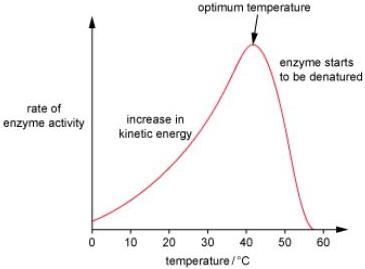
Every enzyme has an optimum temperature and at which it functions most effectively. When conditions deviate from these optima, the rate of reaction decreases.
Temperature
As temperature increases, enzymes and substrates gain more kinetic energy, leading to more frequent and energetic collisions. This increases the reaction rate until the optimum temperature is reached. However, if the temperature rises too far above the optimum, the bonds maintaining the enzyme's 3D structure break. The enzyme becomes denatured, and the active site loses its functional shape, meaning the substrate can no longer fit.

pH
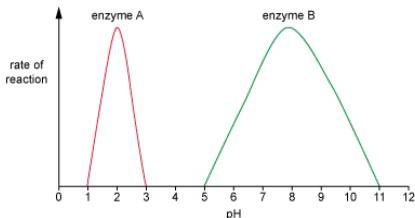
Different enzymes are adapted to different levels. For example, pepsin in the stomach has an optimum of approximately , while enzymes in the small intestine typically work best at . Significant deviations from the optimum cause the enzyme to denature.
Digestive Enzymes: Amylases, Proteases, and Lipases
In the human digestive system, specific enzymes are responsible for breaking down macronutrients into smaller, absorbable molecules:
- Amylases: These enzymes break down carbohydrates, such as starch, into simple sugars like maltose. They are produced in the salivary glands and the pancreas.
- Proteases: These enzymes digest proteins into amino acids. Pepsin is a well known protease in the stomach, while others operate in the small intestine.
- Lipases: These enzymes break down fats (lipids) into fatty acids and glycerol. They are primarily secreted by the pancreas into the small intestine.
Worked Examples
Exercise 26: Why are catalysts necessary in order for reactions to take place in organisms? Answer: Without catalysts like enzymes, metabolic reactions would happen too slowly to sustain life processes.
Exercise 27: Some enzymes were mixed with a substrate.
 Explain why only enzyme Y catalyses the reaction with this substrate.
Answer: Enzyme Y has an active site with a shape that is complementary to the substrate. Enzymes X and Z have different shapes that do not allow the substrate to bind, demonstrating enzyme specificity.
Explain why only enzyme Y catalyses the reaction with this substrate.
Answer: Enzyme Y has an active site with a shape that is complementary to the substrate. Enzymes X and Z have different shapes that do not allow the substrate to bind, demonstrating enzyme specificity.
Key takeaways
- Enzymes are proteins that act as biological catalysts by lowering the activation energy of reactions.
- The lock and key hypothesis describes how a specific substrate fits a complementary active site.
- Amylases digest carbohydrates, proteases digest proteins, and lipases digest fats.
- Denaturation occurs when extreme temperature or pH alters the 3D shape of the active site permanently.
- Hydrolysis is the chemical breakdown of a compound due to reaction with water.
In exam questions, always use the term 'complementary' to describe the relationship between the substrate and the active site. Avoid saying the substrate and enzyme are 'the same shape'; they fit together like a puzzle.
Do not say that enzymes are 'killed' by high temperatures. Enzymes are proteins, not living organisms. The correct term is 'denatured'.
The shape of the active site is determined by the specific sequence of amino acids in the protein chain, which is coded by the organism's DNA. A single mutation in a gene can change an amino acid, potentially altering the active site and making the enzyme non-functional.
Frequently asked questions
Does increasing the temperature always increase the rate of an enzyme reaction?
No. While increasing temperature initially increases the rate due to higher kinetic energy, exceeding the optimum temperature causes the enzyme to denature, which stops the reaction.
What are the specific products of lipid digestion by lipase?
Lipases break down lipids into two types of molecules: fatty acids and glycerol.
Why can amylase only break down starch and not protein?
This is due to enzyme specificity. The active site of amylase is complementary in shape only to starch. It cannot fit protein molecules into its active site to facilitate a reaction.
Is denaturation reversible if the temperature is lowered back to the optimum?
No. Once an enzyme is fully denatured, the chemical bonds holding its specific 3D shape are broken, and the active site is permanently destroyed.