Respiration and the Respiratory System for the ESAT
Updated July 2026
This guide covers cellular respiration and the human respiratory system. You will learn the chemical equations for aerobic and anaerobic respiration and the mechanics of the thorax during ventilation. We also explore gas exchange in the alveoli and the mathematical importance of the surface area to volume ratio in biological systems.
Respiration is a cellular chemical reaction that releases energy from glucose, whereas ventilation is the mechanical process of breathing. Efficient gas exchange requires a high surface area to volume ratio, thin diffusion pathways, and maintained concentration gradients.
Cellular Respiration in Living Cells
Respiration is a fundamental chemical process occurring in every living cell to release energy from nutrient molecules, such as glucose. It is important to distinguish respiration from breathing: breathing is the physical movement of air into and out of the lungs, while respiration is the chemical reaction that provides energy for metabolic processes.
Aerobic Respiration
Aerobic respiration occurs in the presence of oxygen and is the most efficient way for cells to release energy. In eukaryotic cells, this process primarily takes place within the mitochondria. The overall process can be summarised by the following word and chemical equations:
Word Equation:
Chemical Equation:
Anaerobic Respiration
Anaerobic respiration occurs in the absence of oxygen. In animal cells, this process takes place in the cytoplasm. It releases significantly less energy than aerobic respiration and produces a waste product called lactic acid. This often occurs during vigorous exercise when the oxygen supply cannot meet the demands of the muscle cells.
Word Equation:
After exercise, the body must take in extra oxygen, known as an oxygen debt, to oxidise the toxic lactic acid and remove it from the body.
Structure of the Respiratory System
The respiratory (breathing) system is located within the thorax (the chest). Air enters the body through the nose or mouth, passing through the larynx (voice box) and into the trachea (windpipe). The trachea is reinforced with rings of cartilage to ensure the airway remains open.
The trachea divides into two bronchi, one entering each lung. These further branch into narrower tubes called bronchioles. At the terminus of the bronchioles are tiny air sacs called alveoli (singular: alveolus), where gas exchange occurs.
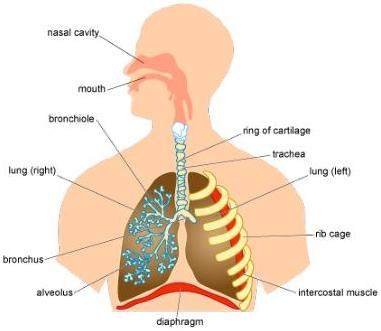
The lungs are protected by the rib cage, which consists of rib bones and intercostal muscles. Below the lungs is the diaphragm, a muscular sheet that plays a vital role in breathing mechanics.
The Function of the Respiratory System
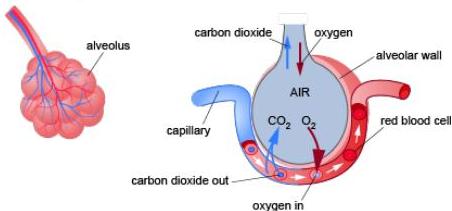
The primary role is to provide oxygen for aerobic respiration and to remove the waste product, carbon dioxide. This exchange happens between the air in the alveoli and the blood in the surrounding capillaries.
Composition of Inhaled and Exhaled Air
Air leaving the body differs from air entering it due to the gas exchange process:
- Oxygen: Inhaled air contains more oxygen: exhaled air contains less.
- Carbon Dioxide: Inhaled air contains less: exhaled air contains more.
- Water Vapour: Inhaled air contains less: exhaled air contains more.
- Cleanliness: Inhaled air contains dust, pollen, and pathogens: exhaled air is cleaner.
The airway is cleaned by cells lining the bronchi. These cells produce mucus to trap particles and pathogens (like bacteria and viruses). Small hairs called cilia then waft this mucus up to the top of the trachea, where it is swallowed and destroyed by stomach acid.
Exercise 40: Which shows the correct order of the structures that a molecule of carbon dioxide would pass through when being exhaled? (Not all structures are included in each answer.) a) mouth bronchus bronchiole alveolus b) alveolus bronchiole ring of cartilage mouth c) trachea bronchiole bronchus alveolus d) bronchus bronchiole trachea nose e) bronchiole alveolus ring of cartilage nose
Answer: b. Carbon dioxide moves from the alveolus to the bronchioles, then through the trachea (containing cartilage), and out through the mouth.
Exercise 41: Some chemicals, like tar from cigarettes, can paralyse the cilia in the bronchi. Which of the following may be a consequence of this?
- Inhaled air would contain less oxygen.
- More dust could be present in exhaled air.
- Air would be cooler when it is exhaled.
- The smoker is more likely to get an infection in their lungs.
Answer: e (2 and 4 only). Cilia remove trapped dust and pathogens: without them, dust remains in the air and infections become more likely.
Ventilation: The Mechanics of Breathing
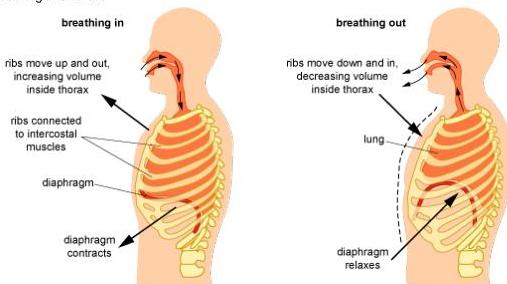
Ventilation is the movement of air into and out of the lungs. It relies on volume and pressure changes within the thoracic cavity.
Inhaling (Breathing In)
- The intercostal muscles contract, pulling the ribs up and out.
- The diaphragm contracts and flattens downwards.
- These movements increase the volume of the thoracic cavity.
- The increase in volume lowers the air pressure inside the lungs relative to the atmosphere.
- Air flows into the lungs to equalise the pressure.
Exhaling (Breathing Out)
- The intercostal muscles relax, and the ribs move down and in.
- The diaphragm relaxes and moves upwards into a domed shape.
- These movements decrease the volume of the thoracic cavity.
- The decrease in volume increases the air pressure inside the lungs.
- Air is forced out of the lungs.
Normal exhalation is passive, using only the diaphragm and intercostals. Forceful (active) exhalation involves the contraction of abdominal wall muscles.
Exercise 42: Which of these are associated with inhaling?
- The ribs move up and out.
- The diaphragm becomes domed.
- The pressure in the thorax decreases.
- The volume inside the thorax decreases.
Answer: b (1 and 3 only). During inhalation, the volume increases, which causes pressure to decrease.
Gas Exchange in the Alveoli
Gas exchange occurs via diffusion across the walls of the alveoli and the capillaries. Gases move from areas of high concentration to areas of low concentration. Oxygen diffuses from the alveoli into the blood, where it binds to haemoglobin in red blood cells. Carbon dioxide diffuses from the blood plasma into the alveoli to be exhaled.
Adaptations for Efficient Diffusion
- Large Surface Area: Millions of alveoli provide a vast area for exchange.
- Short Diffusion Distance: The walls of the alveoli and capillaries are each only one cell thick.
- Wrap-around Capillaries: Capillaries surround the alveoli, further reducing distance.
- Concentration Gradient: Constant blood flow and ventilation ensure oxygen levels remain high in the lungs and low in the blood, maintaining rapid diffusion.
Exercise 44: Which of the following would increase the rate of diffusion of oxygen and carbon dioxide? a) Alveoli changing shape from a bunch of grapes to a single rounded surface. b) Tar being deposited on the surface of the alveoli walls. c) An increase in heart rate.
Answer: c. An increase in heart rate moves blood faster, maintaining a steeper concentration gradient. Options a and b would decrease the surface area or increase diffusion distance.
Surface Area to Volume Ratio ()
The ratio compares the size of an organism's surface to its total volume. A larger ratio means there is more surface available for exchange relative to the volume of the organism.
Calculating SA:V Ratio
Using a cube with sides of as a model:
- Surface Area: A cube has 6 faces. Each face is . Total .
- Volume: .
- Ratio: , which simplifies to .

An organism with a large ratio (like a bacterium) can rely on diffusion for gas exchange. Large multicellular organisms (like humans) have small ratios, meaning diffusion alone is too slow. They require specialised exchange surfaces (lungs) and transport systems (circulatory system) to reach all cells quickly.
Exercise 46: Which is the correct surface area to volume ratio for a cube with sides? a) b) c) d)
Answer: c. . . Ratio .
Key takeaways
- Aerobic respiration requires oxygen and glucose to produce carbon dioxide, water, and energy, whereas anaerobic respiration in animals produces lactic acid.
- Ventilation is driven by pressure changes: inhaling occurs when thoracic volume increases (pressure drops), and exhaling occurs when volume decreases (pressure rises).
- Gas exchange efficiency is maximised by thin walls (one cell thick), a large surface area (millions of alveoli), and a steep concentration gradient (constant blood flow).
- Small organisms have a large surface area to volume ratio, allowing for simple diffusion: large organisms have small ratios and require specialised exchange surfaces.
- The trachea and bronchi are lined with cilia and mucus-producing cells to trap and remove inhaled particles and pathogens.
When answering questions on ventilation, always link the movement of the diaphragm and ribs to a change in volume first, then explain how that volume change creates the pressure difference that moves the air.
Do not confuse respiration with ventilation (breathing). Respiration is a chemical reaction for energy release, while ventilation is the mechanical movement of gas. Also, ensure you use the correct units and square/cube calculations when determining ratios.
The transition from simple diffusion to specialised respiratory systems in animals is a direct consequence of scaling. As an organism increases in size, its volume (demand) increases much faster than its surface area (supply), necessitating complex internal structures like alveoli to artificially increase surface area.
Frequently asked questions
What is the role of cartilage in the trachea?
The cartilage forms rings around the trachea to keep the airway open and prevent it from collapsing during the pressure changes associated with breathing.
Why does breathing rate increase during exercise?
Exercise increases the rate of aerobic respiration in muscle cells. A higher breathing rate brings in more oxygen and removes the increased levels of waste carbon dioxide produced.
How is the concentration gradient maintained in the lungs?
The gradient is maintained by continuous ventilation (bringing in fresh air with high oxygen and low carbon dioxide) and continuous blood flow in the capillaries (carrying oxygen away and bringing carbon dioxide to the lungs).
What happens if the surface area of the lungs is reduced?
If the surface area is reduced (for example, by diseases like emphysema), the rate of diffusion decreases, meaning less oxygen enters the blood and the individual may become breathless easily.