Ionic Bonding and Structure for the ESAT
Updated July 2026
Ionic bonding occurs when metal atoms transfer electrons to non-metal atoms, creating a giant lattice of oppositely charged ions. This page teaches how to predict ion charges, deduce chemical formulae, and explain the physical properties of ionic substances, such as high melting points and variable conductivity.
Ionic bonding is the strong electrostatic attraction between oppositely charged ions arranged in a regular, giant lattice structure. It typically involves the transfer of electrons from a metal to a non-metal to achieve stable noble gas electron configurations.
How are ionic compounds formed?
When a metal reacts with a non-metal, there is usually the transfer of electrons. During this process, the metal atoms lose electrons to become positively charged ions (cations), while the non-metal atoms gain these electrons to become negatively charged ions (anions). The resulting ionic compound is not a collection of individual molecules but a giant lattice composed of positive and negative ions held together by strong electrostatic forces.
Predicting ion charges
When atoms react to form ions, they gain or lose electrons to obtain the electron configuration of a noble gas, which represents a stable state. Consequently, the charge of these ions depends on the original electron configuration of the atoms. For instance, atoms in Group 1 of the Periodic Table possess one electron in their outer shell. By losing this single electron, they form ions.
The following trends apply to common elements in the Periodic Table:
- Group 1: Form ions (e.g. , , ).
- Group 2: Form ions (e.g. , , ).
- Group 13: Aluminium forms .
- Group 16: Form ions (e.g. , ).
- Group 17: Form ions (e.g. , , , ).
Some metals can form ions with different charges depending on the reaction conditions. In these cases, a Roman numeral is included in the name of the compound to identify the specific charge on the metal ion. For example, iron(II) oxide contains ions, whereas iron(III) oxide contains ions.
Common compound ions
Combinations of different atoms can exist as a single unit with an overall charge, known as 'compound ions' or polyatomic ions. You must learn the formulae and charges for the following common ions:
- Hydrogen:
- Ammonium:
- Hydroxide:
- Nitrate:
- Sulfate:
- Carbonate:
- Phosphate:
Determining the formulae of ionic compounds
In any ionic compound, the total number of positive and negative charges must balance out to zero. This principle allows us to determine the chemical formula by ensuring the total charge of the cations equals the total charge of the anions.
Worked Examples
- Iron(III) bromide: The iron(III) ion is and the bromide ion is . To balance the charge, three ions are needed. Formula: .
- Calcium oxide: The calcium ion is and the oxide ion is . One of each ion balances the charge. Formula: .
- Potassium sulfide: The potassium ion is and the sulfide ion is . Two ions are needed to balance one ion. Formula: .
- Aluminium oxide: The aluminium ion is and the oxide ion is . To balance the charges, we need two ions (total ) and three ions (total ). Formula: .
- Sodium carbonate: The sodium ion is and the carbonate ion is . Two ions are required. Formula: .
- Magnesium hydroxide: The magnesium ion is and the hydroxide ion is . Two ions are required. Brackets are used to show the multiplier applies to the whole compound ion. Formula: .
- Ammonium sulfate: The ammonium ion is and the sulfate ion is . Two ions are required. Formula: .
Physical properties of ionic compounds
Ionic compounds are generally solids at room temperature. They exist as a giant lattice, which is a huge, continuous, and regular structure of repeating ions.
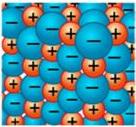
There is a strong overall electrostatic attraction between all the positive and negative ions throughout the lattice. This leads to several key properties:
- High melting points: Significant energy is required to overcome the many strong attractions between the ions in the lattice.
- Electrical conductivity: In the solid state, ionic compounds do not conduct electricity because the ions are held in fixed positions and cannot move. However, when melted (molten) or dissolved in water (aqueous solution), the lattice breaks down and the ions are free to move and carry the charge, making the substance a conductor.
Key takeaways
- Ions form when metals lose electrons to become positive and non-metals gain electrons to become negative.
- Ion charges can be predicted by group number: Group 1 (), Group 2 (), Group 16 (), and Group 17 ().
- Ionic formulae are determined by balancing the total positive and negative charges to zero, using brackets for multiple polyatomic ions.
- Ionic compounds have high melting points due to the strong electrostatic forces within their giant lattice structure.
- Ionic substances conduct electricity only when molten or in solution, as this allows the ions to move and carry charge.
When writing formulae for compounds containing polyatomic ions like or , always use brackets if there is more than one of that ion present, for example, rather than .
Do not confuse the charge of an ion with its group number. While Group 1 elements form ions, Group 17 elements form ions because they gain one electron to complete their outer shell rather than losing seven.
The strength of the ionic bond and the resulting melting point are influenced by the charge density of the ions. Ions with higher charges, such as and , generally form stronger electrostatic attractions than ions with lower charges like and , leading to higher melting points for compounds like compared to .
Frequently asked questions
Why do transition metals like iron have Roman numerals in their names?
Transition metals can form ions with different oxidation states (charges). The Roman numeral, such as in iron(III), specifies that the iron ion has a charge, distinguishing it from iron(II) which has a charge.
Why don't solid ionic compounds conduct electricity?
In a solid ionic lattice, the ions are locked into a regular, rigid structure by strong electrostatic forces. Because the ions are not free to move from place to place, they cannot carry an electrical current.
What is the difference between an atom and an ion?
An atom is electrically neutral with an equal number of protons and electrons. An ion is a charged particle formed when an atom gains or loses electrons to achieve a stable outer shell.