Covalent and Metallic Bonding for the ESAT
Updated July 2026
This lesson covers the nature of covalent and metallic bonding, including the distinction between simple molecular and giant covalent structures. You will learn how the arrangement of atoms and the forces between them dictate physical properties such as melting points, electrical conductivity, and hardness, which are critical concepts for the ESAT Chemistry section.
Covalent bonding involves the sharing of electron pairs between non-metals to achieve stable configurations, while metallic bonding consists of a lattice of positive ions held together by a sea of delocalised electrons.
Formation of Covalent Bonds
When non-metal atoms react with one another, they both require additional electrons to achieve a stable electron configuration. Rather than transferring electrons, they share them. A covalent bond is defined as the sharing of one or more pairs of electrons between atoms. This type of bonding is generally found between non-metal elements.
Molecular Substances
The majority of substances containing covalent bonds consist of discrete molecules. Each individual molecule is composed of a specific number of atoms held together by strong covalent bonds. For example, methane () is a small molecule containing one carbon atom and four hydrogen atoms. Larger molecules also exist, such as glucose (), which contains six carbon atoms, twelve hydrogen atoms, and six oxygen atoms.
Molecules can be represented using different models. A 2D stick diagram shows the bonds as lines between atoms, while a 3D stick diagram or a space-filling diagram provides a more realistic representation of the spatial arrangement of the atoms.
While the atoms within a molecule are joined by very strong covalent bonds, the molecules themselves are not joined to each other. There are only weak attractive forces between neighbouring molecules. Because these intermolecular forces are easy to overcome with relatively little energy, molecular substances typically have low melting and boiling points. Furthermore, molecular substances do not conduct electricity because they lack mobile ions or delocalised electrons to carry an electrical charge.
Giant Covalent Substances
In contrast to small molecules, some covalent substances form a single, giant lattice. These are continuous networks of atoms where every atom is linked to others by strong covalent bonds. Common examples include diamond (), graphite (), and silicon dioxide ().
Because every bond in the structure is a strong covalent bond, giant covalent substances have extremely high melting and boiling points, as a vast amount of energy is required to break these bonds.
Their physical properties depend on their specific lattice arrangement:
- Diamond and Silicon Dioxide: These substances are very hard because of their rigid, three-dimensional network of atoms. They do not conduct electricity because all electrons are fixed in bonds.
- Graphite: Graphite is unique because it is soft. The carbon atoms form layers that are not covalently bonded to each other, allowing the layers to slide. Graphite also conducts electricity because it contains delocalised electrons that are free to move along the layers.
Exercise 67: Interpreting Physical Properties
The properties of several substances are shown in the table below:
| Substance | Melting Point / Celsius | Boiling Point / Celsius | Conductivity as Solid | Conductivity as Liquid |
|---|---|---|---|---|
| A | -183 | -161 | insulator | insulator |
| B | 3550 | 4830 | insulator | insulator |
| C | 842 | 1494 | conductor | conductor |
| D | 114 | 183 | insulator | insulator |
| E | 1414 | 3265 | insulator | insulator |
| F | 661 | 1304 | insulator | conductor |
a) Which of these substances are made up of small covalent molecules? Substances A and D. They have low melting and boiling points and are insulators in both states.
b) Which of these substances have giant covalent structures? Substances B and E. They have very high melting and boiling points and do not conduct electricity.
Exercise 68: Understanding Boiling Points
Ethane () is a molecular substance with a low boiling point. Which of the following is a correct explanation of this?
A. The forces between the and atoms in the molecules are weak. B. The bonds between the and atoms in the molecules are weak. C. There are no double bonds in the molecules. D. The forces between the molecules are weak.
Answer: D. The boiling point is determined by the strength of the forces between molecules, not the bonds within them.
Metallic Bonding
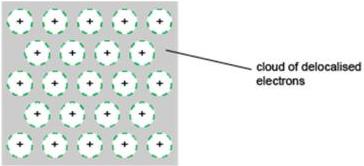
In solid and liquid metals, the atoms lose their outer shell electrons to a common pool. These electrons become delocalised, meaning they are free to move throughout the entire structure. A metal is therefore described as a lattice of positively charged ions surrounded by a sea of delocalised electrons.
Properties of Metals
Metals generally possess high melting points because the metallic bond is strong. This strength arises from the powerful electrostatic attraction between the positive metal ions and the negative delocalised electron cloud.
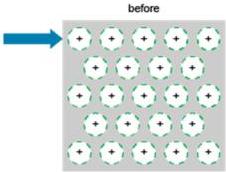
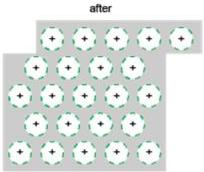
Metals are excellent conductors of electricity because the delocalised electrons can move and carry a charge through the material. They are also malleable, meaning they can be hammered into different shapes. This is possible because the metal ions can slide over each other while the sea of electrons maintains the bond, as shown in the diagrams below:
Exercise 69: Identifying Metallic Structures
Based on the table in Exercise 67 and the new data below, which substances have a metallic structure?
| Substance | Melting Point / Celsius | Boiling Point / Celsius | Conductivity as Solid | Conductivity as Liquid |
|---|---|---|---|---|
| A | 747 | 1396 | insulator | conductor |
| B | 650 | 1091 | conductor | conductor |
| C | -39 | 357 | conductor | conductor |
| D | 1414 | 3265 | insulator | insulator |
| E | 2572 | 2850 | insulator | conductor |
| F | 3422 | 5555 | conductor | conductor |
Answer: B, C, and F. Metals conduct electricity in both solid and liquid states.
Exercise 70: Melting Points of Metals
Iron is a metal with a high melting point. Which of the following is the best explanation of this?
A. The forces between atoms are strong. B. The forces between the metal ions are strong. C. The covalent bonds between the atoms are strong. D. The forces between the metal ions and delocalised electrons are strong.
Answer: D. The high melting point is due to the strong attraction between the positive ions and the delocalised electrons.
Key takeaways
- Covalent bonds are formed by sharing electron pairs, usually between non-metals.
- Simple molecular substances have low melting points due to weak intermolecular forces, while giant covalent structures have high melting points due to strong network bonding.
- Graphite conducts electricity due to delocalised electrons between layers, whereas most other giant covalent structures are insulators.
- Metallic bonding involves a lattice of positive ions in a sea of delocalised electrons, explaining their conductivity and malleability.
When identifying a substance from a table of properties, look at conductivity in the solid state first. If it conducts as a solid, it is likely a metal or graphite. If it only conducts when liquid, it is ionic.
Do not confuse 'intermolecular forces' with 'covalent bonds'. In ESAT questions about boiling points of small molecules, always refer to the weak forces between molecules, never the breaking of the covalent bonds themselves.
The transition from simple molecular to giant covalent is not always distinct. Some polymers act as very large molecules, but for the ESAT, you must strictly categorise them based on whether they form a continuous repeating lattice (giant) or individual discrete units (molecular).
Frequently asked questions
Why do molecular substances like have low boiling points if covalent bonds are strong?
Boiling involves overcoming the weak attractive forces between molecules (intermolecular forces), not breaking the strong covalent bonds within the molecules themselves.
How can graphite conduct electricity while diamond cannot?
In graphite, each carbon atom is bonded to three others, leaving one delocalised electron per atom that is free to move. In diamond, each carbon is bonded to four others, leaving no free electrons.
What determines if a substance is malleable?
Malleability occurs in metals because the layers of positive ions can slide over one another without breaking the metallic bond, as the sea of delocalised electrons acts as a flexible glue.