Density and Experimental Methods for the ESAT
Updated July 2026
Density is a fundamental property of matter that describes the mass per unit volume of a substance. For the ESAT, you must understand how to calculate density, convert between various units, and apply experimental techniques to measure the volume of regular and irregular objects across different states of matter.
Density () is defined as the mass () per unit volume () of a substance, expressed by the equation . It depends on both the mass of the constituent particles and how closely those particles are packed together.
Defining Density
The density of a substance is defined as its mass per unit volume. While different samples of the same material may have different total masses or volumes, the density remains a constant characteristic property at a given temperature and pressure. This makes density a useful tool for identifying substances or distinguishing between different materials.
The relationship between mass, volume, and density is given by the formula:
In symbolic form, this is written as:
Density is typically expressed in units of or . For liquids, is also frequently used.
Unit Conversions
It is common in ESAT questions to need to convert between and . To perform these conversions, recall the following relationships:
To convert from to , you can use the conversion factor of . For example, the density of aluminium is . To convert this to :
If an object is composed of multiple materials, it possesses an average density. This is calculated by dividing the total mass of the object by its total volume.
Worked Example: Aluminium Calculations
The density of solid aluminium is .
a) Write the density of aluminium in . b) Calculate the volume of a sample of aluminium.
Solution for part a:
Since and :
Therefore,
Solution for part b:
Rearrange the density formula to solve for volume:
Ensure units are consistent. If using density in , convert mass to grams: .
Rounding to three significant figures gives .
Experimental Determination of Densities
To determine density experimentally, you must measure both the mass and the volume of a sample. The specific method used depends on the state and shape of the sample.
-
Solid cuboids: Measure the mass using a balance. For volume, use a ruler or calliper to measure the length, width, and height. Multiply these dimensions together to find the volume.
-
Irregularly shaped solids: Measure the mass using a balance. To find the volume, use the displacement of water. Partially fill a measuring cylinder with water and record the initial volume. Submerge the sample completely. Record the new volume. The difference between the two readings is the volume of the solid. Note that the sample must be fully covered and must not cause the water to exceed the cylinder's scale.
-
Liquids: Place a measuring cylinder on a balance and record its mass (or tare the balance). Pour the liquid into the cylinder and record the new mass. Subtract the mass of the empty cylinder to find the mass of the liquid. The volume is read directly from the scale on the measuring cylinder.
Using a Displacement Can
For larger irregular solids, a displacement can (or eureka can) is used. The can is filled with water until it reaches the level of the spout. When the object is lowered into the water, it displaces a volume of water equal to its own volume. This overflow is collected in a measuring cylinder, providing a direct measurement of the sample's volume.
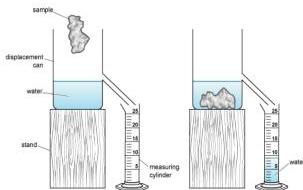
These displacement methods assume the solid does not dissolve in or react with the water, and that the solid sinks.
Objects that Float
If a solid is less dense than water, it will float. In this case, you must tie a heavy weight (a sinker) of known volume to the object. Submerge the combined pair and measure the total displaced volume. Subtract the volume of the sinker to find the volume of the original sample.
Worked Example: Floating Irregular Object
An irregularly shaped solid object has a mass of . A student ties a block of mass and density to the object so that it sinks. The total volume of water displaced by the block and the object together is . Calculate the density of the object.
Step 1: Find the volume of the block (sinker)
Step 2: Find the volume of the object
Step 3: Calculate the density of the object
Comparing Densities of Solids, Liquids, and Gases
The particle model explains density variations through two factors: the mass of individual particles and the spacing between them.
Solids and Liquids
In most substances, solids are slightly denser than their liquid counterparts because particles are packed more closely in a regular arrangement. Generally, a solid is approximately 1.1 times denser than the liquid state of the same substance.
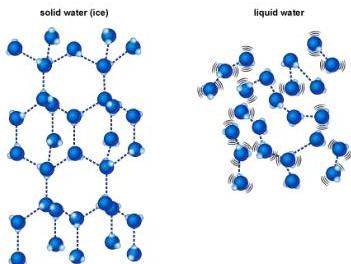
Water is a notable exception. Ice is less dense than liquid water because the molecules in ice are held in a rigid, open hexagonal lattice that keeps them further apart than the randomly arranged molecules in liquid water.
Gases
All substances are significantly less dense in the gaseous state. Particles in a gas are far apart, meaning there is much less mass per unit volume. A liquid's density typically decreases by a factor of roughly 1000 when it evaporates into a gas. Because gas particles are so spread out, their density is highly sensitive to temperature and pressure, which dictate particle separation.
Typical Values
- Solids and Liquids: Usually between and . Extremes include expanded polystyrene (about ) and gold (about ).
- Gases: Typically around at room temperature and atmospheric pressure.
It is possible for a specific solid to be less dense than a specific liquid. For instance, most woods float on water, and many solids float on liquid mercury. Some advanced materials like graphene aerogel are even less dense than air.
Worked Example: Particle Model Comparison
Use the particle model to explain why solids and liquids usually have similar densities but gases have much lower densities.
Solution:
According to the particle model, particles in both solids and liquids are in close contact, with very little empty space between them relative to their size. This results in a high mass per unit volume. In contrast, gas particles are separated by large distances. Consequently, there are far fewer particles in a given volume of gas, leading to a much lower mass per unit volume and a lower density.
Key takeaways
- Density is mass per unit volume, , and is an intrinsic property used to identify materials.
- To convert from to , multiply the value by .
- The volume of irregular solids can be found via water displacement using a measuring cylinder or a displacement can.
- Gases are roughly times less dense than solids or liquids because their particles are much further apart.
- While solids are usually denser than liquids, water is an exception where ice is less dense than the liquid state.
When performing density calculations, always check that your mass and volume units are compatible. If the mass is in and the volume is in , you must convert one of them before calculating the density to ensure you reach a standard unit like or .
A common mistake is forgetting to subtract the volume of the 'sinker' when measuring the volume of a floating object. Always ensure you are only calculating the volume displaced by the sample itself.
The fact that ice is less dense than water is critical for life on Earth. Because ice floats, it insulates the liquid water beneath it in lakes and oceans, preventing them from freezing solid and allowing aquatic life to survive during winter.
Frequently asked questions
Why does the density of a gas change with temperature?
As temperature increases, gas particles gain kinetic energy and move further apart if the pressure is constant. This increase in volume for the same mass results in a decrease in density.
Can two different objects have the same mass but different densities?
Yes. If two objects have the same mass but different volumes, their densities will be different. For example, of iron has a much smaller volume than of expanded polystyrene, so iron is more dense.
How do you measure the volume of a solid that reacts with water?
For solids that react with or dissolve in water, you must use a different liquid in the displacement can or measuring cylinder, such as oil, in which the solid is insoluble and non-reactive.
What is the density of water in standard units?
The density of water is approximately , which is equivalent to .