State Changes and Latent Heat for the ESAT
Updated July 2026
This lesson explains how substances transition between solid, liquid, and gas states. You will learn to identify melting and boiling points, understand the constant-temperature nature of state changes, and perform specific latent heat calculations. These concepts are fundamental for solving thermal physics problems in the ESAT.
During a state change, a pure substance absorbs or releases thermal energy (latent heat) without changing its temperature. This energy is used to change the distances and bonds between particles: .
Understanding Melting Point and Boiling Point
Most pure substances have a specific temperature at which they change state. While most substances progress through solid, liquid, and gas phases, some, like carbon dioxide, undergo sublimation, which is the direct change from solid to gas.
The melting point is the temperature at which a substance transitions between solid and liquid states. Melting occurs when a solid is at its melting point and continues to absorb energy, while freezing occurs when a liquid is at the same temperature and loses energy.
The boiling point is the temperature at which a substance transitions between liquid and gas throughout the entire bulk of the material. Boiling occurs above this temperature, while condensation occurs when a gas falls below it.
The table below outlines the state of a substance based on its temperature relative to these points:
- Below the melting point: Solid.
- At the melting point: Solid and liquid.
- Between the melting point and boiling point: Liquid.
- At the boiling point: Liquid and gas.
- Above the boiling point: Gas.
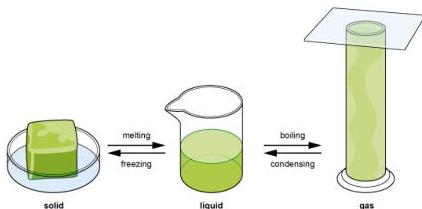
Pure substances have fixed melting and boiling points, but impure substances melt and boil over a range of temperatures. Therefore, an impure substance does not have a single, specific melting or boiling point.
Worked Example: Determining State at a Given Temperature
Determine the state of the following substances at 24 degrees Celsius:
- Bromine (melting point -7 degrees Celsius, boiling point 59 degrees Celsius): Liquid. This is because 24 degrees Celsius is higher than the melting point but lower than the boiling point.
- Fluorine (melting point -220 degrees Celsius, boiling point -188 degrees Celsius): Gas. This is because 24 degrees Celsius is significantly above the boiling point.
- Iodine (melting point 114 degrees Celsius, boiling point 184 degrees Celsius): Solid. This is because 24 degrees Celsius is below the melting point.
Latent Heat of Fusion and Vaporisation
Normally, transferring thermal energy to a body increases its temperature. However, during a state change, the temperature remains constant. While a pure substance melts or boils, the thermal energy it absorbs is used to increase the separations between particles rather than increasing their kinetic energy. This energy is called latent heat.
Conversely, when a substance freezes or condenses, it releases thermal energy to its surroundings. This happens as the attractions between particles increase and their separations decrease. The temperature will only begin to fall again once the entire sample has finished changing state.
- Latent heat of fusion applies to the transition between solid and liquid (melting or freezing).
- Latent heat of vaporisation applies to the transition between liquid and gas (boiling or condensing).
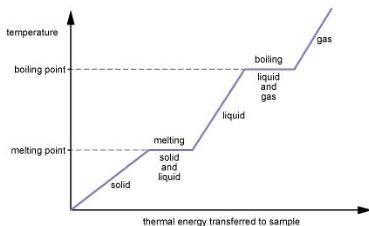
The graph above shows that temperature increases when the substance is in a single state but plateaus during the state change. If thermal energy is transferred at a constant rate, a temperature versus time graph will look identical to a temperature versus energy graph, only scaled differently.
Worked Example: Identifying Latent Heat Types
Identify the type of latent heat involved and whether it is absorbed or released in the following processes:
- Ice melting: Latent heat of fusion is absorbed. The substance is changing from solid to liquid, so it must absorb thermal energy to overcome particle attractions at a constant temperature.
- Gaseous propane changing to liquid: Latent heat of vaporisation is released. This is condensation, where the gas transfers energy to the surroundings as it becomes a liquid.
Specific Latent Heat Calculations
The term specific in physics means per unit mass. The specific latent heat, , is the thermal energy required to change the state of 1 kg of a substance without changing its temperature. The formula is:
Where:
- is the thermal energy transferred in Joules (J).
- is the mass of the sample in kilograms (kg).
- is the specific latent heat in .
When calculating energy for a process involving both temperature changes and state changes, you must calculate the energy for each stage separately and add them together. For example, to turn ice at -10 degrees Celsius into water at 0 degrees Celsius, you would calculate the energy to heat the ice to its melting point using specific heat capacity, and then the energy to melt it using specific latent heat.
Worked Example: Energy Calculation
Calculate the energy required to turn 3.0 kg of ice at 0 degrees Celsius into liquid water at 0 degrees Celsius. The specific latent heat of fusion for water is 330 kJ/kg.
- Identify variables: , .
- Use the formula: .
- Calculate: or 990 kJ.
Worked Example: Finding Specific Latent Heat
Calculate the specific latent heat of vaporisation if 6900 kJ of thermal energy is released when 3.0 kg of water vapour at 100 degrees Celsius condenses to liquid water at 100 degrees Celsius.
- Rearrange the formula: .
- Substitute values: .
- Calculate: or 2300 kJ/kg.
Key takeaways
- A pure substance's temperature remains constant during a state change because energy is used to change particle separation.
- Latent heat of fusion relates to solid and liquid transitions, while latent heat of vaporisation relates to liquid and gas transitions.
- The energy for a state change is calculated using , where is the specific latent heat in .
- Impure substances do not have fixed melting or boiling points but transition over a range of temperatures.
Always check the units for specific latent heat in exam questions. It is frequently given in kJ/kg, so you must multiply by 1,000 to convert to J/kg before using it in the standard formula.
Do not confuse specific heat capacity with specific latent heat. Specific heat capacity is used when the temperature of a substance changes without a state change, while specific latent heat is used when a state change occurs at a constant temperature.
On a cooling or heating curve, the gradient represents the rate of temperature change, which is linked to specific heat capacity. The horizontal sections represent the latent heat being transferred. A longer horizontal section for a given rate of heating indicates a higher specific latent heat for that substance.
Frequently asked questions
What happens to the temperature of a liquid while it is boiling?
The temperature remains constant at the boiling point until all of the liquid has turned into gas. The energy added is used to overcome the intermolecular forces between the particles.
What is the difference between fusion and vaporisation?
Fusion refers to the state change between solid and liquid (melting or freezing), whereas vaporisation refers to the state change between liquid and gas (boiling or condensing).
How do you calculate total energy if a substance is heated and then melts?
You must sum the two separate energy components: the energy to raise the temperature () and the energy to change the state ().
Why do impure substances melt over a range of temperatures?
Impure substances consist of different molecules or atoms that interfere with the regular structure or boiling process, preventing the substance from having a single, sharp transition temperature.