Pressure and Hydrostatic Pressure for the ESAT
Updated July 2026
This lesson covers the fundamental physics of pressure in solids and fluids. You will learn to calculate pressure using force and area, derive hydrostatic pressure from fluid density and depth, and distinguish between pressure contributions from solids, liquids, and the atmosphere.
Pressure is the force per unit area acting on a surface, expressed as . In fluids, the hydrostatic pressure is determined by the depth, density, and gravitational field strength, calculated using .
Understanding Pressure in Solids
When a force is applied to a surface, the pressure exerted is defined by the relationship between that force and the area over which it is distributed. The formula is:
In this context, area refers to the specific area of contact where the force is applied. Therefore, pressure is effectively the force per unit area acting on that surface.
If the force is measured in newtons (N) and the area is measured in square metres (), the resulting unit for pressure is the pascal (Pa). By definition, .
When an object is placed on a horizontal surface, the force it exerts on that surface is equal to the object's weight. For example, consider a box with a mass of 12 kg and a base area of 0.50 resting on the floor. The pressure exerted by the box is calculated as follows:
Using :
Controlling Pressure through Force and Area
As the mathematical relationship indicates, pressure can be manipulated in two ways. To increase pressure, one can either increase the applied force or decrease the contact area. Conversely, to decrease pressure, one must either decrease the force or increase the area.
Practical applications of high pressure include tools like sewing needles and knives. These are designed with extremely small contact areas at their points or edges. This small area maximises the pressure generated from the user's force, allowing the needle to pierce cloth or the knife to slice through food easily.
Applications of low pressure include snowshoes and skis. These items feature a large contact area with the snow. By spreading the wearer's weight over a greater area, the pressure is minimised, preventing the person from sinking into the soft snow.
A drawing pin (thumbtack) illustrates both principles. It has a broad head at one end and a sharp point at the other. When you push the pin into a board, the force applied by your thumb at the head is equal to the force delivered at the sharp point. However, because the area of the point is so small, the pressure at the tip is high enough to penetrate the board, while the pressure at the thumb end remains low enough to avoid causing pain.
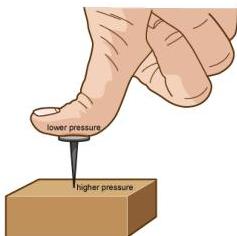
It is important to distinguish between different sources of pressure. The total pressure on a surface is the sum of the pressure from the object (the solid) and the pressure from the surrounding gas, such as the atmosphere. The term 'pressure due to the solid' specifically refers to the contribution from the object's weight alone.
Worked Example: Table Pressure
A table with a weight of 250 N has four legs. Each leg has a square cross-section with a width of 5.0 cm in contact with the ground. To find the pressure exerted on the ground:
- Calculate the contact area of one leg in square metres: .
- Calculate the total contact area for all four legs: .
- Apply the pressure formula: .
Hydrostatic Pressure in Fluids
Fluids include both liquids and gases, which are substances capable of flowing. Pressure in a fluid acts in all directions and increases with depth. The pressure at any point in a fluid is caused by the weight of the fluid situated above that point. This hydrostatic pressure depends on the depth (), the density of the fluid (), and the gravitational field strength ():
When is in metres, is in , and is in , the pressure is calculated in pascals. Crucially, hydrostatic pressure depends only on these variables and is independent of the shape of the container. If multiple containers hold the same liquid, the pressure at the same depth will be identical in all of them, regardless of the container's width or profile.
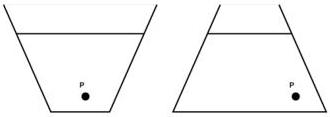
Deriving the Hydrostatic Pressure Formula
We can derive this formula by imagining a cuboid of liquid within a larger body of liquid. The cuboid has a cross-sectional area and a height , with its top surface at the liquid's surface.
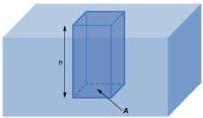
The pressure at the base of this cuboid is due to the weight of the liquid column above it:
- The volume of the liquid cuboid is .
- The mass of the liquid is .
- The weight of the liquid (the force) is .
- Using , the pressure at the base is .
Just as with solids, the total pressure at a depth in a liquid is the sum of the hydrostatic pressure and the atmospheric pressure pressing down on the liquid's surface.
Worked Example: Sea Floor Depth
At a specific point on the sea floor, the total pressure is . Given the density of seawater is , atmospheric pressure is , and , calculate the depth.
- Find the pressure due to the water alone (hydrostatic pressure): .
- Rearrange the formula to solve for height: .
- Substitute the values: .
Key takeaways
- Pressure in solids is calculated as , where is the contact area in .
- Hydrostatic pressure in fluids is calculated as and increases linearly with depth.
- Pressure in a fluid acts in all directions and is independent of the shape of the container.
- Total pressure at a depth is the sum of the fluid's hydrostatic pressure and the atmospheric pressure above it.
- The standard unit of pressure is the pascal (Pa), where .
When calculating the pressure of an object with multiple contact points, such as a chair or a car, remember to sum the areas of all contact points (e.g., all four feet) to find the total area used in the formula.
A common error is forgetting to convert units into the SI standard before calculating. Always ensure areas are in (not ) and heights are in metres to ensure the pressure is correctly output in pascals.
The derivation of assumes that the density of the fluid is constant. While this is largely true for liquids like water, the density of gases (like the atmosphere) changes significantly with altitude, meaning the linear relationship is only an approximation for large vertical distances in the air.
Frequently asked questions
Does the width of a column of water affect the pressure at its base?
No. Hydrostatic pressure depends only on the vertical depth, the density, and gravity. The total volume or width of the container does not change the pressure at a specific depth.
What happens to the pressure if I double the area over which a force is applied?
According to , if the force remains constant and the area is doubled, the pressure will be halved.
Why must I subtract atmospheric pressure when calculating depth from total pressure?
The formula only calculates the pressure exerted by the liquid itself. If you are given the total pressure, you must remove the atmospheric contribution to find the specific pressure caused by the weight of the water column.
What are the units for density in the hydrostatic pressure equation?
To get the pressure in pascals, density must be in kilograms per cubic metre (). If given in , you must convert it by multiplying by 1000.