Wave Properties and the Wave Equation for the ESAT
Updated July 2026
This lesson covers the fundamental physics of waves, exploring how energy is transferred without the movement of matter. You will learn to distinguish between transverse and longitudinal waves, define key terms such as amplitude and frequency, and apply the wave equation to sound and electromagnetic radiation.
A wave is an oscillation that transfers energy from one location to another without any net transfer of matter. The relationship between wave speed, frequency, and wavelength is defined by the fundamental equation .
Energy Transfer Without Net Movement of Matter
Waves are patterns of vibrations, or oscillations. When a wave is absorbed by an object, it transfers energy to that object, but there is no net transfer of matter in the direction the wave is travelling.
Consider these examples of energy transfer:
- Sound: When vocal cords vibrate, they cause nearby air to vibrate. This pattern is passed through the air as a wave until it reaches a listener's ear. No air from the speaker's mouth actually enters the listener's ear.
- Radio Waves: Electrons vibrating in a transmitter create electromagnetic waves. These waves cause electrons in a distant receiving antenna to vibrate at the same frequency, transferring energy. No electrons move from the transmitter to the receiver.
- Water Waves: Ripples on a pond involve a pattern of peaks and troughs moving outwards. While the water moves up and down, no water is actually moved away from the source.
Worked Example: Energy in Sound
A teacher claps his hands to get the attention of his class. Which of the following is correct?
- Energy was transferred from his hands to the air.
- Energy was transferred through the air as a pattern of vibrations.
- Vibrating air was transferred from his hands to the ears of pupils.
- Energy was transferred from the vibrating air to the ears of pupils.
Solution: Clapping transfers energy to the air to create a sound wave (a pattern of vibration). This pattern travels through the room. When it reaches the pupils' ears, it transfers energy to them. No air from the teacher's hands reaches the pupils, so statement 3 is incorrect. Statements 1, 2, and 4 are correct.
Worked Example: Identifying Misconceptions
Which of the following statements about waves is incorrect?
- Ocean waves transfer matter because they move boats up and down as they pass.
- Seismic waves from earthquakes transfer energy because they can destroy buildings.
- Sound waves from a loudspeaker are given energy from the speaker as it vibrates.
- Dark surfaces gain energy when they absorb the light that falls onto them.
Solution: Statement 1 is incorrect. While ocean waves move boats up and down, the water oscillates about a fixed position and does not move with the wave. Statements 2, 3, and 4 are all correct descriptions of energy transfer.
Transverse and Longitudinal Waves
Waves consist of oscillating particles or fields. The nature of these oscillations determines the type of wave:
- Transverse waves: The direction of vibration is perpendicular (at 90 degrees) to the direction of wave travel.
- Longitudinal waves: The direction of vibration is parallel (along the same line) to the direction of wave travel.
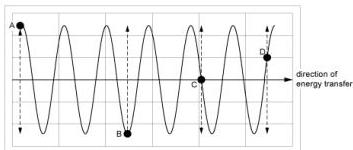
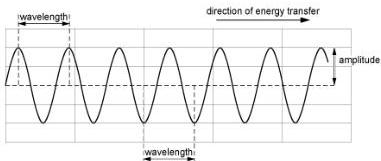
In the transverse wave diagram above, particles A, B, C, and D oscillate vertically while the wave moves horizontally.
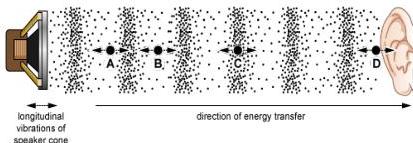
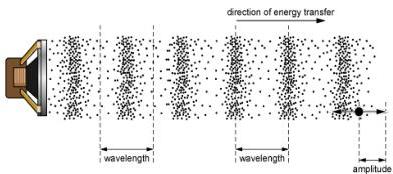
In the longitudinal wave diagram above, particles A, B, C, and D oscillate horizontally, parallel to the direction of energy transfer.
Common Examples
| Transverse | Longitudinal |
|---|---|
| All electromagnetic waves | Sound |
| Waves on a string | Ultrasound |
| Seismic S-waves | Compression waves on a slinky |
| Seismic P-waves |
Water waves are unique because they are a mixture of both transverse and longitudinal motions. Particles move in an elliptical path, yet there is still no net movement of water in the direction of the wave.
Worked Example: Slinky Demonstrations
A teacher uses a slinky to show two types of motion:
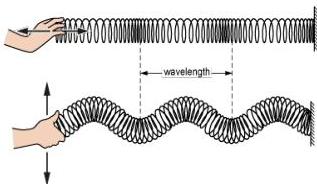
Scenario 1 (Top): The hand moves horizontally, compressing and extending the spring. This makes the coils vibrate parallel to energy transfer. This is a longitudinal wave.
Scenario 2 (Bottom): The hand moves vertically. The coils vibrate perpendicular to energy transfer. This is a transverse wave.
Peak, Trough, Compression, and Rarefaction
In a transverse wave, the pattern creates equally spaced peaks (maximum positive displacement) and troughs (maximum negative displacement).
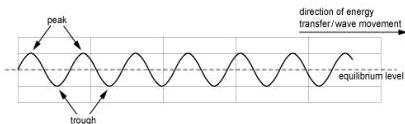
In a longitudinal wave, the pattern creates compressions and rarefactions.
- A compression occurs when particles are pushed together.
- A rarefaction occurs when particles are pulled further apart.
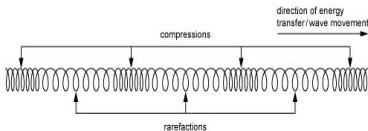
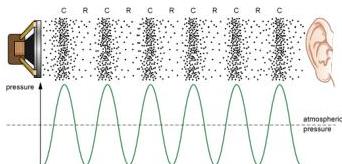
In a sound wave, compressions and rarefactions cause the air pressure to fluctuate above and below atmospheric pressure. Regions of compression correspond to high pressure, while rarefactions correspond to low pressure.
Wavefronts
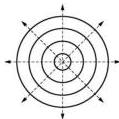
Waves can be represented by wavefronts, which map out the pattern of peaks or compressions. For water ripples from a point source, these are circular.

Worked Example: Swimmers on a Wave
Two swimmers are 12 m apart. As a wave passes, they move up and down, completing a cycle in 5.0 s. When one is at a peak, the other is at the next trough.
- Adjacent peak distance: The distance from peak to trough is half a wavelength. Therefore, the wavelength m.
- Frequency: One cycle in 5.0 s means Hz.
- Wave speed: Speed . A peak moves 12 m (to the trough position) in 2.5 s (half a period). So m/s. Alternatively, m/s.
Mechanical vs Electromagnetic Waves
Mechanical waves (e.g., sound, water, seismic) require a material medium to travel because they rely on vibrating particles. They cannot travel through a vacuum.
Electromagnetic waves (e.g., light, radio, X-rays) consist of vibrating electric and magnetic fields. They do not require a medium and can travel through a vacuum at the speed of light.
Worked Example: Bell in a Jar
An electric bell is in a glass jar. As air is pumped out (creating a vacuum), what happens?
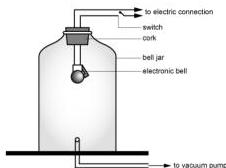
Solution: The observer can still see the bell because light is an electromagnetic wave and travels through a vacuum. However, the observer cannot hear the bell because sound is a mechanical wave and requires a medium (air) to propagate. Therefore, statement 4: "An observer will not be able to hear the bell because sound is a mechanical wave" is correct.
Wave Definitions and the Wave Equation
- Wavelength (): The distance between adjacent peaks/troughs or adjacent compressions/rarefactions.
- Amplitude: The maximum displacement of a particle from its equilibrium position.
- Period (): The time for one complete oscillation (seconds).
- Frequency (): The number of oscillations per second (Hertz, Hz).
Worked Example: Comparing Waves
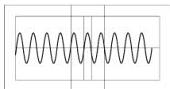
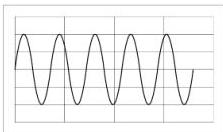 Wave 1 and Wave 2 have the same speed. Looking at the scales: Wave 2 has a larger distance between peaks (longer wavelength) and a greater vertical displacement (larger amplitude). Since , if is constant and is larger for Wave 2, then Wave 1 must have a higher frequency.
Mathematical Relationships
- (where is distance and is time)
Prefixes to recall:
- milli (m):
- micro ():
- nano (n):
- kilo (k):
- mega (M):
- giga (G):
Worked Example: Microphone Signal
A signal shows 6 complete cycles over 108 ms.
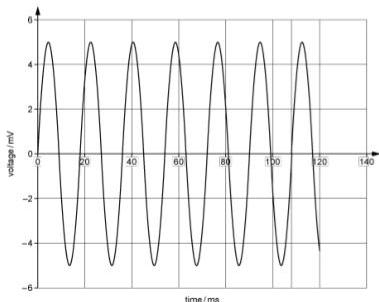
ms, so ms s. Hz.
Ranging and Ultrasound
Wave speed can be used to measure distance via reflection. Distance to an object .
Worked Example: Ultrasound Eye Scan
An A-scan uses ultrasound ( m/s) to measure the eye.
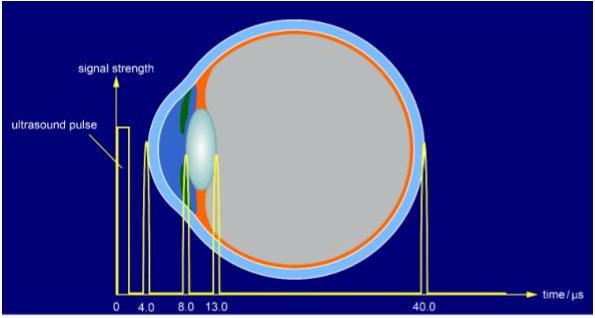 Return times from cornea () and back of eye ().
Length m or 2.8 cm.
Return times from cornea () and back of eye ().
Length m or 2.8 cm.
The Wave Equation Derivation
A source emitting waves at frequency produces waves in time . Each has length , so the total distance moved is . Speed .
Key takeaways
- Waves transfer energy from one point to another without the net transfer of the medium itself.
- Transverse waves oscillate perpendicular to travel (e.g. light), while longitudinal waves oscillate parallel (e.g. sound).
- The wave equation relates speed, frequency, and wavelength for all waves.
- Frequency and period are inversely related by .
- Mechanical waves require a medium, whereas electromagnetic waves can propagate through a vacuum.
When using , always ensure units are consistent. Convert milliseconds or microseconds to seconds and kilohertz or megahertz to hertz before performing calculations.
A common error is confusing the movement of the wave with the movement of the particles. Remember that in a longitudinal wave, particles move back and forth, not in the direction of the wave's travel.
The fact that light can travel through a vacuum while sound cannot was a major clue in early physics that light is not a mechanical vibration of a physical substance, leading eventually to the theory of electromagnetism.
Frequently asked questions
What is the difference between S-waves and P-waves?
S-waves (secondary) are transverse seismic waves that only travel through solids. P-waves (primary) are longitudinal seismic waves that travel faster and can move through both solids and liquids.
Why is a factor of 1/2 used in sonar and radar distance calculations?
The time measured is for the wave to travel to the object and back. Since the distance to the object is only one leg of that trip, we must divide the total distance () by 2.
Can electromagnetic waves be longitudinal?
No. By definition, all electromagnetic waves are transverse waves, consisting of oscillating electric and magnetic fields perpendicular to the direction of travel.
What happens to the frequency of a sound wave if its period is doubled?
Since , doubling the period () will halve the frequency ().