Atomic Structure and Radioactivity for the ESAT
Updated July 2026
This section explores the fundamental nuclear model of the atom, including the properties of protons, neutrons, and electrons. It covers nuclide notation, isotopes, and ionisation, while also introducing the random nature of radioactive decay. Understanding these concepts is vital for solving nuclear equations involving alpha, beta, and gamma radiation on the ESAT.
The atom consists of a small, dense nucleus of protons and neutrons surrounded by electrons. Radioactive decay occurs when an unstable nucleus spontaneously emits radiation (alpha, beta, or gamma) to reach a more stable state, following specific conservation laws for mass and atomic numbers.
The Nuclear Model of the Atom
Every atom is composed of three primary subatomic particles: protons, neutrons, and electrons. The nuclear model of atomic structure states that an atom features a tiny, extremely dense central region called the nucleus. This nucleus contains one or more protons and, in almost all cases, neutrons. The only exception is the most common form of hydrogen, which contains only a single proton. Protons and neutrons, because they reside in the nucleus, are referred to collectively as nucleons.
Apart from the nucleus, the rest of the atom consists of empty space through which one or more electrons move in orbits. The overall size of the atom is defined by these electron orbits.
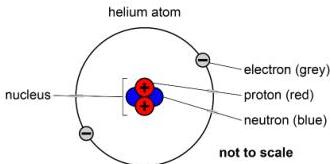
The scale of the atom is surprising: a nucleus typically has a radius approximately 100,000 times smaller than the radius of the entire atom. Despite this size difference, the nucleus contains more than 99.9% of the total mass of the atom.
Worked Example: Calculating Neutrons
An atom of gold possesses 79 protons and 197 nucleons. How many neutrons does this atom contain?
Because the total number of nucleons is the sum of protons and neutrons, we subtract the number of protons from the total nucleon count: neutrons.
Subatomic Particle Properties
Protons, neutrons, and electrons differ significantly in their mass and electrical charge. While protons and neutrons have almost identical masses, the electron is much lighter. In terms of charge, the proton and electron carry equal and opposite charges, while the neutron is neutral.
| Type of particle | Relative mass | Relative charge |
|---|---|---|
| Proton | 1 | +1 |
| Neutron | 1 | 0 |
| Electron | 1/2000 | -1 |
An atom is electrically neutral because it contains an equal number of protons and electrons. While it may seem that the positively charged protons in the nucleus should repel each other, they are held together by the strong nuclear force, which overcomes the electrostatic repulsion.
Worked Example: Nucleus Charge
Which of the following describes the charge on an atomic nucleus?
a) Always positive, b) Always negative, c) Always neutral.
Since a nucleus consists of positive protons and neutral neutrons, the overall charge of the nucleus must always be positive. The correct answer is a.
Worked Example: Electron Count
An atom has 19 nucleons and 10 neutrons. How many electrons are present?
First, find the number of protons: protons. Since the atom is neutral, it must have an equal number of electrons, so there are 9 electrons.
Atomic Number, Mass Number, and Isotopes
The identity of an element is determined by its atomic number (also known as the proton number), which is the number of protons in the nucleus. If two atoms have different atomic numbers, they belong to different elements.
The mass number (or nucleon number) is the total count of protons and neutrons in the nucleus. By knowing both numbers, you can determine the neutron count by calculating the difference.
Isotopes are different varieties of the same element. They possess the same atomic number but different mass numbers, meaning they have the same number of protons but different numbers of neutrons. For instance, hydrogen has three isotopes: , , and .
Nuclide Notation
A nuclide refers to a specific species of nucleus characterized by its specific number of protons and neutrons. We represent these using nuclide notation:
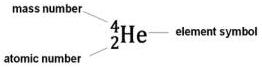
In this notation, the mass number is the upper number and the atomic number is the lower number. Sometimes, nuclides are written as the element name followed by the mass number, such as Helium-4 or He-4.
Worked Example: Converting Notation
Write the nuclide notation for a phosphorus nucleus (P) with 15 protons and 17 neutrons.
The atomic number is 15. The mass number is the sum of protons and neutrons: . The notation is .
Ionisation
Ionisation occurs when an atom gains or loses one or more electrons. This process does not change the nucleus (the number of protons remains the same), but it does change the overall charge of the particle, which is then called an ion.
- If an atom loses electrons, it becomes a positive ion.
- If an atom gains electrons, it becomes a negative ion.
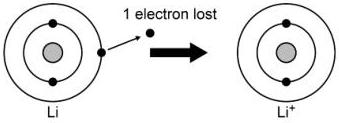
Ionisation can be caused by chemical bonding, friction between materials, or exposure to ionising radiation.
Radioactive Decay and Emissions
Unstable nuclei seek stability by decaying and emitting radiation. This process is random and spontaneous. It is impossible to predict exactly when a specific nucleus will decay, and the rate of decay cannot be altered by external factors like temperature or pressure.
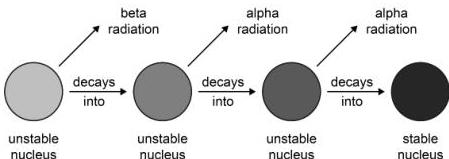
There are three main types of radiation emitted during decay:
- Alpha (): A particle consisting of two protons and two neutrons (a Helium-4 nucleus). It has a relative mass of 4 and a charge of +2. It is relatively slow, at about 0.1 times the speed of light.
- Beta (): A fast-moving electron emitted when a neutron in the nucleus changes into a proton. It has a negligible mass and a charge of -1. Its speed is typically 0.8 times the speed of light.
- Gamma (): High-energy electromagnetic radiation. It has no mass and no charge, and it travels at the speed of light ().
Nuclear Equations
We use nuclear equations to represent decay. In these equations, the sum of the mass numbers and the sum of the atomic numbers must be equal on both sides of the arrow.
Alpha Decay Equation:
Beta Decay Equation:
Worked Example: Sequential Decay
Thorium-232 () undergoes alpha decay to become Radium (Ra). Then, that Radium isotope undergoes beta decay to become Actinium (Ac).
For the first step: . For the second step: .
Key takeaways
- The atomic number () defines the element and represents the number of protons, while the mass number () represents the total number of nucleons.
- Isotopes are atoms of the same element with different numbers of neutrons, while ions are atoms that have gained or lost electrons.
- Radioactive decay is a random and spontaneous process that cannot be influenced by external physical conditions such as temperature.
- Alpha decay reduces the mass number by 4 and the atomic number by 2; beta decay increases the atomic number by 1 while the mass number remains unchanged.
- In any nuclear equation, the total mass number and total charge (atomic number) must be conserved across the reaction.
When balancing nuclear equations, always check the bottom numbers (atomic numbers) first to identify the new element, then use the top numbers (mass numbers) to ensure nucleon conservation.
A common error is confusing the mass of an electron with the mass of a nucleon. For the purpose of mass number calculations, the electron's mass is considered negligible (0), but its charge (-1) is critical for balancing atomic numbers in beta decay equations.
The existence of the strong nuclear force explains why heavy nuclei require a higher ratio of neutrons to protons to remain stable; the neutrons provide additional attractive strong force without adding to the electrostatic repulsion.
Frequently asked questions
Why does the atomic number increase during beta decay if a particle is being emitted?
In beta decay, a neutron inside the nucleus transforms into a proton and an electron. The electron (the beta particle) is ejected, but the new proton remains in the nucleus, increasing the atomic number by 1.
What is the difference between a nucleon and a neutron?
A nucleon is a general term for any particle found in the nucleus, which includes both protons and neutrons. A neutron is a specific type of nucleon that has no electrical charge.
Does gamma emission change the identity of an element?
No. Gamma radiation is electromagnetic energy and carries no protons or neutrons. Therefore, the atomic number and mass number remain the same, and the element does not change.
How can I calculate the charge of an ion if I know the number of protons and electrons?
The charge is calculated as (Number of Protons) minus (Number of Electrons). For example, 11 protons and 10 electrons result in a charge.