Electromagnetic Spectrum for the ESAT
Updated July 2026
This lesson covers the nature, order, and properties of electromagnetic waves for the ESAT Physics syllabus. You will learn the specific order of the spectrum from radio waves to gamma rays, the relationship between wavelength and frequency, and the critical applications and biological hazards associated with each region.
Electromagnetic waves are transverse waves consisting of oscillating electric and magnetic fields that travel at the speed of light, , in a vacuum. They transfer energy from a source to an absorber without the need for a material medium.
The Nature and Properties of Electromagnetic Waves
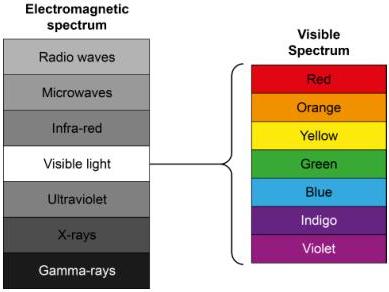
Electromagnetic (EM) waves are a group of transverse waves that include radio waves, microwaves, infrared, visible light, ultraviolet, X-rays, and gamma rays. They have several fundamental properties that distinguish them from mechanical waves like sound:
- They consist of vibrating electric and magnetic fields rather than vibrating particles.
- They do not require a material medium and can travel through a vacuum.
- They all travel at the same speed in a vacuum, known as the speed of light ().
- They transfer energy from a source to an absorber.
The fact that light and other radiations reach us from the Sun and distant stars provides evidence that these waves can travel through a vacuum. Unlike mechanical waves, which slow down or cannot travel in a vacuum, EM waves are at their fastest in a vacuum and travel at lower speeds in other media like glass or water.
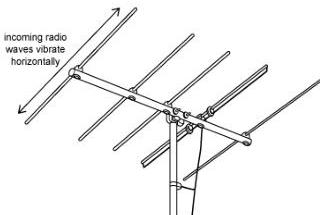
EM waves are transverse because the vibrations of the fields are perpendicular to the direction of energy transfer. This property is demonstrated by TV antennas. As shown in the diagram below, antenna rods are aligned to detect radio waves that vibrate in a specific plane. When these waves hit the rods, they cause electrons to oscillate at the same frequency, creating an electrical signal.
Component Parts of the Electromagnetic Spectrum
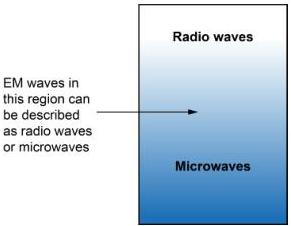
The electromagnetic spectrum is a continuous range of waves. While we divide it into seven distinct regions, the boundaries between them are not sharp and often overlap. For instance, a wave near the border of the microwave and radio regions might be classified as either.
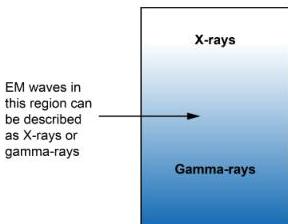
In the overlap between X-rays and gamma rays, the distinction is usually based on their origin. X-rays are typically produced by fast moving electrons hitting a metal target, while gamma rays are produced by radioactive decay. If they have the same wavelength, they are physically identical.
Order, Wavelength, and Frequency
The regions of the EM spectrum are defined by their wavelength () and frequency (). Because all EM waves travel at the speed in a vacuum, frequency and wavelength are inversely proportional, as shown by the wave equation:
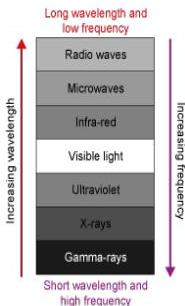
This means that waves with the longest wavelengths have the lowest frequencies, and waves with the shortest wavelengths have the highest frequencies. The order of the spectrum from longest wavelength (lowest frequency) to shortest wavelength (highest frequency) is:
- Radio waves
- Microwaves
- Infrared (IR)
- Visible light
- Ultraviolet (UV)
- X-rays
- Gamma rays
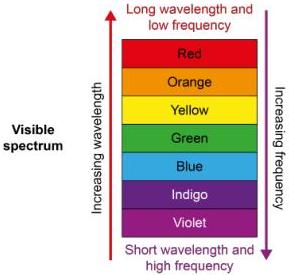
Within the visible spectrum, red light has the longest wavelength and lowest frequency, while violet light has the shortest wavelength and highest frequency.
Applications and Hazards of the EM Spectrum
Each part of the spectrum has specific uses based on its energy and how it interacts with matter. However, higher frequency waves generally carry more energy and pose greater risks, particularly ionisation.
Radio Waves and Microwaves
Radio waves are used for television, radio communications, and radar. They are generally only hazardous at extremely high intensities. Microwaves are used for satellite communications, mobile phones, and cooking. Hazards include internal heating of body tissues and the potential to cause cataracts in the eye.
Infrared and Visible Light
Infrared is used in radiant heaters, remote controls, and thermal imaging. The primary hazard is cell damage or burns. Visible light is used for sight, photography, and fibre optics. Intense sources of visible light, such as lasers or the Sun, can permanently damage the retina.
Ultraviolet, X-rays, and Gamma rays
Ultraviolet radiation is used for security marking, sterilisation, and tanning. It can cause sunburn, skin cancer, and retinal damage. X-rays are used for medical imaging and airport security, while gamma rays are used for cancer radiotherapy and food sterilisation. Both X-rays and gamma rays are ionising radiation. They can damage DNA, leading to cell mutation or cancer. Gamma rays are particularly dangerous because they can affect sex cells, leading to hereditary effects.
Worked Example: X-rays and Ultraviolet Radiation
Question: Which of the following statements about X-rays and ultraviolet radiation is or are correct?
- X-rays are transverse waves but ultraviolet radiation is longitudinal.
- They both travel at the speed of light in a vacuum.
- They have different wavelengths and different frequencies.
- X-rays are invisible but ultraviolet radiation is visible.
Solution: Statement 1 is incorrect because all electromagnetic waves are transverse. Statement 2 is correct as is constant for all EM waves in a vacuum. Statement 3 is correct because X-rays have higher frequencies and shorter wavelengths than UV. Statement 4 is incorrect because neither is within the visible range of 400 to 700 nm. Therefore, statements 2 and 3 are correct.
Worked Example: Wavelength Stretching
Question: As the universe expands, the wavelength of electromagnetic waves is stretched. Which of the following changes could occur as a result of this expansion?
- Gamma rays become microwave radiation.
- Blue light becomes ultraviolet radiation.
- X-rays become infrared radiation.
- Microwaves become visible light.
Solution: Stretching a wavelength means increasing its value. We must look for pairs where the second type of radiation has a longer wavelength than the first.
- Gamma rays () to microwaves (): This is an increase, so it is possible.
- Blue light to UV: UV has a shorter wavelength, so this is impossible.
- X-rays to infrared: Infrared has a longer wavelength, so this is possible.
- Microwaves to visible: Visible has a shorter wavelength, so this is impossible. Statements 1 and 3 are correct.
Key takeaways
- All electromagnetic waves are transverse and travel at in a vacuum.
- The EM spectrum order from longest to shortest wavelength is: Radio, Microwave, IR, Visible, UV, X-ray, Gamma.
- Frequency is inversely proportional to wavelength ().
- High frequency waves like X-rays and Gamma rays are ionising and can cause cancer by damaging DNA.
- EM waves transfer energy from a source to an absorber through oscillating electric and magnetic fields.
In the ESAT, remember that 'shorter wavelength' always means 'higher frequency' and 'higher energy' for EM waves. Memorise the order of the spectrum carefully: many questions rely on knowing which radiation has a higher frequency than another.
Do not confuse ultrasound with ultraviolet. Ultrasound is a high frequency longitudinal mechanical wave, while ultraviolet is a high frequency transverse electromagnetic wave. They have completely different physical properties.
The fact that light speed is constant for all observers and all frequencies in a vacuum is a cornerstone of Einstein's Special Relativity. In other media, however, shorter wavelengths (like blue light) usually travel more slowly than longer wavelengths (like red light), which is why prisms can disperse white light into a spectrum.
Frequently asked questions
How do X-rays and gamma rays differ if they have the same wavelength?
If they have the same wavelength, they are physically identical. The distinction is usually their origin: X-rays are produced by electron interactions with metal targets, while gamma rays are produced by nuclear decay.
Why can electromagnetic waves travel through a vacuum while sound cannot?
EM waves are oscillations of electric and magnetic fields, which do not require a medium. Sound is a mechanical wave that requires the physical vibration of particles to propagate.
What is the relationship between temperature and EM radiation?
All bodies above absolute zero emit EM radiation. As a body gets hotter, it emits more radiation and the peak frequency of that radiation increases. This is why a heating element first glows red before becoming white hot.