Radioactive Decay and Nuclear Equations for ESAT Physics
Updated July 2026
Radioactive decay occurs when unstable nuclei emit radiation to reach a more stable state. This spontaneous process involves the emission of alpha particles, beta particles, or gamma rays, each with distinct properties. Mastering this topic requires understanding the random nature of decay and correctly balancing nuclear equations to track changes in atomic and mass numbers.
Radioactive decay is a random and spontaneous process where an unstable nucleus ejects alpha or beta particles, or gamma radiation. These emissions result in a change to the nucleus's mass number () or atomic number (), following conservation laws for nucleons and charge.
The Unstable Nucleus and Decay
Many nuclides occur naturally in our universe. While some are stable and exist indefinitely, others are unstable. An unstable nucleus will eventually undergo a process known as decay, during which it breaks down and emits radiation to become more stable. Nuclides that undergo this process are described as radioactive. An element can have many isotopes, but typically only one or two are stable, with the remainder being radioactive.
A nucleus may decay directly into a stable nuclide, or it may transition through a series of unstable states. This sequence is known as a decay chain, which only terminates when a stable nuclide is finally reached. These decays can involve various types of radiation, such as alpha, beta, and gamma.
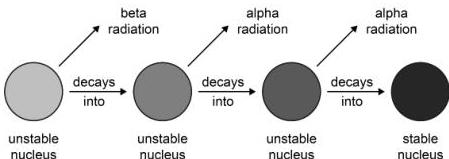
The Random Nature of Emissions
Radioactive decay is fundamentally a random process. It is impossible to predict the exact moment a specific nucleus will decay. There is no known trigger or external cause for decay, making it spontaneous. Consequently, the rate of decay cannot be altered by chemical or physical changes, such as raising the temperature or changing the pressure.
Although individual decays are unpredictable, we can determine the probability that a specific type of nucleus will decay over a given period. This is similar to throwing a six sided dice: while you cannot predict which throw will result in a six, the probability for any single throw is always . Because of this random nature, count rates measured from radioactive sources will always show some variation. To obtain an accurate reading, scientists take the mean value of the count rate over an extended period.
Worked Example: Understanding Decay Properties
Statement 1: Raising the temperature of a radioactive substance makes it decay faster. Answer: Incorrect. Nuclear decay is spontaneous and unaffected by external physical conditions like temperature.
Statement 2: An unstable nucleus can decay into another unstable nucleus. Answer: Correct. This is the basis of a decay chain.
Statement 3: The isotopes of an element are either all stable or all unstable. Answer: Incorrect. Most elements possess both stable and unstable isotopes.
The Nature of Alpha, Beta, and Gamma Radiation
When decay occurs, the nucleus emits ionising radiation. The three primary types are alpha particles, beta particles, and gamma rays. These processes release significantly more energy than chemical reactions.
| Type of radiation | alpha () | beta () | gamma () |
|---|---|---|---|
| Nuclide Notation | or | or | |
| Nature | 2 protons and 2 neutrons | Fast moving electron | Electromagnetic radiation |
| Relative Mass | (approx.) | ||
| Relative Charge | |||
| Speed | approx. | approx. | ( ms) |
An alpha particle is identical to a helium nucleus. It is the heaviest type of radiation and carries a double positive charge. A beta particle is a fast moving electron created when a neutron in the nucleus transforms into a proton and an electron. Gamma radiation is high energy electromagnetic waves with no mass or charge, travelling at the speed of light.
Nuclear Equations and the Effect of Decay
The emission of radiation changes the composition of the nucleus. Because alpha and beta decay change the number of protons, they transform the original atom into an atom of a different element.
Alpha Decay
In alpha decay, the nucleus ejects two protons and two neutrons. This causes the atomic number () to decrease by and the mass number () to decrease by .
General Equation:
Example:
Beta Decay
In beta decay, a neutron changes into a proton (which remains in the nucleus) and an electron (which is emitted). The mass number () remains unchanged, but the atomic number () increases by .
General Equation:
Example:
Gamma Decay
Gamma decay involves the release of excess energy. It does not change the number of protons or neutrons, so the atomic and mass numbers remain the same.
Worked Examples: Applying Nuclear Equations
Example 1: Thorium 232 undergoes alpha decay to become an isotope of radium. Complete the equation: Solution: The mass number must balance: , so . The final equation is .
Example 2: The radium isotope produced above () undergoes beta decay to become actinium (Ac). Write the equation. Solution: In beta decay, the mass number stays . The atomic number increases by , from to . The equation is .
Example 3: Identify the resulting nucleus of after one alpha and two beta decays. Solution: One alpha decay reduces by and by , resulting in . Two beta decays each increase by and do not change . The net change to is . The resulting nucleus has the notation . The element remains the same as the original because the atomic number is unchanged.
Key takeaways
- Radioactive decay is a random and spontaneous process originating from an unstable nucleus.
- Alpha particles consist of two protons and two neutrons, reducing the atomic number by 2 and the mass number by 4.
- Beta decay involves a neutron turning into a proton and an electron, increasing the atomic number by 1 while keeping the mass number constant.
- Gamma radiation is uncharged electromagnetic radiation that does not change the nucleus's mass or atomic number.
- In any nuclear decay equation, the total mass number and the total charge must be conserved across both sides of the arrow.
When solving nuclear equations, always treat the beta particle's atomic number as . When you subtract from the parent atomic number in your calculations (), it correctly results in the required addition of for the daughter nucleus.
Do not confuse mass number with atomic number. The mass number () is the total count of protons and neutrons, while the atomic number () is only the count of protons. Alpha decay is the only common decay that changes the mass number.
The instability of a nucleus often arises from an imbalance between the strong nuclear force, which holds nucleons together, and the electrostatic repulsion between positively charged protons. Decay is the mechanism by which the nucleus adjusts its internal energy and proton to neutron ratio to find a more stable configuration.
Frequently asked questions
Does temperature or pressure affect the rate of radioactive decay?
No. Radioactive decay is a spontaneous nuclear process, meaning it occurs without external triggers. Environmental factors like temperature or pressure only affect electron shells and chemical bonds, not the stability of the nucleus itself.
Why does the atomic number increase during beta decay?
During beta decay, a neutron in the nucleus transforms into a proton and an electron. Since the proton remains in the nucleus, the total number of protons (the atomic number) increases by one, even though a negative beta particle is ejected.
How can you tell if a nuclear equation is balanced?
A nuclear equation is balanced if the sum of the mass numbers () on the left side equals the sum of the mass numbers on the right, and the sum of the atomic numbers () on the left equals the sum of the atomic numbers on the right.
What is a decay chain?
A decay chain is a series of radioactive decays where an unstable nucleus decays into another unstable nucleus. This process continues through multiple steps until a stable, non radioactive nuclide is eventually formed.