Ionising Radiation and Radioactivity for the ESAT
Updated July 2026
Radioactivity involves the emission of alpha, beta, and gamma radiation from unstable nuclei. This page explores their distinct ionising strengths and penetrating abilities, their behaviour in electric and magnetic fields, and how to account for background radiation in measurements and practical applications like medical tracers.
Ionising radiation consists of particles or waves with sufficient energy to remove electrons from atoms. The interaction of alpha, beta, and gamma radiation with matter is governed by their charge, mass, and velocity, which determines their penetration depth and biological hazard.
Relative Penetrating Abilities of Radiation
The penetrating ability of nuclear radiation describes how effectively it can travel through different materials. This property varies significantly between the three primary types: alpha (), beta (), and gamma ().
Gamma radiation is the most penetrating, while beta radiation typically penetrates further than alpha radiation. These abilities are generalisations, as the specific energy of emissions depends on the isotope involved. Typical penetration limits are as follows:
- Alpha radiation: Blocked by a single sheet of paper or human skin. It can typically travel only a few centimetres in air.
- Beta radiation: Typically blocked by a few millimetres of thin metal (such as aluminium). It is usually not blocked by human skin and can travel up to several metres in air.
- Gamma radiation: Requires several centimetres of dense material, such as lead, to be significantly blocked. It can penetrate up to hundreds of metres in air.
Beta radiation exhibits the widest variation in penetration. While thin metal often stops it, the required thickness depends on the specific metal and the energy of the particles. The lowest-energy beta particles may even fail to penetrate the skin.
Experimental Investigation of Penetrating Ability
One can identify the type of radiation emitted by a source by measuring the count rate (detections per second) as different barriers are introduced between the source and a radiation counter.
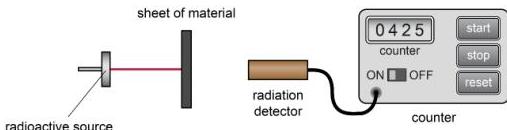
If a source emits multiple types of radiation, such as alpha and gamma, a barrier that blocks alpha (like paper) will only reduce the count rate by the amount contributed by the alpha particles.
Worked Example: Identifying Radiation Types
A radiation counter detects a high count rate from a source. A sheet of paper does not significantly affect the rate. However, a thin sheet of aluminium significantly reduces the rate, though it remains much higher than the background level. What radiation is being emitted?
Solution: Since paper has no effect, the source is not emitting alpha radiation. Aluminium blocks beta radiation, so the significant reduction indicates the presence of beta. Because the count rate remains high even after the beta is blocked, the source is likely also emitting gamma radiation, which passes through the aluminium.
Relative Ionising Abilities
Alpha, beta, and gamma radiation are ionising because they can knock electrons out of atoms during collisions, creating positive ions. The relationship between ionising ability and penetrating ability is inverse:
- Alpha: Most ionising, least penetrating.
- Beta: Intermediate ionising, intermediate penetrating.
- Gamma: Least ionising, most penetrating.
Alpha particles are the most ionising because of their double positive charge and large mass. Although they move slower than beta particles, their greater momentum makes them highly likely to interact with and ionise atoms. Beta particles have a single charge and lower momentum, while gamma rays are uncharged and interact least strongly with matter. Highly ionising radiation loses kinetic energy rapidly as it travels, which explains why it is the least penetrating.
Deflection in Electric and Magnetic Fields
Because alpha and beta particles are charged, they experience forces and change direction (deflect) when passing through electric or magnetic fields. Gamma rays, being uncharged, are not deflected by either field.
Electric Fields
Alpha and beta particles are deflected in opposite directions because they have opposite charges. The extent of the deflection depends on the particle's mass, charge, and speed.
- Charge: An alpha particle has twice the charge of a beta particle, meaning it experiences twice the force in the same field.
- Mass: An alpha particle is approximately times heavier than a beta particle. Using Newton's second law, , the acceleration of an alpha particle is only about or that of a beta particle.
- Speed: Alpha particles typically travel at to of the speed of beta particles. This means they spend more time in the field for the force to act.
- Result: The massive difference in mass is the dominant factor. Consequently, beta particles are deflected much more than alpha particles in the same electric field.
Magnetic Fields
Similar to electric fields, alpha and beta particles are deflected in opposite directions in magnetic fields due to their opposite charges. Beta particles again experience greater deflection because of their much lower mass.
Worked Example: Identifying P, Q, and R
Three types of radiation are tested. In a magnetic field, P and R deflect in opposite directions, while Q does not deflect. R is known to be the most ionising. Identify them.
Solution: Q must be gamma radiation because it is not deflected. Since R is the most ionising, it must be alpha radiation. P must therefore be beta radiation, which explains why it deflects in the opposite direction to R.
Background Radiation
Background radiation is the low-level ionising radiation always present in our environment. Most of it occurs naturally, though human activity contributes a small portion.
Sources of Background Radiation
- Natural (typically over 80%): Radon gas from the ground, cosmic rays from space, rocks and building materials, and naturally occurring radioactive isotopes in food and drink.
- Artificial (typically under 20%): Medical procedures (99% of artificial sources), and trace amounts from nuclear power or weapons testing.
Background levels vary based on geography (local rock types and radon levels) and medical history. Occupation (e.g., hospital or nuclear workers) usually has a negligible effect on total exposure due to strict safety regulations.
Correcting for Background Radiation
To find the true count rate of a source, you must subtract the background count rate:
Worked Example: Calculating Source Count Rate
A scientist measures 200 counts per second (cps) with a source present. Without the source, the counter reads 10 cps. Estimate the source count rate.
Solution: .
Applications and Hazards
Hazards to Human Health
Ionising radiation damages DNA within cell nuclei, which can cause mutations, uncontrolled cell division (cancer), or cell death. High doses lead to radiation sickness or death.
- Alpha: Most hazardous inside the body because it is highly ionising in a concentrated area. Outside the body, it is not hazardous as it cannot penetrate skin.
- Beta: Hazardous both inside and outside the body, as it can penetrate skin to reach underlying tissues.
- Gamma: Hazardous outside the body as it easily penetrates the skin to reach internal organs. Inside the body, it is generally less hazardous than alpha or beta because it is less ionising and much of it passes through without interaction.
Practical Applications
- Sterilisation: Gamma rays are used to kill bacteria on medical equipment or food. Gamma is chosen for its high penetration to reach all parts of the item. A long half-life is preferred so the source does not need frequent replacement.
- Medical Tracers: Gamma-emitting isotopes are swallowed or injected to monitor organ function. Gamma is used because it penetrates the body to be detected externally and is least ionising (minimising damage). A short half-life (hours) is used to ensure the patient is not exposed to radiation for longer than necessary.
- Thickness Gauge: Beta radiation is used to monitor the thickness of paper or foil. Alpha would be entirely blocked, and gamma would pass through unaffected. Beta is ideal because its penetration is sensitive to small changes in thickness. A long half-life is used to ensure changes in count rate are due to thickness changes, not source decay.
Worked Example: Leaking Water Pipes
A tracer is used to find a leak in an underground pipe. What radiation and half-life are best?
Solution: Gamma radiation is required to penetrate the ground to reach the surface detector. A half-life of days is best: long enough to transport and flow through the pipe, but short enough to avoid long-term environmental contamination.
Key takeaways
- Alpha is the most ionising but least penetrating; Gamma is the least ionising but most penetrating.
- Beta particles experience much greater deflection than alpha particles in fields because their mass is significantly smaller.
- True experimental measurements must always be corrected by subtracting the average background count rate.
- The hazard of a radiation source depends on its location; alpha is the most dangerous internally, while gamma is the most dangerous externally.
In ESAT questions regarding thickness gauges, remember that the material being measured must be thin enough for beta to partially pass through. If the material were lead or very thick steel, even beta would be blocked, making it unsuitable.
Do not assume that because an alpha particle has a larger charge () than a beta particle (), it will deflect more. The alpha particle's mass is so much greater (approximately times) that its acceleration, and thus its deflection, is significantly smaller.
The inverse relationship between ionising power and penetration is a direct consequence of the Conservation of Energy. Each ionisation event requires work to be done to remove an electron; therefore, the more 'efficient' a particle is at ionising, the faster it depletes its own kinetic energy and comes to a stop.
Frequently asked questions
Why is gamma radiation used for medical tracers instead of alpha?
Alpha radiation is highly ionising and would cause significant damage to internal tissues. Furthermore, alpha radiation cannot penetrate through the body to be detected by external sensors, whereas gamma radiation can easily pass through tissues to reach a detector.
Does irradiating food with gamma rays make the food radioactive?
No. Exposure to ionising radiation does not make an object radioactive. It only kills bacteria and pathogens on or within the food.
Why does alpha radiation have the least penetration?
Alpha particles are highly ionising. Because they interact so strongly with the atoms in the material they are passing through, they lose their kinetic energy very quickly over a short distance.
Which factors determine the deflection of a particle in an electric field?
Deflection is determined by the particle's charge (which dictates the force), its mass (which dictates acceleration via ), and its speed (which dictates the duration of time the force acts upon it).