Sound Waves and Ultrasound for the ESAT
Updated July 2026
Sound waves are longitudinal mechanical vibrations that require a material medium to propagate. For the ESAT, you must understand how these waves are produced, how amplitude and frequency correlate to perception, the range of human hearing, and the practical applications of ultrasound in sonar and medical imaging.
Sound is a longitudinal wave produced by vibrating sources, consisting of alternating compressions and rarefactions in a medium. Its physical properties of amplitude and frequency determine the perceived loudness and pitch, respectively.
The Production and Nature of Sound
Sound waves are produced by a vibrating source. When an object oscillates, it causes the surrounding medium to vibrate, and this pattern of vibrations travels away from the source as a wave. For example, a loudspeaker cone vibrates back and forth, moving the air in front of it to create a sound wave.
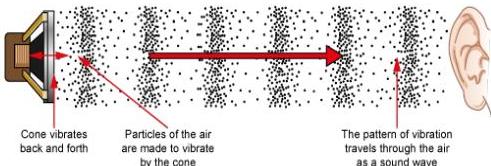
There are three critical relationships between the source and the resulting sound wave:
- The frequency of the sound wave matches the frequency of the vibrating source.
- The amplitude of the sound wave depends on the amplitude of the source vibrations.
- The speed of the sound wave is determined solely by the medium it travels through, not by the source.
Examples of sound sources include vibrating strings (pianos, guitars), vibrating surfaces (drums, speakers), vibrating air columns (saxophones, flutes), and vibrating vocal cords.
The Need for a Medium
Sound waves are mechanical waves. This means they consist of the vibrations of material particles and therefore require a medium (solid, liquid, or gas) to travel. Sound cannot travel through a vacuum because there are no particles to transmit the oscillations. This is famously demonstrated by the bell jar experiment.
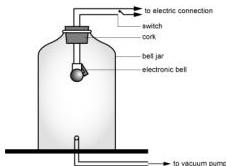
In this setup, an electric bell is placed inside a jar. As air is removed by a vacuum pump, the sound fades until it becomes silent, even though the bell hammer is still seen moving. This also proves that while sound cannot travel through a vacuum, light can.
Sound as a Longitudinal Wave
Sound is a longitudinal wave. In a longitudinal wave, the direction of particle vibration is parallel to the direction of wave travel. As the wave passes, particles in the medium are pushed together to form regions of high pressure called compressions (C) and are pulled apart to form regions of low pressure called rarefactions (R).
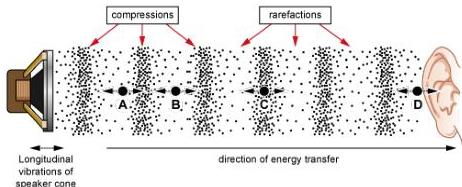
The distance between two adjacent compressions or two adjacent rarefactions is equal to one wavelength ().
Worked Example: Dust in Sound Waves A tiny particle of dust is suspended in still air. If a sound wave passes horizontally from left to right, how does the dust move? Because sound is longitudinal, the particle will vibrate back and forth about its original position, parallel to the wave direction, rather than moving steadily with the wave.
Loudness, Pitch, and Oscilloscopes
We perceive the physical properties of sound waves qualitatively:
- Loudness is related to the amplitude of the wave. Larger amplitudes represent more energy and result in louder sounds.
- Pitch is related to the frequency of the wave. Higher frequencies result in higher pitched sounds.
An oscilloscope can be used to visualize these properties by converting sound pressure into a voltage signal.
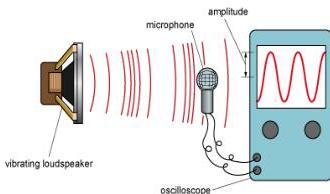
- Greater height of the trace (amplitude) indicates a louder sound.
- Peaks closer together (shorter period , higher frequency ) indicate a higher pitch.
Reflection and Echoes
Sound waves obey the law of reflection, where the angle of incidence equals the angle of reflection. An echo is simply the sound heard after it has reflected off a surface and returned to the listener. Because the reflected path is longer than the direct path, the echo is heard after a time delay.
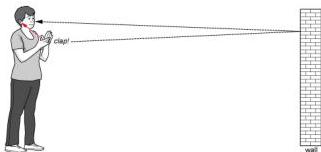
Worked Example: Ranging with Echoes A man stands m from a cliff and bangs wood together. He wants the echoes to occur exactly halfway between his hits. If the speed of sound is ms, at what frequency should he bang the wood?
- Distance to cliff and back m.
- Time for echo s.
- For the echo to be halfway between hits, the period between hits must be s.
- Frequency Hz.
Human Hearing and Ultrasound
The standard range of human hearing is Hz to kHz. Sounds below Hz are infrasound, and sounds above kHz are ultrasound. While humans cannot hear ultrasound, many animals can (e.g., dogs up to kHz, bats up to kHz).
Applications of Ultrasound
Ultrasound is used for ranging and imaging because it has a very short wavelength, allowing for high resolution. The distance to an object is calculated using , where is the wave speed and is the total travel time.
- SONAR: Used by ships to measure sea depth or locate fish shoals.
- Medical Scanning: Ultrasound pulses reflect off internal tissue boundaries. This is used in prenatal scanning as it is non-ionising and safe for the foetus.
- Crack Detection: In industrial settings, ultrasound identifies flaws in solids by detecting reflections from internal cracks.
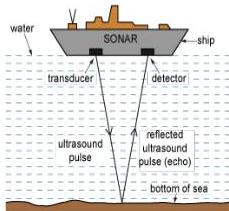
Worked Example: Sea Depth A sonar pulse is detected s after emission. If the speed in water is ms, find the depth. m.
Key takeaways
- Sound is a longitudinal mechanical wave requiring a medium and cannot travel through a vacuum.
- Pitch is determined by frequency, while loudness is determined by amplitude.
- The human hearing range is Hz to Hz.
- Ultrasound refers to frequencies above kHz and is used in sonar and medical imaging.
- Distance calculations for echoes must include a factor of because the wave travels to the target and back.
In the ESAT, always check the units for frequency. You will often see kHz ( Hz) or ms ( s). Always convert to SI units before using the wave equation .
A common mistake is forgetting to halve the total time or distance when solving echo or sonar problems. The 'time' measured is usually for the 'round trip', so the distance to the object is only half the total distance covered by the wave.
While we represent sound waves as transverse-looking squiggles on an oscilloscope, remember this is a plot of pressure or voltage against time. The physical displacement of the air particles themselves is always back and forth along the line of travel.
Frequently asked questions
Does sound travel faster in solids or gases?
Sound generally travels much faster in solids than in gases because the particles in a solid are closer together and more tightly bonded, allowing vibrations to be passed on more quickly.
What is the difference between a compression and a rarefaction?
A compression is a region in a longitudinal wave where the particles are at their closest and the pressure is at its maximum. A rarefaction is a region where particles are furthest apart and the pressure is at its minimum.
Why is ultrasound used for medical imaging instead of X-rays?
Ultrasound is non-ionising, meaning it does not carry enough energy to remove electrons from atoms and damage DNA. This makes it safe for imaging sensitive areas like a developing foetus, whereas X-rays are ionising and carry higher risks.