Reflection and Refraction for the ESAT
Updated July 2026
A comprehensive guide to the principles of optics for the ESAT, covering the laws of reflection and refraction. This page teaches how to draw and interpret ray diagrams for mirrors and planar boundaries, explains the relationship between wave speed and direction, and works through complex examples involving prisms and atmospheric refraction.
Reflection occurs at a boundary where the angle of incidence equals the angle of reflection (). Refraction is the change in direction of a wave when it enters a medium of different speed, bending towards the normal when slowing down and away from the normal when speeding up.
Fundamentals of Ray Diagrams
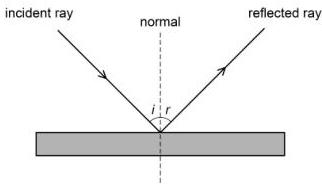
In optics, we use specific geometric terms to describe the path of light. Rays are lines that represent the direction of energy transfer in a wave. When a ray hits a surface, we draw a Normal, which is an imaginary line perpendicular to the surface at that specific point. The Angle of Incidence () is the angle between the incident ray and the normal, while the Angle of Reflection () is the angle between the reflected ray and the normal.
Reflection in Plane Mirrors
The fundamental Law of Reflection states that the angle of incidence equals the angle of reflection (). Both rays and the normal must lie in the same plane.
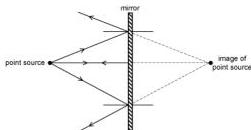
In a plane mirror, rays from a point source spread out and reflect from different positions. Because they follow the law of reflection, they continue to diverge after reflection but appear to originate from a point behind the mirror. This point is the image. For extended objects, light from every point on the object reflects to form a complete image behind the mirror. Crucially, the image is formed at the same distance behind the mirror as the object is in front of it.
Worked Example: Mirror Rotation
A student reflects light along line AB. If the mirror is accidentally rotated by about point A, what is the angle between the original reflected ray AB and the new reflected ray AC?
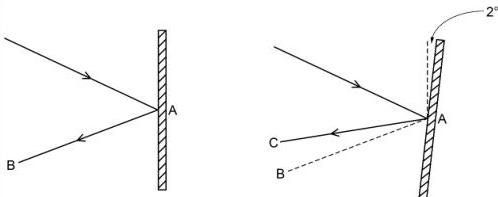
Solution: When the mirror rotates by , the normal also rotates by . Since the incident ray's direction is fixed, the incident angle () changes by . Because , the reflected angle () also changes by . The total angle between the incident and reflected rays changes by . Therefore, the reflected ray turns through , which is the angle between AB and AC.
Worked Example: Triangular Prisms in Binoculars
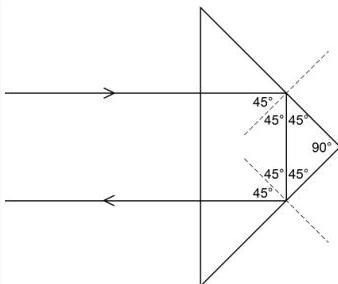
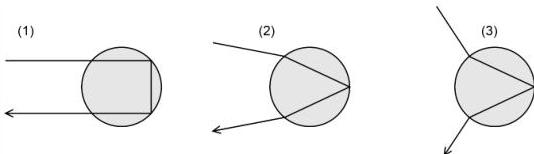
Binoculars often use glass prisms to reflect light back . Light enters along a normal, reflects symmetrically off two internal faces, and returns parallel to the incident line. What is the angle at the prism apex?
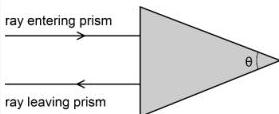
Solution: To turn through after two reflections, the light must turn through at each reflection. This requires an incident angle of at both internal faces. In the resulting internal geometry, the base angles of the small triangle formed by the ray and the apex must be , making the apex angle .
Reflection from Curved Surfaces
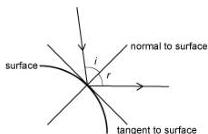
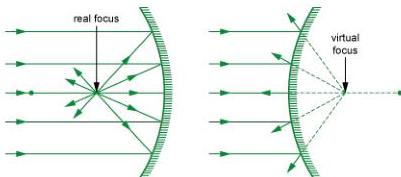
The law still applies to curved surfaces, but the normal must be perpendicular to the tangent at the point of incidence. For a concave mirror, parallel rays reflect towards a focal point, while for a convex mirror, they diverge outwards.
Refraction at Planar Boundaries
Refraction occurs when waves cross a boundary between media where they travel at different speeds. This change in speed causes a change in direction, unless the ray is travelling along the normal.
- If a wave slows down (e.g., air to glass), it refracts towards the normal.
- If a wave speeds up (e.g., glass to air), it refracts away from the normal.
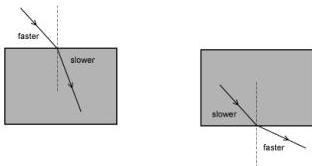
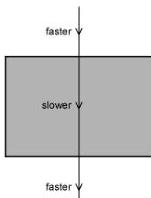
When light travels along the normal (), it changes speed but does not change direction.
Multiple Boundaries and Dispersion
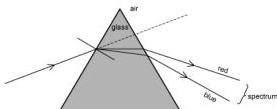
In a rectangular glass block, the emerging ray is parallel to the incident ray because the decrease in speed at the first boundary is exactly reversed by the increase in speed at the second. However, in a triangular prism, the non-parallel sides cause the ray to be deviated.
White light consists of different wavelengths that travel at different speeds in glass. Shorter wavelengths (blue/violet) slow down more than longer wavelengths (red). Consequently, blue light deviates more than red light, creating a spectrum.
Worked Example: Refraction and Apparent Depth
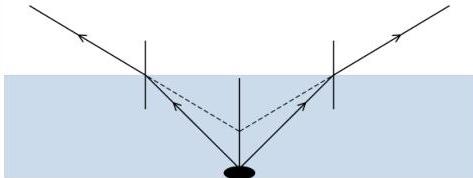
Consider a pebble at the bottom of a pool. Rays of light leave the pebble and travel from water into air.

Analysis: The speed of light in air () is greater than in water (). As the rays exit the water, they refract away from the normal and diverge more. When these rays reach the observer and are traced back, they appear to originate from a point above the actual pebble. This makes the pool appear shallower than it is.
Interpreting Refraction in Semi-Circular Blocks and Raindrops
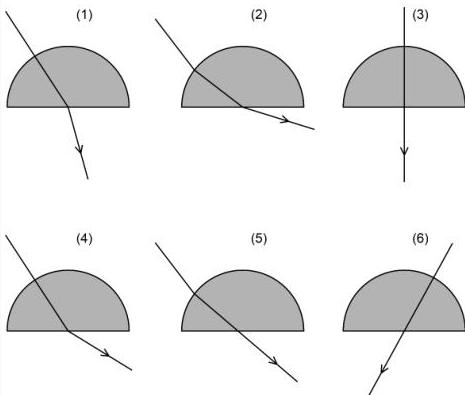
In a semi-circular block, if a ray enters through the curved surface radially, it is travelling along the normal and does not refract. However, it will refract upon leaving the flat face. Conversely, if it enters the flat face at an angle, it refracts towards the normal inside the glass, then exits through the curved face along the normal without further refraction.
For raindrops, light enters, refracts towards the normal (air to water), reflects off the back surface, and refracts away from the normal as it exits back into the air. This path is essential for the formation of rainbows.
Effects of Refraction on Speed and Direction
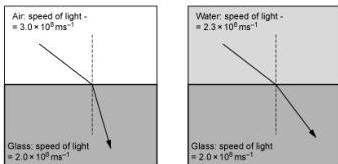
The greater the change in speed, the larger the deviation in direction. For instance, light at an air to glass boundary ( to ) refracts more than light at an air to water boundary ( to ).
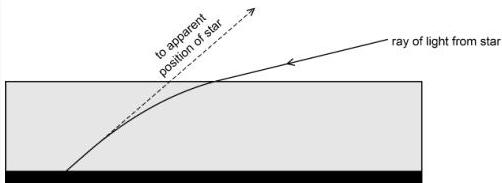
Refraction also occurs in the atmosphere. Light from stars slows down as it enters the denser air, causing it to refract towards the vertical. This makes stars appear higher in the sky than they actually are. Because the atmosphere's density increases gradually, the light follows a curved path.
Key takeaways
- The Law of Reflection states the angle of incidence equals the angle of reflection (), measured from the normal.
- Refraction is caused by a change in wave speed; waves bend towards the normal when they slow down.
- Frequency remains constant during reflection and refraction, but wavelength changes in proportion to speed.
- Images in plane mirrors are virtual, upright, and the same distance behind the mirror as the object is in front.
- In a prism, shorter wavelengths (blue) slow down more and thus refract more than longer wavelengths (red).
When drawing refraction diagrams, always draw the normal first. If you are moving to a medium with a lower speed of light, such as from air to glass, ensure your refracted ray is physically closer to that normal than the incident ray.
Commonly, students measure angles from the surface rather than the normal. Always draw the normal perpendicular to the surface and measure and from that line to avoid calculation errors.
The dispersion of white light into a spectrum occurs because the speed of light in glass is 'frequency dependent'. This phenomenon, where different frequencies travel at different speeds, is why prisms can separate colors while reflection cannot.
Frequently asked questions
What happens to the wavelength of light when it enters a glass block?
When light enters a glass block, it slows down. Since and the frequency remains constant, the wavelength must decrease in the same proportion as the speed decreases.
Why do rays not refract when they hit a surface at ?
When a ray is parallel to the normal (an angle of incidence of ), all parts of the wavefront hit the boundary at the same time. While the wave changes speed, there is no change in direction.
How do you find the normal on a curved mirror?
The normal at any point on a curved surface is a line perpendicular to the tangent at that point. For a circular or spherical mirror, the normal always passes through the centre of curvature.
What is the difference between an angle of incidence and an angle of refraction?
The angle of incidence is the angle between the incoming ray and the normal. The angle of refraction is the angle between the ray that has entered the second medium and the normal.