Wave Behaviour: Reflection Refraction and the Doppler Effect
Updated July 2026
This lesson explains how waves interact with boundaries and observers through reflection, refraction, and the Doppler effect. It covers the laws governing direction changes, the impact on speed and wavelength across media, and the frequency shifts caused by relative motion. These principles are essential for solving wave-based problems in the ESAT Physics section.
Waves reflect at surfaces where the angle of incidence equals the angle of reflection, and refract when crossing boundaries due to a change in speed. During these interactions, frequency remains constant, while wavelength and speed vary proportionally according to .
Reflection at a Surface
When a wave hits a surface, it may reflect, meaning all or part of its energy bounces back into the original medium. The direction of this reflection is governed by the law of reflection.
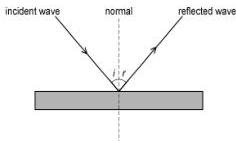
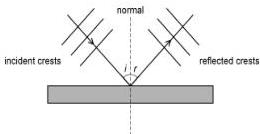
The incident angle () is the angle between the incoming wave direction and the normal, an imaginary line perpendicular to the surface at the point of impact. The reflected angle () is the angle between the normal and the direction of the reflected wave.
The Law of Reflection
For any wave reflecting from a surface:
Incident angle = Reflected angle ()
The incident ray, the reflected ray, and the normal must all lie in the same plane.
Reflection of Crests and Troughs
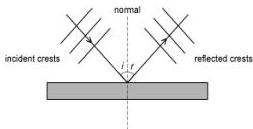
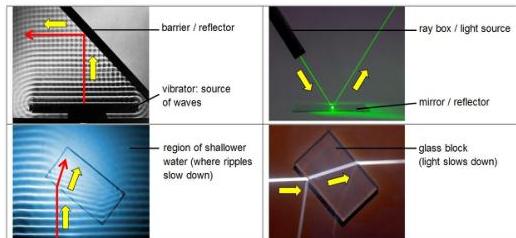
In diagrams showing wavefronts (crests or troughs), such as those seen in a water ripple tank, the crests are always perpendicular to the direction of wave travel (the rays). When ripples hit a straight barrier, the reflected crests maintain their shape but change direction according to the law of reflection.
Smooth and Rough Surfaces
The law of reflection applies at every point on a surface. On a smooth surface, all normals are parallel, leading to orderly reflection (specular reflection) that can form clear images. On a rough surface, the normals point in various directions, causing rays to reflect in random directions (diffuse reflection), which is why we can see objects like paper from many angles but cannot see an image in them.
Worked Example: Measuring the distance to the Moon
Astronomers measure the distance to the Moon by timing a laser pulse () reflecting back to Earth. If the average round-trip time is , calculate the distance in km.
- Calculate total distance: .
- Halve the distance for a one-way trip: .
- Convert to km: (approx ).
Worked Example: Echoes from a Cliff
A man stands from a cliff. He bangs wood together so that the echoes arrive exactly halfway between hits. At what frequency should he bang them? (Speed of sound ).
- Time for one echo: . .
- For the echo to be halfway between hits, the time between hits () must be double the echo time: .
- Frequency .
Refraction at a Boundary
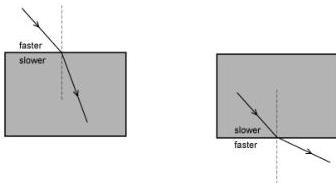
Refraction occurs when waves cross a boundary between two different media where their speeds differ. This change in speed causes a change in direction, unless the wave is travelling along the normal.
- If a wave slows down, it refracts towards the normal (e.g. air to glass).
- If a wave speeds up, it refracts away from the normal (e.g. glass to air).
Refraction of Wavefronts
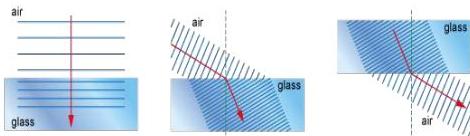
Wavefronts (crests) are perpendicular to the direction of travel. When light enters glass from air, it slows down, causing the wavefronts to bunch closer together (shorter wavelength) and tilt towards the normal.
Conservation of Energy and Partial Reflection
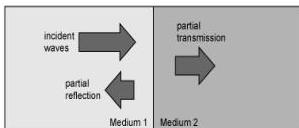
It is rare for of energy to reflect or refract. At most boundaries, some energy is reflected, some is transmitted (refracted), and some is absorbed.
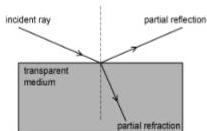
Energy is conserved: .
Worked Example: Coastal Refraction
Wave crests approaching a shore change direction and wavelength as the water gets shallower.
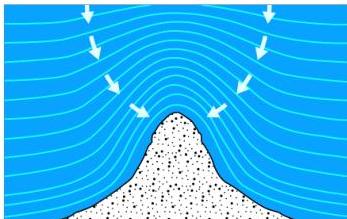
In this scenario, waves travel more slowly in shallower water. Because frequency cannot change, the speed decrease causes a decrease in wavelength. This change in speed causes the waves to refract toward the coastline.
Effects on Wave Properties
Reflection Properties
Reflection only changes the direction of a wave. Because the wave stays in the same medium, its speed, frequency, and wavelength remain constant. Every crest that hits the surface reflects from it, so the number of waves per second (frequency) remains the same.
Refraction Properties
Refraction changes the speed, wavelength, and direction, but the frequency always remains constant.
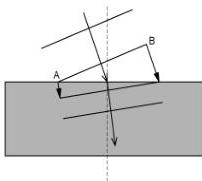
Frequency is constant because every crest that reaches the boundary must enter the second medium. Since , if the speed decreases, the wavelength must decrease by the same factor.
| Effect on crossing boundary | Frequency | Wavelength | Direction |
|---|---|---|---|
| Speed Increase | No change | Increases | Away from normal |
| Speed Decrease | No change | Decreases | Toward normal |
Worked Example: Atmospheric Refraction
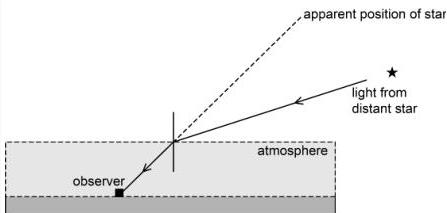
As light from a star enters the Earth's atmosphere, it slows down. This causes the light to refract towards the normal. This makes the star appear higher in the sky than its actual position, unless the star is directly overhead (along the normal), where no direction change occurs.
Analogy between Water Waves and Light
A ripple tank is used to show wave behaviour (using crest shadows), while a ray box shows light behavior (using rays). Both types of waves follow the same laws of reflection and refraction, allowing us to use water waves to model light behaviour.
However, there are fundamental differences:
- Light is electromagnetic; water waves are mechanical.
- Light travels through a vacuum; water waves require a medium.
- Light consists of vibrating fields; water waves consist of vibrating particles.
The Doppler Effect
The Doppler effect is the change in observed wavelength and frequency due to the relative motion between a wave source and an observer.
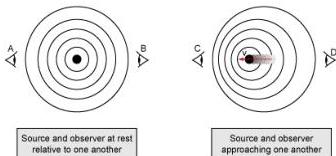
- Approaching: As the source moves towards an observer, successive wave crests are emitted from positions closer to the observer. This 'bunches up' the waves, resulting in a shorter wavelength and a higher frequency.
- Receding: As the source moves away, the waves are 'stretched out', resulting in a longer wavelength and a lower frequency.
Key points of the Doppler effect:
- The faster the relative motion, the greater the shift.
- Only motion along the line between the source and observer causes a shift. Motion perpendicular to this line (e.g. flying in a perfect circle around a listener) produces no Doppler shift.
Worked Example: Galaxies and Redshift
Hubble and Slipher found that light from distant galaxies had longer wavelengths than light from sources at rest. This increase in wavelength implies the galaxies are moving away from Earth. Furthermore, the shift was greater for more distant galaxies, proving they are moving away at higher speeds.
Key takeaways
- The law of reflection states that the angle of incidence equals the angle of reflection ().
- Refraction occurs when a wave changes speed at a boundary, changing direction towards the normal if it slows down and away from the normal if it speeds up.
- Frequency remains constant during both reflection and refraction; only speed, wavelength, and direction can change.
- The Doppler effect causes a higher observed frequency when a source and observer approach, and a lower frequency when they move apart.
- Light and water waves are analogous in behaviour but differ in nature (electromagnetic vs. mechanical).
In ESAT questions involving reflection or refraction diagrams, always start by drawing the normal. Many mistakes are made by measuring angles from the surface rather than the normal.
Do not confuse the Doppler effect with a change in wave speed. The speed of the wave in a medium is constant; the frequency shift is purely due to the relative motion changing how often the wave crests reach the observer.
The fact that refraction makes stars appear higher in the sky is why the Sun can sometimes be seen just after it has actually set below the horizon. The atmosphere acts like a lens, bending the light around the curve of the Earth.
Frequently asked questions
Why does frequency stay constant during refraction?
Frequency is determined by the source. Every wave crest produced by the source must eventually cross the boundary into the new medium. Therefore, the number of wave crests passing a point per second must be the same on both sides of the boundary.
Does the Doppler effect happen if the observer is moving but the source is stationary?
Yes. The Doppler effect depends on relative motion. If the observer moves toward a stationary source, they will intercept wave crests more frequently, leading to a higher observed frequency.
What happens if a wave hits a boundary exactly along the normal?
If the angle of incidence is , the wave will not change direction. However, it will still change speed and wavelength as it enters the new medium.
How is energy conserved when a wave is partially reflected and refracted?
The total energy of the incident wave is distributed among the reflected wave, the transmitted (refracted) wave, and any energy absorbed by the material. .