Animal Physiology Hormones and the Endocrine System
Updated July 2026
The endocrine system controls vital body functions through hormones, which are chemical messengers secreted by glands into the blood. This guide covers the mechanisms of thyroxine and adrenaline, alongside the complex hormonal regulation of the menstrual cycle and the various methods of contraception used in human reproduction.
Hormones are chemical substances produced by endocrine glands and transported by the blood to specific target structures, where they regulate long term physiological responses and maintain homeostasis through negative feedback loops.
The endocrine system
The endocrine system is a coordination system that uses hormones to respond to environmental changes or internal bodily shifts. It consists of a network of endocrine glands that produce and secrete specific hormones directly into the blood plasma.
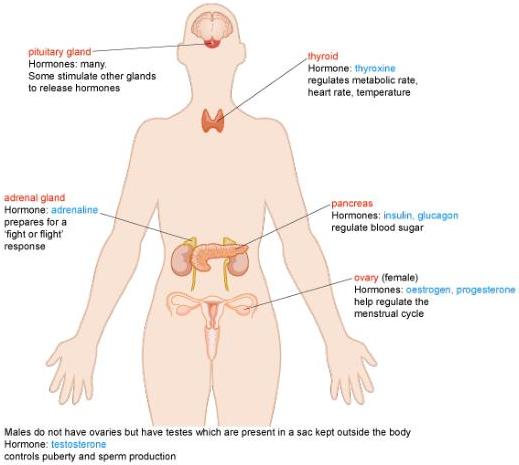
Hormones are chemical messengers. Because they are carried in the blood, they are relatively slow to act, but their effects tend to be long lasting. Importantly, each hormone is specific: it only affects particular cells in particular organs, which are referred to as target structures.
While both the nervous and endocrine systems respond to change, they differ in three main ways:
- Speed of action: The nervous system is very fast, whereas the endocrine system is slow.
- Length of action: The nervous system has a short effect, while the endocrine system has a long effect.
- Area of action: The nervous system acts on a very precise area, but the endocrine system has a more general area of action.
Thyroxine and negative feedback
Thyroxine is a hormone released by the thyroid gland. Its primary role is to regulate the basal metabolic rate, which is the speed at which chemical reactions occur while the body is at rest. The release of thyroxine is controlled by a classic negative feedback system involving the pituitary gland and the hypothalamus.
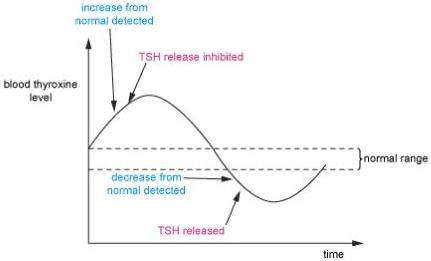
The level of thyroxine in the blood is monitored by the hypothalamus. If thyroxine levels rise above the normal range, the hypothalamus signals the pituitary gland to inhibit the release of thyroid stimulating hormone (TSH). With less TSH, the thyroid gland reduces its thyroxine production, and blood levels return to normal. Conversely, if thyroxine levels fall too low, the pituitary gland releases TSH, which stimulates the thyroid to produce more thyroxine.
Exercise 55
Explain why blood thyroxine levels continue to rise after TSH is inhibited.
Answer: After TSH production is inhibited, there is still TSH present in the blood from previous secretion. This remaining TSH continues to stimulate the thyroid gland until it is broken down or used, causing a temporary continued rise in thyroxine levels.
The role of adrenaline
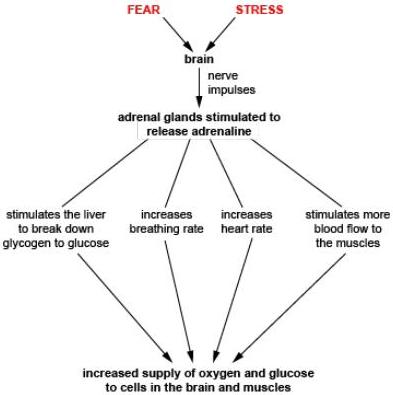
Adrenaline is secreted by the adrenal glands during stressful, scary, or physically demanding situations. It initiates the fight or flight response, preparing the body for immediate physical action. Unlike many hormones, adrenaline has many different target structures across the body.
Exercise 56
Why are nervous impulses used to stimulate the adrenal glands to release adrenaline in this case, instead of hormones?
Answer: The fight or flight response must be instantaneous to ensure survival. Nervous impulses travel much faster than hormonal signals, allowing for a near immediate release of adrenaline in response to a threat.
Exercise 57
What is the purpose of increasing the supply of oxygen and glucose to cells in the brain and muscles?
Answer: Oxygen and glucose are the raw materials for aerobic respiration. By increasing their supply, cells can release energy more rapidly, which is essential for increased muscle contraction and heightened mental alertness during a crisis.
Human reproduction
During puberty, the body begins to produce reproductive hormones that trigger the development of secondary sexual characteristics. Testosterone is the primary male hormone, produced in the testes, and it stimulates sperm production. In females, oestrogen is the main reproductive hormone produced in the ovaries. At puberty, eggs (ova) begin to mature. Every days, approximately at day of the menstrual cycle, a mature egg is released in a process called ovulation.
Regulation of the menstrual cycle
Four main hormones interact to regulate the menstrual cycle. Their levels fluctuate throughout the day cycle to prepare the body for potential pregnancy.
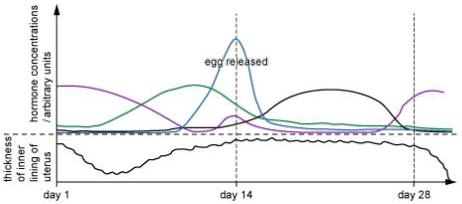
- Follicle Stimulating Hormone (FSH): Produced by the pituitary gland, it travels to the ovaries where it causes an egg to mature within a follicle and stimulates the ovaries to produce oestrogen.
- Oestrogen: Produced by the ovaries, it causes the lining of the uterus to thicken. It also inhibits the further release of FSH to ensure only one follicle matures at a time.
- Luteinising Hormone (LH): Produced by the pituitary gland, a surge in LH levels around the middle of the cycle (day ) triggers ovulation.
- Progesterone: Secreted by the empty follicle (the corpus luteum) after ovulation. It maintains the uterus lining during the second half of the cycle. If progesterone levels drop, the lining breaks down, resulting in menstruation.
Exercise 58
What would happen if oestrogen did not inhibit the production of FSH?
Answer: If FSH was not inhibited, the pituitary gland would continue to stimulate the development of more follicles. This could lead to multiple eggs maturing and being released simultaneously, increasing the likelihood of multiple births.
Use of hormones in contraception
Contraception can be achieved by using synthetic oestrogen and progesterone to disrupt the natural cycle. If these hormones are taken daily, their high levels in the blood inhibit the production of FSH. Without FSH, egg maturation is halted, and ovulation cannot occur. Progesterone also thickens the cervical mucus, creating a physical barrier that prevents sperm from entering the uterus.
Hormonal methods include:
- The oral pill: Can be combined (oestrogen and progesterone) or progesterone only. It is over effective if taken correctly but requires daily adherence and does not protect against sexually transmitted diseases (STDs).
- Skin patches: Contain both hormones and are changed weekly.
- Implants: Inserted under the skin, releasing progesterone for up to years.
- Injections: Progesterone doses lasting to months.
- Plastic Intrauterine Devices (IUD): Release progesterone and prevent embryo implantation.
Non-hormonal methods of contraception
Non-hormonal methods focus on physical barriers or permanent biological changes:
- Barrier methods: Condoms are effective and are the only method that protects against STDs. Diaphragms are plastic cups used with spermicide (a chemical that kills sperm).
- Copper IUDs: Prevent sperm survival in the uterus and prevent implantation.
- Surgical methods: Sterilisation involves cutting or tying the oviducts (females) or sperm ducts (males). It is effective.
- Natural methods: These involve abstinence (the only effective method) or rhythm methods (avoiding sex during fertile windows), though the latter is often unreliable.
Key takeaways
- Hormones are chemical messengers secreted by endocrine glands into the blood to affect specific target structures.
- Thyroxine levels are maintained by a negative feedback loop involving the hypothalamus, pituitary gland (TSH), and thyroid gland.
- Adrenaline prepares the body for action by increasing the delivery of oxygen and glucose to brain and muscle cells.
- The menstrual cycle is regulated by the interaction of FSH, LH, oestrogen, and progesterone, which control follicle maturation, ovulation, and the uterus lining.
- Hormonal contraceptives prevent pregnancy by inhibiting FSH to stop egg maturation, while barrier methods like condoms are the only form of protection against STDs.
In ESAT questions, pay close attention to the feedback loops. If a question asks what happens when a hormone level is high, remember that it usually inhibits the hormone that stimulated its own production.
A common mistake is confusing where the menstrual hormones are produced. Always remember: FSH and LH are from the pituitary gland, while oestrogen and progesterone are from the ovaries.
The integration of the nervous and endocrine systems is best seen in the adrenaline response: a rapid nervous impulse triggers a widespread chemical change, showing how the body uses both systems to survive immediate threats.
Frequently asked questions
How does the endocrine system differ from the nervous system in its mode of transmission?
The endocrine system transmits signals chemically via hormones dissolved in the blood plasma, which is slower than the electrical impulses transmitted along neurones in the nervous system.
What is the specific role of the corpus luteum in the menstrual cycle?
The corpus luteum is the remains of the follicle after ovulation; it secretes progesterone to maintain the uterus lining for a potential fertilised egg.
Why is the combined pill effective as a contraceptive?
The combined pill maintains high levels of oestrogen and progesterone, which inhibits the pituitary gland from releasing FSH, thereby preventing any eggs from maturing.
What are the primary side effects associated with hormonal contraception?
Side effects, largely due to oestrogen, can include headaches, nausea, fluid retention, and irregular menstrual bleeding.