Sex Determination and Chromosomes for the ESAT
Updated July 2026
Sex determination in mammals, including humans, depends on the inheritance of specific sex chromosomes. This topic covers the distinction between XX and XY genotypes, the role of the Y chromosome in male development, and the use of Punnett squares to predict offspring sex ratios, which typically result in a 1 to 1 probability.
Human sex is determined by a single pair of sex chromosomes, where females are homozygous () and males are heterozygous (), with the sex of the offspring determined by whether the sperm carries an or a chromosome.
Sex Chromosomes and Sex Determination
In humans and most other mammals, the nucleus of a somatic cell contains 23 pairs of chromosomes. Of these, 22 pairs are known as autosomes, which are the same in both males and females. The 23rd pair consists of the sex chromosomes, which determine the biological sex of the individual.
There are two types of sex chromosomes: the chromosome and the chromosome. The chromosome is significantly smaller than the chromosome and consequently carries fewer genes. Crucially, the chromosome contains the specific genes required to trigger male sexual development. Without these genes, the individual will develop as female.
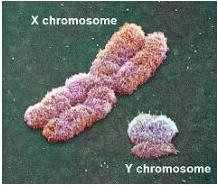
The combination of these chromosomes defines the sex of the individual:
- Females possess two chromosomes, giving them the genotype .
- Males possess one chromosome and one chromosome, giving them the genotype .
Sex Chromosomes in Gametes
Gametes are produced through the process of meiosis, which halves the chromosome number from the diploid state (46 chromosomes in 23 pairs) to the haploid state (23 single chromosomes). Because females are , every ovum (egg cell) produced will contain one chromosome.
Males, however, are . When sperm are produced through meiosis, the and chromosomes separate into different cells. This means that 50 percent of the sperm produced will carry an chromosome and 50 percent will carry a chromosome.
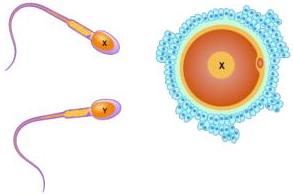
The Role of Fertilisation
The sex of a zygote (the fertilised egg) is determined at the moment of fertilisation by the type of sperm that successfully reaches and fuses with the egg. Since the egg always contributes an chromosome, the sperm is the deciding factor in sex determination.
- If a sperm carrying a chromosome fertilises the egg, the resulting zygote will have the combination and develop into a male.
- If a sperm carrying an chromosome fertilises the egg, the resulting zygote will have the combination and develop into a female.
Analysing Genetic Data and Ratios
A Punnett square is the standard genetic diagram used to show the probability of offspring being male or female. By crossing the female genotype () with the male genotype (), we can visualise the potential combinations for the offspring.
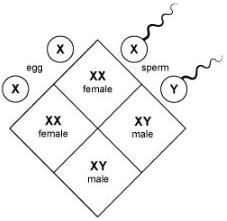
From the Punnett square, we can conclude the following:
- There is a 50 percent (or 0.5) probability that a child will be female ().
- There is a 50 percent (or 0.5) probability that a child will be male ().
- The ratio of male to female individuals in the human population should be 1 to 1.
Worked Example: Explaining Sex Development
Question: Explain why a zygote formed from the fertilisation of an ovum by a sperm cell carrying an chromosome develops into a female child.
Answer: Every somatic cell in a male contains both an and a chromosome. The chromosome is the carrier of key genes that initiate male sexual development. A sperm cell carrying an chromosome does not possess these specific male-initiating genes. Therefore, when it fuses with an ovum (which also always carries an chromosome), the resulting genotype lacks the necessary triggers for male development and proceeds to develop into a female. This is why the absence of a chromosome results in a female phenotype in humans.
Key takeaways
- In humans and most mammals, females have the genotype and males have the genotype .
- The chromosome is smaller than the chromosome and contains the essential genes for male development.
- The sex of the offspring is determined by the sperm: an sperm results in a female, while a sperm results in a male.
- The expected probability for either sex is 50 percent, resulting in a 1 to 1 ratio of males to females in a population.
When solving ESAT questions involving Punnett squares for sex determination, always ensure you represent the mother as and the father as . This will consistently show two and two boxes, confirming the 1 to 1 ratio.
Do not confuse the terms 'haploid' and 'diploid'. Somatic (body) cells are diploid and contain 23 pairs of chromosomes, whereas gametes (sperm and egg) are haploid and contain only 23 single chromosomes, including one sex chromosome.
The 1 to 1 sex ratio is a direct consequence of Mendel's Law of Segregation applied to the sex chromosomes during meiosis in the male. Because the and chromosomes must separate into different gametes, they are produced in exactly equal numbers.
Frequently asked questions
Can the mother ever determine the sex of the child?
No. In humans, mothers are homozygous for the sex chromosome (), meaning all egg cells carry an chromosome. Therefore, the mother always contributes an , and the variable factor is the father's sperm.
What are autosomes?
Autosomes are the 22 pairs of chromosomes in a human cell that are not involved in sex determination. They are identical in both males and females.
Does every sperm cell contain both an X and a Y chromosome?
No. Due to meiosis, the and chromosomes separate. Each individual sperm cell is haploid and contains only one sex chromosome: either an or a .
Why does the sex ratio in small families often deviate from 1 to 1?
Fertilisation is a random process. While the probability for each child is 50 percent, small sample sizes are subject to chance. The 1 to 1 ratio is only reliably seen in very large populations.