Enzymes and Biological Catalysis for the ESAT
Updated July 2026
Enzymes are essential protein molecules that function as biological catalysts. They speed up metabolic reactions, such as respiration and digestion, by providing an active site for substrates to bind. Understanding enzyme specificity, the lock and key hypothesis, and the effects of temperature and pH is vital for the ESAT Biology syllabus.
Enzymes are protein catalysts with a unique active site that bind to specific substrates to form an enzyme substrate complex, lowering the energy required for metabolic reactions without being consumed.
Enzymes as Biological Catalysts
Metabolic processes within cells consist of various chemical reactions that must occur quickly enough to sustain life. These processes, including respiration, protein synthesis, photosynthesis, and digestion, rely on catalysts to speed them up. Enzymes are biological catalysts, primarily made of proteins, that allow these reactions to proceed at necessary rates. The specific enzymes present within a cell determine which metabolic pathways can take place.
The Mechanism of Enzyme Action
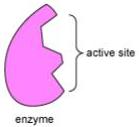
Enzymes are proteins that possess a specific area with a unique shape known as the active site. This is the location where the chemical reactions occur.
The Lock and Key Hypothesis
Enzymes exhibit specificity, meaning they only react with a particular substrate or type of molecule. For example, starch acts as a substrate for the enzyme amylase, while proteins bind with proteases. This relationship is often described using the lock and key hypothesis. In this model, the active site is the lock with a unique shape, and only a substrate with a complementary shape, the key, can fit into it.

When the substrate binds to the active site, they form an enzyme substrate complex (ESC).

Breaking and Making Molecules
Enzymes convert substrates into different molecules called products. During this process, the enzyme itself remains unchanged and is not used up, allowing it to be used repeatedly for subsequent reactions.





An enzyme may break one substrate into two products through a hydrolysis reaction, which involves the addition of water. Alternatively, it may join two substrates to form a single product through a condensation reaction, which involves the removal of water.


Induced Fit Theory
While the lock and key model provides a basic understanding, the induced fit theory suggests a more dynamic interaction. It proposes that while the active site is a specific shape, it changes shape slightly once the substrate enters. This adjustment allows the active site to fit even more closely around the substrate, helping the reaction to occur more efficiently.
Worked Examples
Example 1: The Necessity of Catalysts Question: Why are catalysts necessary in order for reactions to take place in organisms? Answer: Without enzymes acting as biological catalysts, metabolic reactions would occur too slowly to sustain the life of the organism.
Example 2: Enzyme Specificity Question: Use the diagram below to explain why only enzyme Y catalyses the reaction with the provided substrate.

Answer: Enzyme Y is the only one with an active site that has a shape complementary to the shape of the substrate. This allows it to form an enzyme substrate complex, whereas enzymes X and Z do not fit the substrate.
Factors Affecting Enzyme Action
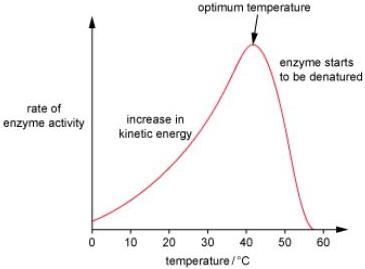
Every enzyme has optimum conditions, which are the specific temperature and values where it works most effectively. If conditions deviate from the optimum, the rate of reaction decreases. This can happen because there is less energy for the reaction or because the bonds maintaining the enzyme shape break, causing the enzyme to become denatured. When denatured, the active site shape is altered and is no longer complementary to the substrate.

Temperature and the Rate of Reaction
As temperature increases, enzymes and substrates gain more kinetic energy and move faster. This increases the frequency of collisions between substrates and active sites with sufficient energy for a reaction. The rate is highest at the optimum temperature. Beyond this point, the enzyme denatures and the rate falls to zero. This loss of function is permanent, even if the temperature is later reduced.
and the Rate of Reaction
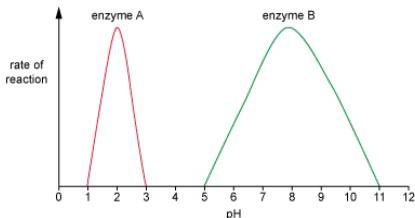
Different enzymes have different optimum levels. For instance, stomach enzymes function best at approximately , while small intestine enzymes prefer . Moving away from the optimum in either direction causes the enzyme to denature, destroying the functional shape of the active site.
Digestive Enzymes
In the human digestive system, specific enzymes are required to break down large food molecules. Amylases break down carbohydrates (such as starch) into simple sugars. Proteases, such as pepsin in the stomach, break down proteins into amino acids. Lipases break down fats (lipids) into fatty acids and glycerol.
Key takeaways
- Enzymes are biological catalysts, mainly proteins, that speed up metabolic reactions without being consumed.
- The lock and key hypothesis explains enzyme specificity based on a complementary 3D active site shape.
- The induced fit theory describes how an active site adjusts its shape to bind more tightly to a substrate.
- Denaturation occurs when high temperatures or extreme pH levels permanently alter the active site shape.
When answering questions about enzyme rates, always mention the shape of the active site and whether it is complementary to the substrate. Use the term 'denatured' rather than 'dead'.
Be careful not to confuse the terms 'protease' and 'protein'. A protease is the enzyme, while a protein is the substrate it acts upon.
The concept of optimum conditions explains why different organisms are restricted to specific habitats. Some bacteria, for example, have evolved enzymes with extremely high optimum temperatures, allowing them to thrive in hot springs where other life would perish due to protein denaturation.
Frequently asked questions
What is an enzyme substrate complex?
An enzyme substrate complex (ESC) is the temporary structure formed when a substrate molecule binds to the active site of its specific enzyme.
How does temperature affect enzyme collisions?
Higher temperatures increase the kinetic energy of molecules, leading to more frequent and more energetic collisions between the substrate and the enzyme active site.
Can a denatured enzyme be fixed by returning to optimum conditions?
No, once an enzyme is denatured, the bonds holding its 3D structure are broken and the active site is permanently altered, so it cannot be repaired by returning to the optimum environment.
What is the difference between hydrolysis and condensation?
Hydrolysis is a reaction that breaks a substrate apart by adding water, while condensation is a reaction that joins substrates together by removing water.